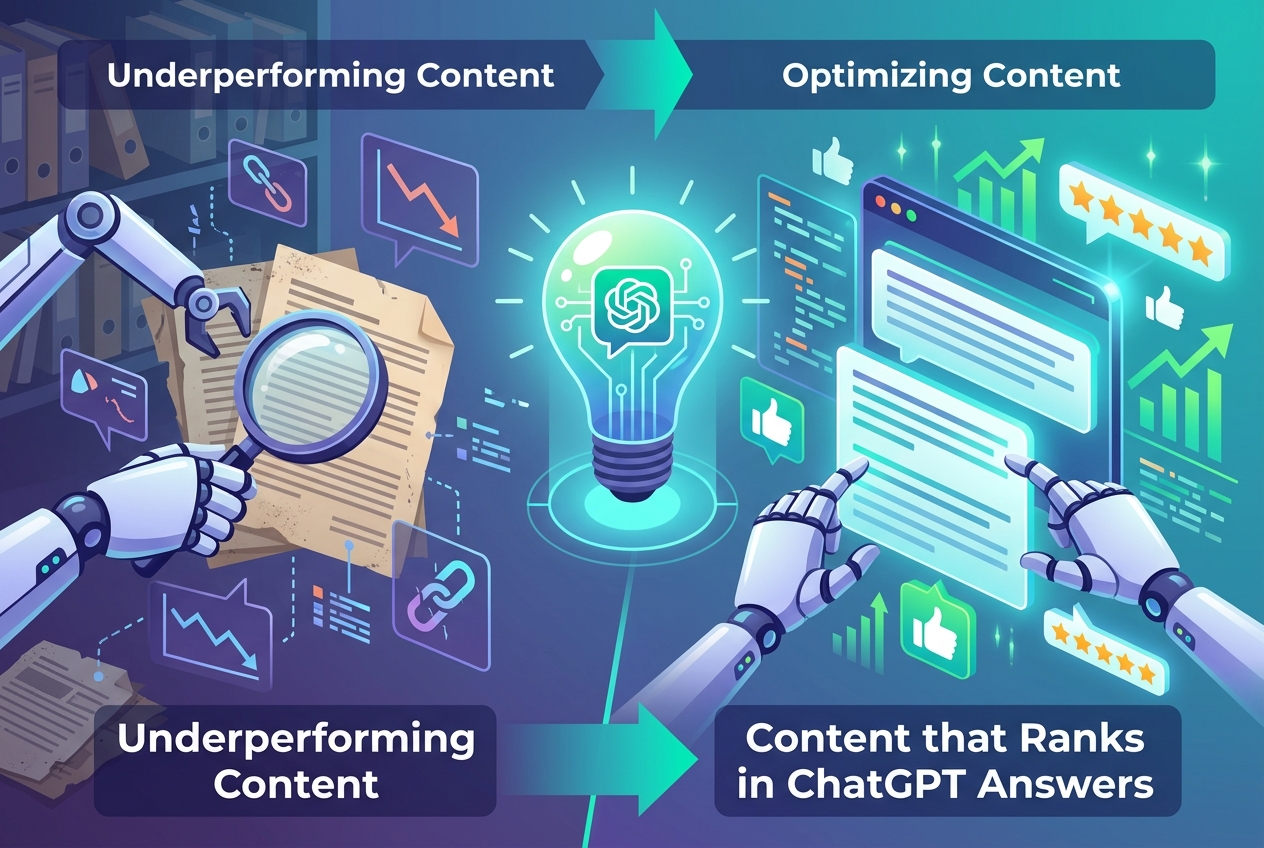

How to Build Authority and Rank Higher in ChatGPT Search Results
Ranking in ChatGPT: An Overview
People are changing how they find information. They no longer depend only on search engines and wading through numerous links. Instead, they use AI platforms like ChatGPT for specific answers, suggestions, and remedies. This change requires a shift in how we create content and build online presence. Ranking well in ChatGPT is now a vital part of any complete digital marketing plan. This guide explains how to establish authority and improve your ranking in ChatGPT search results. The focus is on refining content for AI answer engines.
This updated method is called Answer Engine Optimization (AEO). It involves becoming a reliable source that AI models use to form their responses. It’s more than just ranking high on a search results page. AEO means ensuring your content is well-structured, your details are confirmable, and credible sites support your knowledge. When an AI cites your brand, it’s a strong endorsement delivered to a user actively seeking your services.
To succeed, you must learn how AI models like ChatGPT process data. The goal isn’t to fool an algorithm. Instead, it’s about offering clear and reliable content that AI can easily grasp and apply. Focus on these areas:
- Prompt Research: Learn what questions your audience asks ChatGPT.
- Results Analysis: Study ChatGPT’s answers to see who it mentions.
- Content Creation: Develop useful content that directly answers user questions.
- Authority Building: Position your brand as a reliable source in your field.
- Results Tracking: Watch your rankings and adjust your plan accordingly.
The Value of Katteb AI Writer for AEO
Content that ranks in ChatGPT answers requires a deliberate strategy. Katteb AI writer can assist with this. Katteb helps you craft optimized, high-quality content appealing to both readers and AI. Here’s how Katteb can improve your AEO:
- Simplified Content Creation: Katteb simplifies creating content. Generate articles, blog posts, and website copy quickly. This is important for scaling content and addressing user questions.
- Keyword Optimization: Katteb identifies relevant keywords and integrates them naturally. This ensures content is discoverable by search engines and AI models.
- Structured Data Support: Katteb makes it easy to add structured data, like schema markup. This helps AI understand the content’s context, improving its chances of being cited in ChatGPT answers.
- Fact-Checking and Accuracy: Katteb checks facts and ensures accuracy. This builds trust with readers and AI algorithms.
- E-E-A-T Enhancement: Katteb provides tools for author bios, citation management, and content verification, improving your content’s E-E-A-T (Experience, Expertise, Authoritativeness, Trustworthiness).
By using Katteb AI writer, you create informative content optimized for AI. This increases your chances of ranking higher in ChatGPT answers and establishing your brand as a trusted source.
For instance, imagine creating a guide on “Content Marketing Best Practices for 2024.” With Katteb, you could:
- Develop a detailed article outline, covering keyword research, content planning, and promotion.
- Craft introductions and conclusions that grab attention and summarize key points.
- Naturally incorporate relevant keywords.
- Add structured data to highlight statistics and recommendations.
- Verify all claims and statistics for accuracy.
- Develop a professional author bio showcasing your content marketing knowledge.
Following these steps, you can create an optimized guide likely to rank well in ChatGPT answers, attracting a larger audience to your brand.
Search Engines Evolving into Answer Engines
The Rise of Answer Engines
The internet is changing. People are moving away from standard search engines like Google and toward AI-driven answer engines such as ChatGPT. Users now want quick, clear answers, skipping the work of sorting through many search results. This change in how people find information requires a new way to create content and get noticed online.
The goal is no longer just to rank high in search engine results. Now, it’s about being a reliable source that AI can use when creating responses. This change marks the start of Answer Engine Optimization (AEO), which focuses on making content suitable for AI.
Think of it like this: SEO was about climbing the ranks of website results. AEO is about becoming a key piece of the AI’s knowledge. Your content must be easy to find and trustworthy enough to be used in AI answers.
To do well in this new environment, focus on:
- Content Structure: Organize your content so it is easy for AI to understand. Use headings, bullet points, and tables to highlight important information.
- Factual Accuracy: Make sure your information is correct and supported by reliable sources. AI uses facts to create trustworthy responses.
- Authority Building: Show that your brand is a trusted source by getting mentions from other respected websites.
Being a source that AI trusts and cites has real benefits. When AI mentions your brand, it’s a strong endorsement to users who are looking for what you offer. This can increase brand awareness, website visits, and sales.
For example, imagine a user asks ChatGPT, “What are the best ways to improve website SEO?” If your content is seen as a good source on SEO, ChatGPT might mention your website, giving the user a direct link. This brings traffic to your site and positions your brand as an expert in SEO.
The move from search engines to answer engines is a big change. By understanding AEO and making your content suitable for AI, you can set your brand up for success in this new age of information.
SEO vs. AEO: What’s the Difference?
Here’s a table that shows the main differences between SEO and AEO:
| Feature | SEO (Search Engine Optimization) | AEO (Answer Engine Optimization) |
|---|---|---|
| Goal | Rank high in search engine results pages (SERPs) | Become a trusted, citable source for AI models |
| Target Audience | Human searchers | AI models and human searchers |
| Content Focus | Keywords and backlinks | Factual accuracy, structured data, and authority |
| Measurement | Keyword rankings, organic traffic | Citations in AI-generated answers, brand mentions |
| Strategy | Keyword research, link building, on-page optimization | Content structure, fact-checking, authority building |
Knowing these differences is important for changing your content plan. It helps make sure your brand stays visible and relevant as the internet changes.
Understanding Answer Engine Optimization (AEO)
Traditional SEO has long been the basis of online visibility. It focused on keyword rankings and backlinks to improve search engine results. With the rise of AI answer engines like ChatGPT, a new approach is emerging: Answer Engine Optimization (AEO). AEO isn’t a replacement for SEO. It’s the next step in ensuring your content reaches its audience as AI grows.
Think of traditional SEO as climbing a ladder of websites. AEO is becoming a foundational element in the AI’s knowledge. It moves past simple keywords. It focuses on concepts, entities, and facts the AI can verify. Katteb.com believes that understanding AEO is important for maintaining a competitive content strategy.
How does AEO differ from traditional SEO? The difference lies in targeting human searchers and catering to AI models. AEO emphasizes:
- Concepts and Entities: AEO prioritizes understanding the concepts related to your topic instead of focusing on keywords. This allows AI models to grasp the context of your content.
- Verifiable Facts: Accuracy is important in AEO. AI models rely on verifiable facts to generate trustworthy answers. Your content must be researched and supported by credible sources.
- Structured Data: Using structured data, like schema markup, helps AI models understand the elements of your content, such as questions, answers, and author information.
To excel in AEO, your content needs elements that resonate with AI algorithms. These include:
Key Elements for AI-Friendly Content
- Easy Digestibility for AI: AI models must quickly grasp your content. Use clear headings, subheadings, bullet points, and tables to break up text and highlight key information. For example, instead of burying product specs in a paragraph, use a simple HTML table that an AI can instantly read.
- Authority and Trustworthiness: AI models favor content from authoritative sources. Build your brand’s authority by earning citations from other reputable websites and showcasing your expertise through clear author bios. Katteb.com provides tools for citation management and author bio creation.
- Verifiable Accuracy: AI models cross-reference information. Providing clear sources for your data makes your content more reliable and citable.
Katteb.com understands the need to create content that appeals to both humans and AI. Our AI writing tools help you craft informative, high-quality content that connects with both audiences. We offer features such as:
- Entity Optimization: Our platform helps you identify and incorporate relevant entities into your content. This ensures that AI models understand the context and meaning of your writing.
- Competitor Analysis: We provide real-time competitor analysis. This helps you match top-ranking content and find opportunities to improve your own writing.
- Brand Voice Matching: Our AI can extract your unique brand identity so every article sounds authentically you. This ensures consistency and builds trust with your audience.
By using Katteb AI writer, you can create content that ranks well in traditional search results and becomes a trusted source for AI-powered answer engines. This will help you reach more readers, establish your brand as a leader, and increase conversions.
AEO involves creating content that is clear, credible, and well-structured so you become a key source in your field. Anticipate your audience’s questions and provide accurate answers that AI models can confidently cite. Katteb.com helps you adapt to this new environment and ensure your content stays relevant and impactful.
Creating Content for AI
Creating Content Optimized for AI
Ranking well in ChatGPT answers requires a shift in how you approach content creation. It’s no longer enough to target keywords and create general, informative content. You must craft content specifically for AI consumption. Provide direct, clear answers to user questions. Structure your content so AI models can easily understand, verify, and cite it.
The main idea is to become a reliable source for AI. Consider AI models as researchers seeking solid data to answer questions. Your goal is to give them the most accurate, thorough, and accessible information possible. Move away from long paragraphs. Instead, use concise, structured content designed for machine readability.
Here’s how to create content for AI consumption:
- Direct Answers: Give clear answers to specific questions. Avoid vague language and jargon. Get to the point and directly address the user’s question.
- Structured Data: Use headings, subheadings, bullet points, lists, and tables to organize your content logically. This helps AI models quickly find key information and understand the relationships between ideas.
- Factual Accuracy: Make sure all information is accurate, verifiable, and supported by reliable sources. AI models need factual accuracy to give trustworthy responses.
- Clear Sourcing: Cite your sources clearly. Link to reputable websites and publications to back up your claims. This lets AI models check the information and judge its reliability.
- Schema Markup: Use schema markup to give AI models more context about your content. Schema markup helps AI models understand the content type (e.g., recipe, product review, news article) and pull out key information, like the author, date, and topic.
For example, imagine a user asks ChatGPT, “What are the benefits of using cloud storage?” To create content that ranks well for this question, you could:
- Start with a direct answer: “Cloud storage offers benefits like better accessibility, improved data security, and lower costs.”
- Explain each benefit in detail, using bullet points or lists to structure the information.
- Cite reliable sources to support your claims about the benefits of cloud storage.
- Use schema markup to identify the content as an article about cloud storage benefits.
Following these tips can help you create content that is informative for readers and designed for AI. This will boost your chances of ranking higher in ChatGPT answers and building your brand as a trusted source.
Adapting E-E-A-T Principles for AI
You likely know Google’s E-E-A-T (Experience, Expertise, Authoritativeness, Trustworthiness) guidelines. It’s also important to understand how to adapt these ideas for AI models. AI algorithms judge E-E-A-T using different signals than people do. Here’s how:
- Experience: Share unique case studies, original research, or step-by-step guides that show your real-world experience. Instead of general advice, give specific examples and data-backed insights.
- Expertise: Clearly state the author’s credentials. An author bio that links to a professional profile, such as on LinkedIn, helps AI connect the content to a real expert.
- Authoritativeness: Get citations and mentions from respected sites. These are like votes of confidence that AI can easily track and verify online.
- Trustworthiness: Cite everything. Every claim, statistic, and piece of data should link to a reliable primary source. This makes your information easily verifiable.
Focusing on these elements helps you create content that is informative and designed for AI. This raises your chances of ranking higher in ChatGPT answers and building your brand as a trusted source.
E-E-A-T for AI: Optimizing for ChatGPT Ranking
You’re likely familiar with Google’s E-E-A-T (Experience, Expertise, Authoritativeness, Trustworthiness) guidelines. Understanding how to translate these concepts for AI models is key for ranking well in ChatGPT responses. AI algorithms assess E-E-A-T using different signals than humans. Here’s how to adjust each element for AI consumption:
- Experience: Go beyond basic advice. Share unique case studies, original research, or detailed, step-by-step tutorials. Show you’ve actually done what you’re writing about. For example, instead of “tips for better sleep,” write “How I Tested 5 Sleep Trackers and Improved My REM Sleep by 20%: A Data-Driven Review.” Include specific data points and metrics to highlight your direct experience.
- Expertise: Clearly state author credentials. An author bio that links to a recognized professional profile, such as on LinkedIn, lets an AI connect the content to a legitimate expert. The bio should highlight relevant qualifications, certifications, and years of experience.
- Authoritativeness: Earn citations and mentions from respected sites. These act as third-party endorsements that an AI can easily track and verify across the web. Seek opportunities to contribute guest posts to reputable industry blogs and participate in relevant online communities.
- Trustworthiness: Cite everything. Each claim, statistic, and piece of data should link to a reputable primary source. This transparency makes your information verifiable. Avoid vague claims. Always provide concrete evidence to back up your statements. For instance, instead of “our product is effective,” provide a table showing performance metrics from a real customer case study, with a link to the full report.
The following table summarizes how to translate E-E-A-T for AI:
| E-E-A-T Element | Traditional Approach | AI-Optimized Approach | Example |
|---|---|---|---|
| Experience | Providing general advice and tips | Sharing unique case studies and data-driven insights | “How I Increased Website Traffic by 50% in 3 Months: A Detailed Case Study” |
| Expertise | Mentioning qualifications in passing | Providing a detailed author bio with links to professional profiles | Author bio linking to LinkedIn profile with relevant certifications listed |
| Authoritativeness | Building backlinks | Earning citations and mentions from reputable websites | Being cited in a leading industry publication as a thought leader |
| Trustworthiness | Making claims without evidence | Sourcing every claim with links to reputable primary sources | Providing a link to a peer-reviewed study to support a scientific claim |
Focusing on these elements helps you create content that is informative and engaging, and also suited for AI consumption. This increases your chances of ranking higher in ChatGPT answers. It also establishes your brand as a reliable source.
Experience: Share Unique Case Studies
Demonstrating real experience is essential for AI-driven content. Vague advice lacks the depth that AI algorithms seek. To showcase your knowledge and gain trust with AI models, share unique case studies, original research, or tutorials that demonstrate your experience.
AI algorithms prioritize content that provides proof of expertise. Share your own experiences to give AI models the data they need to assess your credibility. Go beyond stating that you have experience. Provide examples of your work and show the results you’ve achieved.
Instead of writing a general article on “Tips for Improving Website Conversion Rates,” share a case study on “How We Increased a Client’s Website Conversion Rate by 30% in 6 Months.” Include details about the client’s website, their challenges, your strategies, and the results. Add data and metrics to support your claims.
Here’s how to transform generic advice into a data-backed guide:
Generic Advice: “Use social media to promote your content.”
Data-Driven Guide: “How We Generated 1,000 Leads from LinkedIn in 30 Days: A Step-by-Step Guide.”
In this guide, provide details about the LinkedIn strategies you used, the tools you applied, and the results you got. Include screenshots and data visualizations to back up your claims.
Sharing unique case studies and detailed tutorials demonstrates your experience and builds trust with AI models. This increases your chances of ranking higher in ChatGPT answers and establishing your brand as a trusted source.
Showcase Your Expertise with Clear Author Credentials
Establishing your expertise is critical for AI-driven content consumption. While insightful content is key, AI models require clear signals to confirm the author’s credibility. Explicit author credentials are a simple, effective strategy. Create a detailed author bio and link it to a recognized professional profile, such as LinkedIn.
Why is this important? AI algorithms analyze information source credibility. A professional profile link allows the AI to connect your content to a legitimate expert. This helps the AI verify your qualifications, experience, and expertise. Without this connection, the AI may struggle to assess your credibility, reducing your content’s chances of appearing in ChatGPT responses.
Your author bio should include your name and title. Highlight relevant qualifications, certifications, and years of experience. Be specific and provide concrete examples of your accomplishments. Instead of stating you’re a “marketing expert,” mention expertise in SEO, content marketing, or social media. Include links to published works, presentations, or other relevant materials.
Key elements for your author bio:
- Full Name and Professional Title: Clearly state your full name and professional title to establish your identity.
- Relevant Qualifications and Certifications: Highlight qualifications or certifications demonstrating your expertise.
- Years of Experience: Mention your years in the industry to showcase your experience.
- Areas of Expertise: Specify your areas of expertise to help AI models understand your knowledge.
- Links to Professional Profiles: Include links to your LinkedIn profile, website, or other professional profiles.
- Published Works and Presentations: Provide links to your published works, presentations, or other materials.
A detailed, informative author bio linked to a professional profile enhances your content’s credibility. It also increases its chances of ranking higher in ChatGPT responses. AI models prioritize content from trusted sources. Showcasing your expertise establishes you as a reliable authority.
Build Authority Through Citations and Mentions
Earning citations and mentions is essential to ranking higher in ChatGPT answers. Expertise and experience are important, but demonstrating that other reputable sources recognize your knowledge is also key. When well-regarded sites link to your content or mention your brand, they vouch for your expertise and information. These endorsements signal to AI models that your content is trustworthy.
AI algorithms track citations and mentions across the web. They analyze the linking websites’ authority, relevance, and reputation to assess your content’s credibility. More citations and mentions from high-quality sources make your content appear more authoritative to AI models. This increases its chances of being cited in ChatGPT answers.
Here’s why citations and mentions matter for AEO:
- Validation of Expertise: Citations and mentions from reputable sources validate your expertise. They demonstrate that others in your field recognize your knowledge.
- Increased Trustworthiness: Third-party endorsements enhance your content’s trustworthiness, making it more likely to be cited by AI models.
- Improved Discoverability: Citations and mentions improve your content’s discoverability. This makes it easier for AI models to find and assess its relevance.
- Enhanced Brand Reputation: Earning citations and mentions from reputable sources enhances your brand reputation. It establishes you as a thought leader.
To build authority through citations and mentions, consider these strategies:
- Create High-Quality, Linkable Content: Focus on informative, well-researched, original content that other websites will link to.
- Guest Blogging: Contribute guest posts to reputable industry blogs and publications. Include links back to your website.
- Outreach to Influencers: Contact influencers and thought leaders in your industry. Ask them to review or mention your content.
- Participate in Online Communities: Engage in relevant online communities and forums. Share your expertise and link to your content when appropriate.
- Monitor Mentions: Use tools to monitor mentions of your brand and content online. Engage with those who are referencing you.
Actively pursuing these strategies builds a strong network of citations and mentions. It establishes your brand as a trusted information source. This significantly increases your chances of ranking higher in ChatGPT answers and reaching a wider audience.
Trustworthiness Through Transparent Sourcing
Trustworthiness is essential for AI-driven content. Expertise and authority are useless without verifiable facts. To gain an AI model’s trust, source every claim, statistic, and piece of data. Use clear outbound links to reputable primary sources. This transparency is key to verifiable information. It helps determine if ChatGPT will cite your content.
AI algorithms cross-reference information. They assess source credibility. Direct links to original data sources allow AI to verify your claims. This shows the reliability of your information. It also saves AI models time and resources. That makes your content a more likely choice as a trusted source.
Sourcing is vital for AEO for a few reasons:
- Verifiability: Clear sourcing lets AI easily verify claims by checking originals.
- Credibility: Reputable primary sources boost your content’s credibility. They demonstrate thorough research.
- Transparency: Transparency builds trust with AI and human readers. It shows you back up claims with evidence.
- Reduced Bias: Diverse, reputable sources reduce bias. They ensure fair, objective content.
Consider these best practices for sourcing:
- Use Primary Sources: Link to original research, government reports, and official statistics when possible.
- Link to Reputable Websites: Choose websites known for accuracy and reliability. Avoid unreliable or biased sources.
- Use Anchor Text: Use descriptive anchor text that indicates the linked page’s content.
- Avoid Link Rot: Regularly check links and update them as needed.
- Be Consistent: Apply consistent sourcing practices throughout your content.
Instead of saying “studies show exercise benefits mental health,” link to a specific study in a medical journal. This allows AI to verify the claim and assess research quality.
Prioritize transparency. Provide clear outbound links to reputable primary sources. This enhances your content’s trustworthiness. It also increases its chances of ranking higher in ChatGPT answers. Verifiable accuracy builds trust. It establishes you as a reliable information source.
Structure Content for Easy Parsing
AI needs to break content into logical pieces. Long paragraphs hinder understanding. Structure articles with a machine-first approach. Think about how an AI model will scan and process your content. Prioritize clarity, conciseness, and organization. Familiarize yourself with prompt engineering strategies to think like the AI you’re trying to reach.
The goal is to ease the extraction of key information, the understanding of relationships between concepts, and the verification of claims. A deliberate and structured approach to content creation is required. Focus on clear headings, concise summaries, dedicated FAQ sections, and well-formatted data tables.
Key elements for structuring content:
- Clear Headings and Subheadings: Use descriptive headings and subheadings to delineate sections. This helps AI models quickly identify the main topics and subtopics.
- Concise Summaries: Provide summaries at the beginning of each section. This gives AI models a high-level overview. It allows them to quickly grasp the main points and determine relevance.
- Dedicated FAQ Sections: Include a FAQ section to address common questions. This helps AI models quickly find answers to specific queries and provide users with relevant information.
- Well-Formatted Data Tables: Use tables to present data in an organized manner. This makes it easier for AI models to extract and process the information.
Here’s how to transform a standard blog post into an AI-friendly resource. Consider a blog post about “Best Quiet Dishwashers.”
Practical Example: Ranking for “Best Quiet Dishwashers”
-
Start with a Concise Summary: Begin your article with a two-sentence summary. This offers the AI an immediate understanding of the article’s focus.
- Example: This guide reviews the top five quietest dishwashers of 2024, highlighting models with decibel ratings below 45 dB. We compare features, energy use, and cost to help you choose the best option for an open kitchen.
-
Include a Dedicated FAQ Section: Use an H2 or H3 heading for “Frequently Asked Questions.” List common questions and provide short, direct answers.
- What is considered a quiet dishwasher? A dishwasher rated at 45 dB or less is considered quiet.
- Do quiet dishwashers clean well? Yes, current models use insulation and motor tech that maintains cleaning ability.
-
Present Data in Simple Tables: Avoid burying specs within paragraphs. A clean HTML table offers an easy-to-read format for an AI.
<table>
    <thead>
        <tr>
            <th>Model Name</th>
            <th>Decibel Rating</th>
            <th>Price</th>
        </tr>
    </thead>
    <tbody>
        <tr>
            <td>Bosch 800 Series</td>
            <td>42 dB</td>
            <td>$1,149</td>
        </tr>
        <tr>
            <td>Miele G 7000</td>
            <td>44 dB</td>
            <td>$1,699</td>
        </tr>
        <tr>
            <td>LG Top Control</td>
            <td>44 dB</td>
            <td>$999</td>
        </tr>
    </tbody>
</table>
This structured approach changes your content into a quotable source. You provide clear, factual components for an AI’s response. Prioritizing structure and clarity increases your chances of ranking higher in ChatGPT results. It also establishes your brand as a reliable source.
Lead with a Punchy Summary
Capturing attention quickly is vital, especially when aiming for AI visibility. A short, two-sentence summary works well. This concise overview gives AI models a quick understanding of your content’s purpose.</ Think of it as an executive summary for AI algorithms.
This summary acts as a filter. AI models can quickly assess if your content relates to a specific search. If the summary aligns with what the user wants, the AI is more likely to examine your article and use it as a source. A vague or irrelevant summary might cause the AI to skip to another source.
Here’s why a punchy summary matters:
- Immediate Understanding: The summary gives AI models a fast grasp of your content’s topic and goal.
- Relevance Assessment: It lets AI models quickly judge if your content fits a user’s search.
- Increased Engagement: A strong summary can draw AI models to explore your content and use it as a source.
- Improved Ranking Potential: By making your content easier for AI models to understand, you boost its chances of ranking higher in ChatGPT answers.
When writing your summary, keep these points in mind:
- Clarity: Use language that AI models can easily understand.
- Specificity: Be specific about your content’s topic.
- Relevance: Make sure the summary directly relates to possible user searches.
- Keywords: Add keywords to help AI models identify your content’s main ideas.
Instead of a long introduction, try a summary like this:
“This guide offers a detailed look at the best ways to set up your website for phones and tablets. It covers responsive design, mobile-first indexing, and ways to make your pages load faster.”
This summary quickly tells AI models the article’s focus and key topics. A punchy summary improves the chances that AI models will understand, assess, and cite your content.
Build a Dedicated FAQ Block
FAQ Blocks and Data Tables for AI
Creating a “Frequently Asked Questions” (FAQ) block helps optimize your content for AI consumption. By anticipating common questions and providing direct answers, you improve the chances of your content appearing in ChatGPT responses. Mark this section clearly using an H2 or H3 heading to signal its purpose to AI models.
An FAQ block gives AI models readily accessible answers to user queries. Instead of sifting through long text, AI can quickly identify the FAQ section and extract relevant information. This saves time and increases the likelihood that your content will be chosen as a trusted source.
Here’s why building a dedicated FAQ block matters:
- Direct Answers: FAQs offer concise answers to questions, simplifying information extraction for AI.
- Relevance: FAQs address common user queries, ensuring your content meets their needs.
- Efficiency: FAQs allow AI to quickly find answers without reading entire articles.
- Improved Ranking: Making your content easier for AI to understand increases its chances of ranking higher in ChatGPT answers.
When creating your FAQ block, consider these points:
- Use Clear Headings: Use
H2orH3headings to mark the FAQ section and each question. - Ask Common Questions: Address the most common questions related to your topic.
- Provide Direct Answers: Give concise answers to each question, avoiding ambiguity.
- Use Conversational Language: Write answers in a conversational tone, as if speaking to a user.
- Keep it Concise: Focus on providing the most essential information.
For example, an article about “Best Practices for Content Marketing” might include these FAQ questions:
- What is content marketing?
- What are the benefits of content marketing?
- How do I create a content marketing strategy?
- How do I measure the success of my content marketing efforts?
Clear answers to these questions improve your content’s chances of being cited in ChatGPT responses, establishing your brand as a trusted source.
Presenting data in simple tables also makes it easily digestible for AI models. Instead of burying specifications, metrics, or comparisons within paragraphs, use a clean HTML table. This is an efficient format for AI to parse, understand, and reuse in its responses, transforming your content into a citable asset.
AI algorithms extract and process information from structured data. Tables offer a clear framework that allows AI to quickly identify key data points and their relationships. This helps when comparing products, summarizing research, or presenting statistics.
Here’s why using simple tables for data is important:
- Easy Parsing: Tables offer a structured format that AI can easily parse.
- Data Extraction: They help extract key data points, such as values, labels, and units.
- Relationship Identification: Tables define relationships between data points, helping AI understand context.
- Reusability: The structured format makes it easy for AI to reuse the data in its responses, providing users with accurate information.
When creating tables for AI, keep these guidelines in mind:
- Use Clean HTML: Code tables using valid HTML. Avoid complex formatting that may confuse AI.
- Keep it Simple: Focus on presenting essential data. Avoid unnecessary columns or rows.
- Use Clear Headings: Use descriptive headings for each column to indicate the data type.
- Use Consistent Units: Use consistent units of measurement.
- Provide Context: Include a brief description or explanation of the data.
Following these guidelines creates tables that are informative for readers and optimized for AI consumption. This increases your chances of ranking higher in ChatGPT answers, establishing your brand as a trusted source.
Consider this example of a table comparing cloud storage providers:
<table>
    <thead>
        <tr>
            <th>Provider</th>
            <th>Storage Capacity</th>
            <th>Price</th>
        </tr>
    </thead>
    <tbody>
        <tr>
            <td>Google Drive</td>
            <td>15 GB</td>
            <td>Free</td>
        </tr>
        <tr>
            <td>Dropbox</td>
            <td>2 GB</td>
            <td>Free</td>
        </tr>
        <tr>
            <td>Microsoft OneDrive</td>
            <td>5 GB</td>
            <td>Free</td>
        </tr>
    </tbody>
</table>
This table provides AI models with a clear overview of the storage capacity and pricing of different providers. Using this format makes it easy for AI to extract relevant information and provide helpful answers.
Prioritize Factual Accuracy and Clear Sourcing
Factual accuracy and clear sourcing are essential for AI-driven content. Every claim, statistic, and piece of information on your page must be verifiable and supported by credible sources. This builds trust with AI models, increasing the chance your content is cited in ChatGPT responses.
Data shows platforms like ChatGPT are a primary interface where people seek answers and make buying decisions. To succeed, prioritize factual accuracy and transparent sourcing in your content.
ChatGPT’s revenue jumped from under $10 million in 2022 to a projected $1 billion in 2024. It holds a 60.6% market share in the AI industry. These figures indicate that optimizing for these platforms is a critical strategy.
Make your content scannable, fact-based, and well-structured. This prepares it for AI consumption, increasing the likelihood your site is chosen as a trusted source. AI models cross-reference information and assess source credibility. Direct links to original data sources allow AI models to easily verify your claims.
Your job shifts from writing articles to building citable knowledge. Anticipate audience questions and provide accurate answers that AI models can confidently cite. This is the new content strategy, and embracing it is key for long-term success.
Follow these guidelines to ensure factual accuracy and clear sourcing:
- Verify Every Claim: Double-check the accuracy of every claim, statistic, and piece of information before publishing.
- Use Reputable Sources: Use authoritative sources like peer-reviewed studies, government reports, and industry publications.
- Cite Your Sources Clearly: Provide direct links to the original data sources, using descriptive anchor text.
- Avoid Vague Claims: Avoid unsubstantiated claims. Provide concrete evidence to support your statements.
- Update Your Content Regularly: Review and update your content to maintain accuracy.
By prioritizing factual accuracy and clear sourcing, you build trust with AI models and establish your brand as a reliable information source. This increases your chances of ranking higher in ChatGPT answers and improves your online reputation.
Making Your Site Technically Sound for AI Crawlers
Excellent content is only half the battle. If an AI crawler struggles to understand and trust your website’s technical foundation, your insights may never appear in an answer. AI models, like Google’s, require clear signposts to explore your site, verify your information, and confidently cite you.
We must look at the code and structure that hold everything together. Consider it preparing your website’s resume for a very literal-minded AI recruiter. Every detail must be correct.
Technical SEO for AI
Many traditional SEO practices still apply. However, optimizing for AI crawlers demands a more nuanced strategy. Here’s what to focus on to improve your site’s technical SEO.
- Site Speed: AI crawlers must access and process your content efficiently. A slow website can prevent them from fully understanding your site. Refine images, use browser caching, and consider a Content Delivery Network (CDN) to boost site speed.
- Mobile-Friendliness: Mobile devices are used more and more. Make sure your website adapts to them. AI crawlers prioritize mobile-first indexing, so responsive design is key.
- Clear Site Architecture: A well-organized site with straightforward navigation makes it easier for AI crawlers to understand the relationships between pages. Use a logical structure of categories and subcategories.
- XML Sitemap: An XML sitemap gives AI crawlers a roadmap of your website. It helps them discover and index all your important pages. Submit your sitemap to search engines to ensure it’s crawled correctly.
- Robots.txt: Use a robots.txt file to control which parts of your website AI crawlers can access. This is especially important for preventing them from crawling sensitive or irrelevant pages.
- HTTPS Security: Secure your website with HTTPS. AI crawlers favor secure websites because they are more trustworthy and protect user data.
Using Structured Data for AI
One of the most effective ways to make your site technically sound for AI crawlers is to implement structured data. Structured data, like schema markup, gives AI models more context about your content. This helps them understand its meaning and purpose. This is vital for ensuring your content is interpreted accurately and cited in ChatGPT answers.
Here’s how structured data can be beneficial:
- Contextual Understanding: Structured data gives AI models context about the type of content you’re providing. Examples include a recipe, a product review, or a news article.
- Key Information Extraction: It helps AI models pull out key information, like the author, publication date, and main topic.
- Enhanced Visibility: Structured data can improve how visible your content is in search results. This makes it more likely to be discovered by AI crawlers.
By implementing these technical SEO practices, you can ensure your website is accessible, understandable, and trustworthy for AI crawlers. This will increase your chances of ranking higher in ChatGPT answers and establishing your brand as a reliable source.
Website Audits for AI and SEO
AI and SEO change quickly. Regular technical audits of your site are crucial. Find and fix problems that hurt your ranking. Check for broken links, slow pages, and old structured data.
Proactive website improvements keep your content relevant and effective for AI crawlers. This helps maintain your site’s impact over time.
Communicate with AI Using Schema Markup
Use Schema Markup to Speak the AI’s Language
Schema markup acts as a translator. This structured data transforms ambiguous human text into a format machines understand. Instead of forcing an AI to guess the content’s purpose, schema directly states: “This is a question,” “This is the answer,” or “This is the author’s name.”
Many frequently cited sources within ChatGPT use schema extensively. It gives the LLM the context to pull your information accurately. Think of schema markup as explicit instructions for the AI, ensuring it grasps your page’s purpose. This clarity helps AI models interpret and use your information, increasing the chance it will be cited.
Implementing schema markup helps you communicate with AI, allowing it to understand and trust your content. Your content is then more likely to appear in ChatGPT answers, bringing in traffic and establishing your brand as a reliable source.
Here’s how schema markup benefits AI models:
- Provides Context: Schema markup provides AI models with context about the type of content on your page, such as a blog post, a product review, or a recipe.
- Clarifies Relationships: It helps AI models understand the relationships between different elements on your page, such as the author, the publication date, and the main topic.
- Enhances Accuracy: By providing clear and structured information, schema markup reduces the risk of misinterpretation by AI models.
- Boosts Confidence: Schema markup gives AI models the confidence to accurately extract and utilize your information, increasing the likelihood of it being cited in ChatGPT answers.
To implement schema markup effectively, understand the available types and choose those most relevant to your content. Common types include:
- Article Schema: Used for blog posts, news articles, and other types of written content.
- Product Schema: Used for product pages to provide information about the product, such as its name, price, and availability.
- FAQ Schema: Used for FAQ pages to provide answers to common questions.
- HowTo Schema: Used for how-to guides to provide step-by-step instructions.
- Recipe Schema: Used for recipe pages to provide information about the ingredients and instructions.
Carefully select and implement the correct schema markup for your content. You can improve its chances of being understood and used by AI models. This can lead to higher rankings in ChatGPT answers.
How Katteb AI Writer Helps You Rank in ChatGPT
How Katteb AI Writer Helps You Rank in ChatGPT
To succeed in both traditional search engine results and AI-powered answer engines, the right tools are key. Katteb AI Writer helps you produce SEO-optimized articles. These articles can rank in Google’s AI Overviews and standard search results, and also perform well in ChatGPT searches. Katteb’s features allow you to craft content that appeals to readers and AI algorithms, maximizing visibility and impact.
Katteb AI Writer does more than simple keyword stuffing. It provides tools to help you create content optimized for AI. These features include:
- Entity Optimization: Katteb identifies and incorporates relevant entities into your content. This ensures AI models grasp the context and meaning of your writing. By focusing on concepts and relationships, you create informative content relevant to user queries.
- Competitor Analysis: Katteb offers real-time competitor analysis. You can pinpoint the strategies that work for your competitors. By analyzing their content, keywords, and backlinks, you can learn how to improve your writing and outrank them in search results.
- Brand Voice Matching: A consistent brand voice builds trust and strengthens your online presence. Katteb’s AI can learn your brand identity. Every article will sound like you, building audience trust.
These features help you create informative and engaging content designed for AI consumption. This increases your chances of ranking higher in ChatGPT answers. It also positions your brand as a reliable source.
Here’s how Katteb AI Writer helps you create content that ranks in ChatGPT:
- Generate High-Quality Content: Katteb helps you generate informative content relevant to your audience.
- Optimize for AI Consumption: Katteb provides tools to prepare your content for AI, including entity optimization, structured data implementation, and clear sourcing.
- Build Authority and Trust: Katteb helps you build authority through author bio creation, citation management, and content verification.
- Monitor Your Results: Katteb allows you to track your rankings and adjust your strategy.
With Katteb AI Writer, you can confidently create AI-ready content. Your brand can remain visible for years to come.
Entity-Based SEO for AI Overviews Optimization
Entity-Based SEO for AI Overviews Optimization
Traditional SEO centered on keywords is changing. Entity-based SEO is becoming more important, especially for ranking well in AI Overviews and ChatGPT responses. Rather than just targeting keywords, entity-based SEO emphasizes understanding the ideas, connections, and characteristics linked to a subject. This strategy works well with how AI models such as ChatGPT handle and interpret data.
Katteb AI Writer helps you use entity-based SEO to improve your content for AI Overviews. The platform uses advanced natural language processing (NLP) to find and add relevant entities to your writing. This makes sure your content is educational and interesting, as well as semantically rich and easy for AI models to understand.
Here’s how Katteb helps you develop topical authority that AI models recognize and suggest:
- Entity Identification: Katteb automatically finds relevant entities related to your topic, including people, places, organizations, and ideas. This helps you make sure your content covers all the important parts of the subject.
- Semantic Analysis: Katteb analyzes the semantic links between different entities in your content. This helps you create a connected and logically organized story, which is important for AI models to understand the meaning of your writing.
- Contextual Enrichment: Katteb suggests ways to add details and context to your content related to the entities it finds. This helps you create a more thorough and educational resource that is very helpful to both readers and AI models.
- Topical Authority Building: By regularly creating high-quality content rich in entities on a specific topic, you can build your brand as a reliable expert in that field. This makes it more likely that your content will be cited in AI Overviews and ChatGPT answers.
By focusing on entity-based SEO, you can produce content that is optimized for AI and more interesting and educational for readers. This comprehensive strategy will help you rank higher in regular search results and in AI-powered answer engines.
Consider this example: You’re writing about “The History of Artificial Intelligence.” Instead of just mentioning key people and events, Katteb can find and add relevant entities such as:
- People: Alan Turing, John McCarthy, Marvin Minsky
- Organizations: Dartmouth College, Stanford University, Google AI
- Concepts: Machine Learning, Deep Learning, Neural Networks
- Events: The Dartmouth Workshop, The AI Winter, The Deep Learning Revolution
By including these entities in your writing and giving context about their relationships, you can create a more thorough and educational piece that is very helpful to both readers and AI models. This will greatly increase your chances of ranking higher in AI Overviews and building your brand as an expert on artificial intelligence.
Analyzing Competitor Content to Improve Your Ranking
Knowing what your competitors do is key to online success, including ranking well in ChatGPT responses. Katteb offers real-time competitor analysis. It gives you insight into successful strategies. By studying their content, keywords, and backlinks, you can find ways to improve your writing and rank higher.
Katteb’s tool offers a detailed look at your competitors’ online presence, going beyond simple keyword tracking. Here’s what it does:
- Content Analysis: Katteb examines competitor content to find key topics, entities, and writing styles. This shows you what content engages their audience and which strategies they use.
- Keyword Analysis: Katteb identifies competitor keywords. You can then refine your content for those terms, ensuring discoverability by search engines and AI.
- Backlink Analysis: Katteb checks competitor backlink profiles, showing which sites link to their content. This reveals their authority and influence.
Using these insights, you can make content that informs, engages, and is refined for search engines and AI. This boosts your chances of ranking higher in ChatGPT and reaching a larger audience.
Katteb’s AI SEO Assistant analyzes entities, topics, and sentiment to refine content for Google AI Overviews and ChatGPT. It helps you create content that appeals to readers and AI:
- Entity Analysis: The AI SEO Assistant finds key entities related to your topic and suggests ways to include them. This creates semantically rich content that AI understands.
- Topic Analysis: The AI SEO Assistant analyzes competitor topics and suggests ways to expand or explore new angles. This helps you make content thorough and informative.
- Sentiment Analysis: The AI SEO Assistant analyzes the sentiment in competitor content and suggests ways to tailor your writing to your audience. This helps you create engaging and persuasive content.
With Katteb’s competitor analysis and AI SEO Assistant, you can make content refined for search engines, AI, and your audience. This helps you rank higher in ChatGPT and build trust in your brand.
Brand Voice Cloning for Consistent, Authentic Content
Brand Voice Cloning for Consistent Content
Maintaining a consistent and authentic brand voice is increasingly important. AI models, including ChatGPT, can now assess content tone and style with greater accuracy. A consistent brand voice resonates with your audience. It also signals authority and trustworthiness to AI, improving your ranking in AI-driven search results.
Katteb’s brand voice cloning feature creates content that sounds like you. It ensures a high tone match across all your articles. This feature uses AI to analyze your content and extract your unique brand identity. It identifies stylistic elements like sentence structure, vocabulary, and tone.
Here’s how the brand voice cloning feature operates:
- Content Analysis: AI examines your existing content to identify your writing style.
- Brand Identity Extraction: AI pulls out stylistic elements, including sentence structure, vocabulary, and tone.
- Voice Profile Creation: A voice profile captures the essence of your brand’s writing.
- Content Generation: When creating new content, AI uses your voice profile to maintain a consistent writing style.
Using the brand voice cloning feature, you can ensure that all your content maintains a consistent tone, no matter the topic. This enhances your brand’s credibility. It also improves its ranking in AI-powered search results. AI is more likely to trust and cite consistent content, as it suggests higher quality and expertise.
A consistent brand voice builds trust with your audience. It also establishes your brand as a leader in your field. By using AI, you can ensure your content reflects your brand identity and connects with readers and AI.
Establish E-E-A-T Authority with Katteb
Build E-E-A-T Authority with Katteb
Establishing strong E-E-A-T (Experience, Expertise, Authoritativeness, Trustworthiness) is vital for high rankings in traditional search and AI answer engines like ChatGPT. Katteb helps establish this authority by automating the inclusion of elements that signal credibility to users and AI algorithms.
Katteb enhances E-E-A-T by simplifying the integration of credible sources into your content. This includes:
- Patent Citations: For technical or scientific topics, Katteb can identify and suggest relevant patent citations. Including these demonstrates a deep understanding and offers verifiable evidence.
- Expert Quotes: Katteb can assist in finding and incorporating quotes from recognized experts. These quotes add credibility and show consultation with knowledgeable sources.
- Authoritative Sources: Katteb helps you identify and link to reputable sources, such as peer-reviewed studies, government reports, and industry publications. This shows your content is based on solid evidence.
By adding these elements automatically, Katteb helps build trust signals that are important for ranking well in ChatGPT and other AI-powered search results. AI algorithms assess the credibility of content sources. Including patent citations, expert quotes, and authoritative sources gives AI models the evidence they need to trust your content and cite it.
Here’s a closer look at how these elements contribute to E-E-A-T:
- Expertise: Patent citations and expert quotes demonstrate subject matter understanding and showcase your knowledge.
- Authoritativeness: Linking to reputable sources shows your content is based on credible information and that you’re connected to the broader knowledge base.
- Trustworthiness: Providing verifiable evidence and citing sources builds trust with readers and AI algorithms.
Katteb also provides tools to help you create a strong author bio that highlights your qualifications. This further improves your E-E-A-T and increases your chances of ranking high in ChatGPT and other AI-powered search results.
By using Katteb’s features to build E-E-A-T authority, you create content that is informative, engaging, credible, and trustworthy. This will help you establish your brand as a leader in your industry and attract a larger audience to your website.
The Future of Content: AI Optimization
The Future of Content: AI Optimization
AI-powered answer engines, such as ChatGPT, are changing how people find and use information. To succeed, adjust your content strategy and adopt Answer Engine Optimization (AEO) principles. Focus on creating content that informs and engages human readers, but also is easily understood, verified, and cited by AI.
Several strategies can help build authority and improve ChatGPT search rankings:
- Understanding Prompt Research: Identify questions your audience asks ChatGPT.
- Results Analysis: Analyze ChatGPT’s answers and note who it mentions.
- Creating AI-Friendly Content: Develop high-quality, informative content that directly answers user questions with clear headings, summaries, and structured data.
- Building E-E-A-T Authority: Establish your brand as a trusted information source by demonstrating experience, expertise, authoritativeness, and trustworthiness.
- Prioritizing Factual Accuracy and Clear Sourcing: Ensure all information is verifiable and supported by credible sources.
- Optimizing Technical SEO: Make your website technically sound for AI crawlers by improving site speed, mobile-friendliness, and architecture.
- Leveraging Schema Markup: Use schema markup to give AI models more context about your content.
Katteb.com recognizes the challenges of adapting to these changes. We provide AI writing tools to help you create content that ranks in Google AI Overviews, ChatGPT search, and standard search results. Our platform provides the following:
- Speed Up Content Creation: Quickly generate high-quality, optimized content.
- Optimize for AI Consumption: Add relevant entities, structured data, and clear sourcing to your content.
- Build Authority and Trust: Create strong author bios, manage citations, and verify content accuracy.
- Maintain Brand Consistency: Replicate your brand voice to ensure authentic content.
Content creation now requires AI awareness. By embracing AEO and using tools like Katteb, you can prepare your brand for AI-powered answer engines and reach a larger audience.