TL;DR. An Apollo AI agent is a system that does the repetitive prospecting work around Apollo.io for you: building lists that match your ideal customer, enriching contacts, researching accounts before calls, watching for hiring and news signals and keeping sequences clean. Apollo.io pricing, as published on 8 October 2026, runs from a Free plan to Basic at $49 per seat per month billed annually ($65 billed monthly), Professional at $79 ($99 monthly) and Organization at $119 per seat (annual only, minimum 3 seats), and everything that touches data is paid for in credits. This guide explains what an Apollo agent actually does, what each Apollo plan and API call costs, two worked cost scenarios with every assumption written down, and where an agent platform such as Katteb helps and where it simply adds a line to your bill.
Apollo.io is where a lot of sales teams start. It has a large contact and company database, an email sequencer, a Chrome extension and an API. What it does not do on its own is decide, every Monday, which 50 accounts deserve attention this week, research them, find the right people, check the emails, write a first line that is not generic, load them into the right sequence and tell you what happened. That surrounding work is what people mean when they talk about an “Apollo AI agent”.
It is also why “Apollo.io pricing” is one of the most searched questions about the product. Before a team builds a prospecting agent, it needs to know what the seats cost, how credits are spent, what the API charges and whether a cheaper plan plus automation does the same job as a more expensive plan. This article answers those questions with numbers you can check against Apollo’s own pages.
What is an Apollo AI agent?
An Apollo AI agent is an AI system that uses Apollo’s data and tools to run a prospecting workflow with little or no manual driving. In practice it has four parts:
- A data source: Apollo’s people and company records, reached either through the Apollo web app and extension or through the Apollo API.
- A plan: who your ideal customer is, how many new accounts you want each week, which signals matter (a new funding round, a job posting, a new executive) and what should happen when one appears.
- Actions: searching, enriching, saving to lists, adding to sequences, logging notes, updating the CRM.
- Memory and reporting: which accounts were already contacted, what bounced, who replied, and a short report so a person can see what the agent did.
Apollo has its own AI Assistant, listed on its pricing page as an introductory feature on every plan (the Free plan is limited to 5 chats of 10 messages each). That assistant works inside Apollo. An external agent is useful when the job crosses tools: Apollo for contacts, LinkedIn for context, your CRM for history, your inbox for replies and a spreadsheet or Slack channel for the report.
What does an Apollo AI agent actually do? Seven use cases
1. Build a fresh list for your ideal customer every week
The agent applies the same filters each week (industry, headcount, location, technology, job title), removes accounts you already work, and saves a new list of a fixed size. The value is consistency: a list arrives every Monday whether or not anyone remembered to build it.
2. Enrich inbound sign-ups and form leads
When someone signs up with a work email, the agent looks up the company and the person, adds size, industry and title, and decides whether the lead goes to a rep or to a nurture sequence. In Apollo’s API this is the people enrichment and organization enrichment calls, priced in credits (see the pricing section).
3. Research an account before a call
Ten minutes before a meeting, the agent pulls the company record, recent news and open roles, reads the prospect’s site and writes a five-line brief: what they sell, what changed recently, who else is involved and one question worth asking.
4. Watch for hiring signals
Open roles tell you what a company is about to invest in. A company hiring three SDRs is building outbound; a company hiring a RevOps lead is about to change its tooling. Apollo’s API has an organization job postings endpoint, and the agent can check a watch list weekly and flag the accounts where the signal appears.
5. Trigger outreach from news
Funding rounds, acquisitions, product launches and leadership changes are good reasons to reach out. Apollo’s news articles search can be checked for your target accounts, and the agent can draft a short note that refers to the news rather than a template.
6. Keep sequences clean
Bounced addresses, out-of-office replies, people who changed jobs and replies that were never logged all degrade a sequence. The agent reviews them on a schedule, removes or pauses contacts and reports what it changed.
7. Clean the CRM
Duplicate companies, missing industries and stale titles make reporting unreliable. An agent can compare CRM records with Apollo’s records and propose fixes, leaving the final change to a person if you prefer.
Apollo.io pricing in October 2026
We read the official pricing page at apollo.io/pricing and Apollo’s API documentation on 8 October 2026. Prices are in US dollars per seat per month, before tax (“Prices exclude any applicable taxes”, the page says). Apollo labels its pricing as introductory and notes that features and pricing may change, so check the live page before you budget.
| Plan | Billed annually | Billed monthly | Credits |
|---|---|---|---|
| Free | $0 | $0 | 900 per seat per year, granted monthly |
| Basic | $49 | $65 | 30,000 per seat per year (annual) or 2,500 per seat per month (monthly), granted upfront |
| Professional | $79 | $99 | 48,000 per seat per year (annual) or 4,000 per seat per month (monthly) |
| Organization | $119 (minimum 3 seats) | Annual only | 72,000 per seat per year |
A few details from the same page change the maths more than the headline prices do:
- Credits are pooled across the team and granted at the start of each billing cycle.
- Unused credits do not roll over. They expire at the end of the billing cycle, including purchased add-on credits.
- All seats are on the same plan. You cannot put one rep on Professional and the rest on Basic.
- The Free plan has hard limits: 2 sequences per team, basic filters, a record selection limit of 25, and 5 AI Assistant chats. Basic raises the record selection limit to 1,000 and allows unlimited sequences.
- Add-ons such as Inbound (Essentials $119, Max $639 per team per month, billed annually) and the Advanced Dialer ($119 per team per month, billed annually) are separate.
What the Apollo API charges
Apollo’s API documentation (docs.apollo.io, “API Pricing and Credits”) says that endpoints which create, update, list or manage records use 0 credits, and that enrichment, search and insight endpoints may use credits when qualifying data is returned:
| API call | Credit usage (as documented) |
|---|---|
| People enrichment | 1 credit for demographics/email; +8 credits if a mobile phone is returned (up to 9 per person); charged only if data is found |
| Bulk people enrichment | Same as above, up to 10 people per request |
| Organization enrichment | 1 credit per organization |
| Organization search | 1 credit per page, up to 100 results per page |
| Organization job postings | 1 credit per page |
| News articles search | 1 credit per page, up to 25 results per page |
| Waterfall enrichment | Typically 1 to 4 credits for email and 8 to 25 for phone, and more with some vendor configurations |
On the pricing page the Free plan lists “API Access” and the paid plans list “API Enrichment”, while the FAQ says that for more advanced or custom integrations API access is available on Custom plans. Rate limits vary by plan and endpoint. In other words: the API is there, but what you can call and how fast depends on your plan, so confirm it in Settings before you design a workflow around it.
What Katteb costs, and what it is
Katteb is an agent platform. You describe a task or a goal in plain language, and an agent carries it out in a real browser, signed in to the sites you use, then reports back. Prices from katteb.com/pricing on 8 October 2026, in US dollars:
| Plan | Price | What you get |
|---|---|---|
| Lite | $19/month or $190/year | 1 agent working on a goal daily, weekly or monthly; 30 hours of agent time a week; sites signed in once; daily reports |
| Goals | $99/month or $990/year | 10 agents, each on its own goal; 120 hours of agent time a week; schedules every hour, day, week or month; up to 5 agents at once; 3 users |
One point matters for everything that follows: Katteb is not a contact database and does not sell Apollo data. When a Katteb agent prospects in Apollo, it works inside your own Apollo account, and every reveal or enrichment it performs spends your Apollo credits exactly as it would if you clicked the button yourself. Katteb replaces the hours of clicking and checking, not the Apollo subscription.
Put your weekly prospecting on a schedule
Describe the job in one sentence, for example “every Monday, find 15 new SaaS companies with 20 to 200 staff in the UK, add the head of sales to my Apollo list and send me a short report”. Katteb writes the plan, then an agent runs it and reports every day.
Two worked cost scenarios
Assumptions for both scenarios: prices in US dollars, list prices read on 8 October 2026, before tax; one month means one billing month; your own time is not counted unless we say so; Apollo credit usage follows the documented rates above (1 credit per email found, 9 per contact when a mobile number is returned).
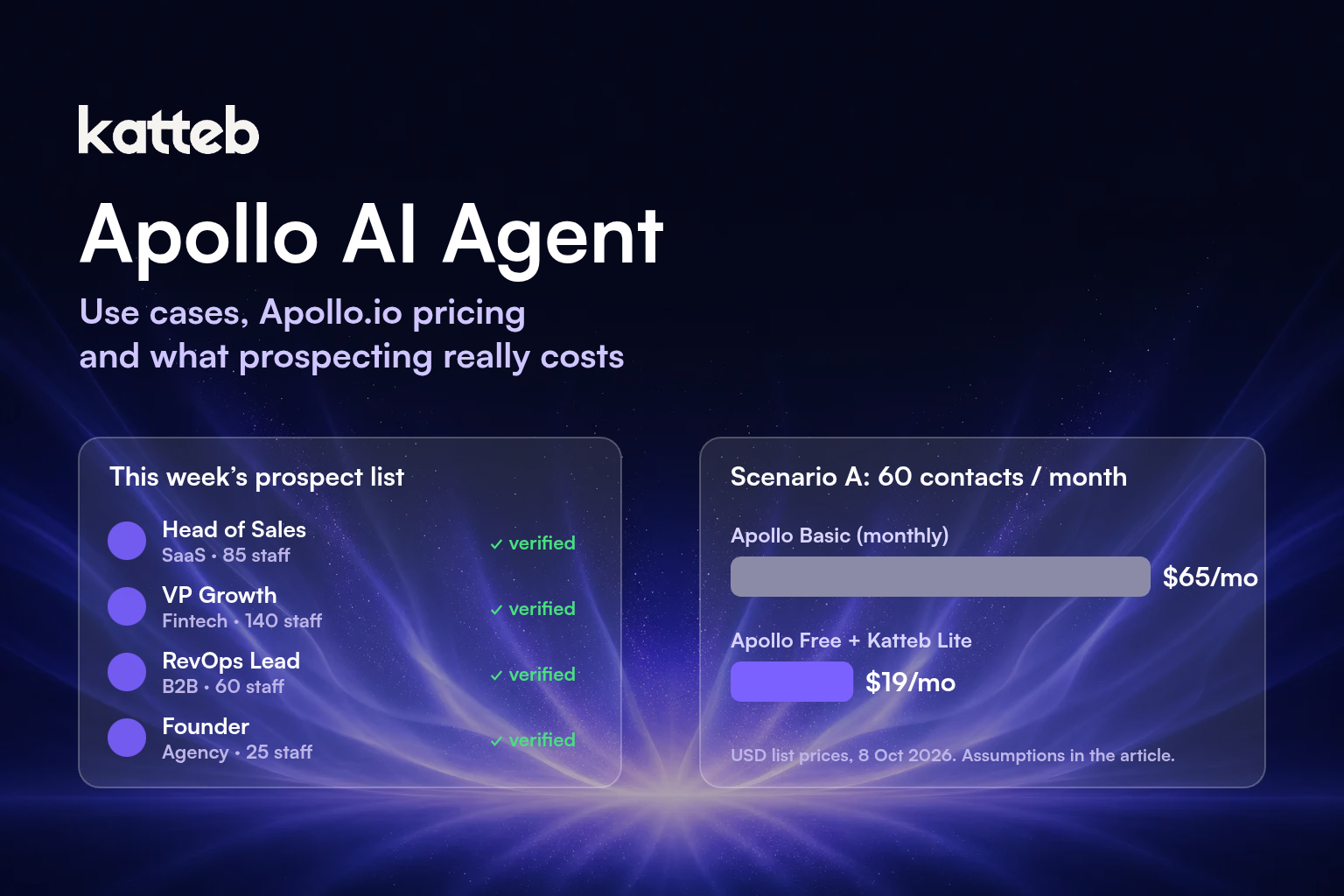
Scenario A: a founder who needs 60 verified contacts a month
A founder selling to a narrow market wants 15 new contacts a week, email only, loaded into one sequence, with a short weekly report. That is about 60 contacts a month.
- Credits needed: 60 contacts × 1 credit = 60 credits a month.
- Free plan allowance: 900 credits a year ÷ 12 = 75 credits a month. 60 ≤ 75, so the Free plan covers the credits.
- Option 1, upgrade Apollo and do it yourself: Basic, billed monthly, 1 seat = $65 a month.
- Option 2, stay on Apollo Free and let an agent do the work: Apollo Free $0 + Katteb Lite $19 = $19 a month.
- Difference: $65 − $19 = $46 a month. Over 12 months on monthly billing: $46 × 12 = $552. On annual billing: Basic $49 × 12 = $588 against Lite $190 a year, a difference of $588 − $190 = $398.
So in this scenario, and only in this one, Apollo Free plus Katteb Lite is the cheaper option by $46 a month. The calculation stops holding as soon as the requirements change: if you want mobile numbers, 75 credits buy only 8 contacts with a phone (8 × 9 = 72); if you need advanced filters, unlimited sequences or a record selection limit above 25, you need a paid Apollo plan anyway, and Katteb becomes an extra cost rather than a substitute.
Scenario B: a three-rep team that needs 2,300 credits a month
A team of three reps wants 1,500 new contacts a month: 1,400 with email only and 100 with a mobile number.
- Credits needed: 1,400 × 1 + 100 × 9 = 1,400 + 900 = 2,300 credits a month.
- Apollo: three seats are needed for three people. Basic monthly: 3 × $65 = $195 a month, with 3 × 2,500 = 7,500 credits. Basic annual: 3 × $49 = $147 a month equivalent ($1,764 a year).
- Apollo plus Katteb Goals: $195 + $99 = $294 a month on monthly billing.
Here Katteb is not cheaper. It adds $99 a month on top of a subscription the team needs regardless. The honest question is whether the agent saves more than it costs. If you value a rep’s hour at $30 (use your own figure), $99 ÷ $30 = 3.3 hours a month. If list building, enrichment checks, account briefs and sequence cleanup take the team more than about 3.3 hours a month, the agent pays for its time; if they take less, it does not.
| Scenario A (60 contacts) | Scenario B (2,300 credits) | |
|---|---|---|
| Apollo only | $65/mo (Basic monthly, 1 seat) | $195/mo (Basic monthly, 3 seats) |
| Apollo + Katteb | $19/mo (Free + Lite) | $294/mo (Basic + Goals) |
| Difference | Katteb route $46/mo less | Katteb route $99/mo more |
| Main caveat | Free plan limits (2 sequences, basic filters, 25-record selection) | Worth it only if it saves more than ~3.3 rep-hours a month at $30/hour |
Which route fits which job?
| Job | Best route | Why |
|---|---|---|
| Enrich every new sign-up in real time | Apollo API in your own code | Event-driven, needs to run in seconds, credits per record |
| Weekly list for a narrow market | Apollo Free or Basic + an agent | The work is judgment and routine, not volume |
| Pre-call research briefs | An agent | It needs Apollo plus the website, LinkedIn and news |
| Large outbound team with dialer | Apollo Professional or Organization | Built-in AI features, call recording and the dialer live there |
| CRM cleanup | Apollo CRM enrichment, or an agent for review | Automated enrichment on paid plans; an agent if you want proposals a person approves |
Five questions to answer before you build an Apollo agent
- How many credits will one week of work use? Count contacts × credit cost, and remember mobile numbers cost 9 times more than emails.
- Which plan limits will the agent hit first? On Free, the 25-record selection limit and 2 sequences are usually the ceiling, not the credits.
- Does the work cross tools? If everything happens inside Apollo, its own AI Assistant and workflows may be enough. If it needs your CRM, LinkedIn, inbox and a report, an external agent is the better fit.
- Who approves what gets sent? Decide whether the agent loads contacts into a sequence directly or leaves drafts for a person.
- How will you measure it? Pick one number, such as qualified meetings booked or replies per 100 contacts, and compare four weeks with the agent against four weeks without it.
How to run Apollo prospecting as a Katteb goal
A goal in Katteb is an outcome the agent keeps working toward on a schedule, with memory of what it already did. A prospecting goal looks like this:
- Say what should be true. For example: “40 new qualified contacts from UK SaaS companies with 20 to 200 staff added to my Apollo list every month.”
- Give the rules. Ideal customer, job titles, accounts to exclude, email only or phone too, and the maximum credits per week.
- Sign in once. The agent uses your Apollo, LinkedIn and CRM sessions in its browser.
- Set the rhythm. Weekly list building, daily reply checks, a short report every day.
- Review the first two weeks. Read the report, check ten contacts by hand, tighten the rules.
If you want more background on choosing an agent for sales work, see our guides to AI agents for sales and the AI lead generator.
Common mistakes
- Revealing phone numbers by default. At 9 credits per contact, a habit of revealing mobiles uses a month of Basic credits about nine times faster than email-only work.
- Paginating searches without a cap. Organization search and news search cost 1 credit per page, and Apollo’s own docs warn that paging through results adds up.
- Buying seats for automation. Seats are for people. An agent working inside one account does not need its own seat to save you time, though it does share that account’s credits.
- Letting credits expire. Unused credits do not roll over, so an annual plan with credits granted upfront rewards a steady weekly rhythm.
- Skipping the review step. An agent that adds the wrong 50 people to a sequence costs more in reputation than it saves in time.
When you do not need an Apollo agent
If you prospect a few accounts a month by hand and enjoy it, you do not need one. If your team already has a RevOps person who has built enrichment into your CRM with the API, an agent adds little. And if your whole process lives inside Apollo, try Apollo’s own AI Assistant and workflows first; they are included in the plan you already pay for.
FAQ
How much does Apollo.io cost per month?
On 8 October 2026: Free $0; Basic $49 per seat per month billed annually or $65 monthly; Professional $79 annually or $99 monthly; Organization $119 per seat per month, annual only, minimum 3 seats. Prices exclude tax.
How many credits does an Apollo API enrichment use?
According to Apollo’s API docs, people enrichment uses 1 credit when email or demographic data is found, plus 8 more if a mobile number is returned. Organization enrichment uses 1 credit per organization.
Do unused Apollo credits roll over?
No. Apollo’s pricing FAQ says unused credits expire at the end of each billing cycle, including add-on credits.
Can a Katteb agent use my Apollo account?
Yes. A Katteb agent works in a real browser signed in to the sites you choose, so it uses your own Apollo account and its credits. Katteb does not supply Apollo data or credits.
Is an agent cheaper than upgrading Apollo?
Only in specific cases. In Scenario A above, Apollo Free plus Katteb Lite costs $46 a month less than Apollo Basic billed monthly, because 60 email-only contacts fit inside the Free plan’s 75 monthly credits. For a team that needs a paid plan anyway (Scenario B), Katteb is an extra cost, and the question is whether it saves enough hours. You can describe your own prospecting job to a Katteb agent and compare.
The bottom line
Apollo.io gives you the data and the sequencer; its credit model makes every reveal and enrichment a small, countable cost. An Apollo AI agent is the routine around that data: the weekly list, the research, the signals, the cleanup and the report. For a solo founder with modest volume, staying on a smaller Apollo plan and letting an agent do the routine can cost less than upgrading. For a team that needs a paid plan anyway, an agent is an addition that has to earn its keep in hours saved. Run the two scenarios with your own numbers, then try the agent route on one week of prospecting and compare.
Prices in this article are list prices in US dollars read from apollo.io/pricing, docs.apollo.io (API Pricing and Credits) and katteb.com/pricing on 8 October 2026, before tax. Apollo describes its pricing as introductory and subject to change; check the live pages before you decide.

About Ahmed Ezat
Ahmed Ezat is the founder behind Katteb, an AI writing and SEO platform built to help businesses create fact-checked, search-ready content that ranks in both traditional search and AI-powered results. With more than a decade of hands-on experience in SEO, SaaS, and digital marketing, Ahmed has launched and scaled multiple AI products serving hundreds of thousands of users across the MENA region and globally.