TL;DR. On 11 October 2026 the Firecrawl pricing page listed a Free plan with 1,000 credits a month, Hobby at $19 a month (5,000 credits), Standard at $99 (100,000), Growth at $399 (500,000) and Scale at $749 (1,000,000) on monthly billing, or $190, $990, $3,990 and $7,190 a year on annual billing. One credit is one scraped, crawled or mapped page, a search costs 2 credits per 10 results, and JSON or question formats add 4 credits per page. Credits refresh monthly and only Scale rolls them over. A Firecrawl AI agent is not a replacement for the API. Firecrawl turns pages into data for your code; an agent such as Katteb reads pages in a real browser, signed in where needed, and turns them into finished work: a report, a sheet, a message. The worked scenarios below show where the raw API costs less, where they cost the same, and where an agent is simply the wrong tool.
Firecrawl has become a default way to feed web pages to language models. Give it a URL and it returns clean markdown with the page’s metadata, give it a domain and it maps every URL on it, give it a query and it searches the web and scrapes the results. Because it is billed in credits, and because different options burn credits at different rates, people search for Firecrawl pricing to find out what a real workload will cost before they wire it in.
This guide works that out with arithmetic. It lists every plan, explains how credits are counted, prices three realistic workloads and shows where an AI agent sits next to Firecrawl rather than instead of it. Every figure was read on the official pricing page and billing documentation on 11 October 2026, in US dollars, before tax. Engineering and hosting time is excluded unless a scenario says otherwise.
How does Firecrawl count credits?
Everything draws on one shared balance. The billing documentation lists the base costs:
| Endpoint | Credits | Notes |
|---|---|---|
| Scrape | 1 per page | One URL to markdown, HTML or structured data |
| Crawl | 1 per page | Same per-page options as scrape apply to every page |
| Map | 1 per call (docs) | The pricing page phrases it as 1 credit per page; the billing docs say per call |
| Search | 2 per 10 results | Rounded up: 11 results cost 4 credits; scraping each result costs extra |
| Interact | 2 to 7 per browser minute | 7 when the session uses a prompt, one-minute minimum |
| Agent | Dynamic | 5 daily runs free, usage-based after that |
The options are where budgets slip. JSON extraction, the question format, highlights, audio or video transcription, PII redaction and the prompt-injection check each add 4 credits per page; PDF parsing adds 1 credit per PDF page; zero data retention adds 1. They stack, so a page scraped with JSON format and zero data retention costs 1 + 4 + 1 = 6 credits. A scrape that returns no result is not charged, but a page that answers 403 or 404 is returned to you and costs 1 credit.
Firecrawl pricing by plan (read 11 October 2026)
| Plan | Monthly billing | Annual billing | Credits / month | Concurrency | Extra credits |
|---|---|---|---|---|---|
| Free | $0 | n/a | 1,000 | 2 | Not available |
| Hobby | $19 | $190 / year ($16/month) | 5,000 | 5 | 1,000 per $5 |
| Standard | $99 | $990 / year ($83/month) | 100,000 | 25 | 2,000 per $5 |
| Growth | $399 | $3,990 / year ($333/month) | 500,000 | 50 | 2,500 per $5 |
| Scale | $749 | $7,190 / year ($599/month) | 1,000,000 | 100 | 5,000 per $5 |
| Enterprise | Custom | Custom | Custom | Custom | Bulk discounts |
Rate limits rise with the plan too: /scrape, /map and /search go from 10 a minute on Free to 100 on Hobby, 500 on Standard, 5,000 on Growth and 10,000 on Scale. Pay-as-you-go top-ups are available on paid plans only, in $5 steps up to a monthly cap you set.
What 1,000 credits cost on each plan
| Plan | Monthly price ÷ credits | Per 1,000 credits | Top-up per 1,000 |
|---|---|---|---|
| Hobby | $19 ÷ 5,000 | $3.80 | $5.00 |
| Standard | $99 ÷ 100,000 | $0.99 | $2.50 |
| Growth | $399 ÷ 500,000 | $0.80 | $2.00 |
| Scale | $749 ÷ 1,000,000 | $0.75 | $1.00 |
The jump from Hobby to Standard is the important one. At $3.80 per 1,000 credits, Hobby is roughly four times the unit price of Standard, so a workload that regularly outgrows 5,000 credits should move up rather than top up. For example, 20,000 credits a month on Hobby with top-ups is $19 + (15,000 ÷ 1,000 × $5) = $94, almost the price of Standard, which includes 100,000.
Monthly or annual
| Plan | 12 × monthly | Annual | Difference per year |
|---|---|---|---|
| Hobby | $228 | $190 | $38 |
| Standard | $1,188 | $990 | $198 |
| Growth | $4,788 | $3,990 | $798 |
| Scale | $8,988 | $7,190 | $1,798 |
Get the report, not just the markdown
Tell Katteb what you want to watch on the web in one sentence. It reads the pages on a schedule, compares them with last time and sends you what changed.
What can a Firecrawl AI agent actually do?
“Firecrawl AI agent” can mean two things. Firecrawl itself ships an Agent endpoint, a research agent you call through the API, with 5 free runs a day and usage-based pricing after that. People also use the phrase for an AI agent that uses web data the way Firecrawl provides it. Katteb is the second kind: it works in a real browser, follows a goal you set in plain language, runs on a schedule, remembers what it found last time and reports every day. Next to Firecrawl, these are the jobs it takes on:
- Competitor and price monitoring. Read a set of pages every day, compare with yesterday and report only real changes.
- Research briefs. Search, open the best sources, read them and write a summary with links.
- Lead and directory building. Visit a list of sites, pull the same fields from each and write them to a sheet.
- Signed-in work. Read your own dashboards, inboxes or admin panels, which a public scraping API cannot reach without your session.
- Acting on what it reads. Draft a reply, fill a form, publish a post or update a sheet, with your approval where you want it.
- Content audits. Walk your own site, check titles, links and images, and list what to fix.
What the agent does not do
An agent is not a bulk data pipeline. It reads at human pace in one browser, so it is the wrong tool for scraping tens of thousands of pages a month into a vector database. It does not expose an API for your code to call. If your product needs markdown from URLs inside a request, use Firecrawl or another scraping API directly.
Katteb vs the Firecrawl API: three worked scenarios
Assumptions: US dollars, list prices read 11 October 2026, before tax, monthly billing unless stated, staff time valued at $30 an hour, engineering and hosting excluded. Katteb Lite is $19 a month or $190 a year and includes 30 hours of agent time a week (katteb.com/pricing); a month is taken as 4.33 weeks, so about 130 hours.
Scenario A: watching five competitor pricing pages every day
A SaaS team wants to know when any of five competitors changes its pricing page. That is 5 pages × 30 days = 150 page reads a month. With JSON extraction to pull the plan names and prices, each read costs 1 + 4 = 5 credits, so 150 × 5 = 750 credits.
- Firecrawl: 750 credits fits inside the Free plan’s 1,000, so $0 a month in Firecrawl fees.
- Katteb Lite: $19 a month.
- On subscription fees alone the Firecrawl API costs $19 a month less. We say that plainly.
- What the $0 leaves out: the scheduler, the storage of yesterday’s result, the diff, the alert and fixing it when a page changes layout. Those are engineering hours we excluded. Katteb is worth it here only if it saves you more than $19 ÷ $30 = 0.63 hours, about 38 minutes, of building and maintaining that each month.
Scenario B: ingesting 40,000 pages a month for a RAG system
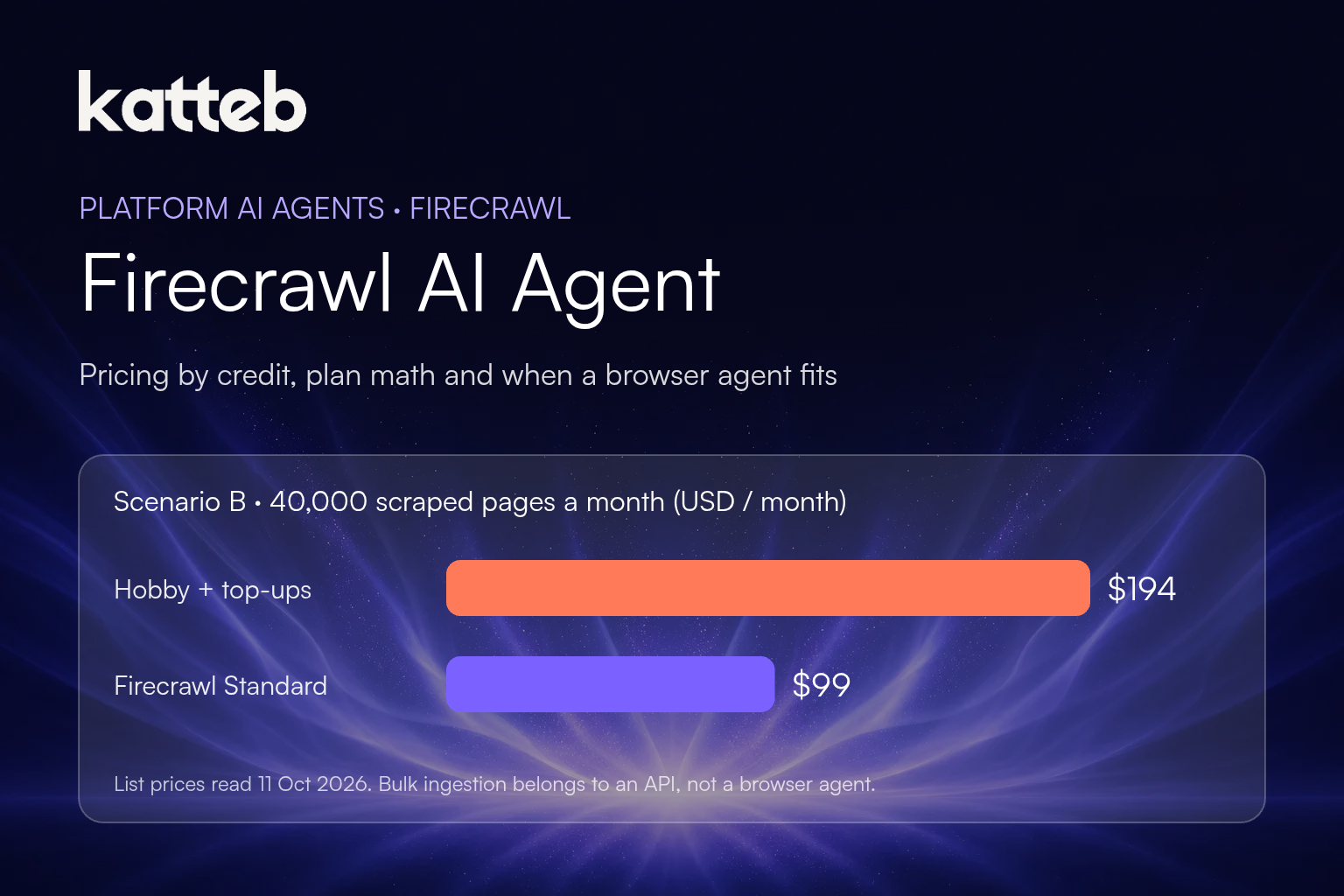
A team keeps a knowledge base fresh by scraping 40,000 documentation pages a month as plain markdown, 1 credit each, so 40,000 credits.
- Firecrawl Standard: $99 a month or $990 a year, 100,000 credits, plenty of headroom.
- Firecrawl Hobby with top-ups: $19 + (35,000 ÷ 1,000 × $5) = $19 + $175 = $194 a month, so Standard is $95 a month less than topping up Hobby.
- Katteb: not a fair comparison. Even at an assumed 20 seconds a page, 40,000 × 20 s = 800,000 s, about 222 hours, which is more than the roughly 130 hours of agent time Lite includes in a month. This job belongs to an API.
Scenario C: a weekly market research brief
A marketer runs 300 searches a month and reads the top 5 results of each to write a weekly brief. Search costs 300 × 2 = 600 credits; scraping 1,500 results is 1,500 credits; total 2,100 credits. That is over the Free plan, so Hobby.
- Firecrawl Hobby: $19 a month, plus a model to summarise and a script to assemble the brief.
- Katteb Lite: $19 a month, which reads the pages and writes the brief itself. At an assumed 30 seconds a page, 1,500 reads take about 12.5 hours, inside the Lite allowance.
- The subscription prices are the same, so neither is cheaper on fees. The difference is who builds and runs the workflow: with Firecrawl, you do; with Katteb, the agent does, and it can also post the brief to your sheet or inbox.
API or browser agent: which one for which job?
| Job | Best fit | Why |
|---|---|---|
| Markdown from URLs inside your app | Firecrawl API | Programmatic, fast, metered per page |
| Bulk crawl for embeddings | Firecrawl Standard or higher | Unit price falls to under $1 per 1,000 credits |
| Daily change report on a few pages | Either | API is $0 on Free; agent saves the building |
| Pages behind your own sign-in | Agent | Works in your own signed-in browser |
| Read, then act (reply, post, update a sheet) | Agent | The output is a finished task, not data |
How to set up a web research agent in Katteb
- Write the goal in one sentence. For example: “Every morning, check these five pricing pages and tell me if any plan, price or limit changed.”
- List the sources. Paste the URLs, or describe them and let the agent find them.
- Choose the output. A message, an email or rows in a Google Sheet.
- Sign in where needed. For your own dashboards, sign in once in the Katteb browser.
- Check the first report. Then let it run on its schedule.
Turn a list of pages into a daily brief
Katteb reads the pages you care about, remembers what they said last time and tells you only what changed.
Common mistakes that burn Firecrawl credits
- Requesting JSON or question formats on every page when plain markdown would do: that is 5 credits a page instead of 1.
- Searching with more results than you read. Search is billed per 10 results, rounded up.
- Crawling a whole site when a map plus a targeted scrape would cover the pages you need.
- Staying on Hobby and topping up past about 20,000 credits a month, when Standard costs about the same and includes five times the credits.
- Forgetting that error pages (403, 404) still cost 1 credit each.
When you do not need an agent at all
If you are a developer and the web data goes straight into your own code, use the API: the Free plan or Hobby is often enough, and the per-page price only falls as you grow. Add an agent when what you need at the end is a decision, a report or an action, and you would rather not build and maintain the workflow that produces it.
Frequently asked questions
How much does Firecrawl cost per month?
On 11 October 2026: Free $0 (1,000 credits), Hobby $19 (5,000), Standard $99 (100,000), Growth $399 (500,000) and Scale $749 (1,000,000) on monthly billing, before tax.
Is there a free Firecrawl plan?
Yes: 1,000 credits a month, refreshed monthly, no card, 2 concurrent requests and low rate limits.
Do unused credits roll over?
Only on Scale, for one month. On the other self-serve plans the allotment resets each billing cycle.
What does a Firecrawl search cost?
2 credits per 10 results, rounded up, plus the scrape cost for each result you ask it to scrape.
Can Katteb replace Firecrawl?
For bulk data into code, no. For reading a modest number of pages and turning them into a report or an action, it can do the whole job. Describe the pages you want watched in Katteb chat and it will tell you which fits.
Sources
- firecrawl.dev/pricing (and its markdown version): plans, monthly and annual prices, top-ups, rate limits, read 11 October 2026.
- Firecrawl billing documentation: credit costs per endpoint and per option.
- katteb.com/pricing: Katteb Lite and Business, read 11 October 2026.
- Structure inspired by the Monid guide on wiring Firecrawl into Claude; text and scenarios are our own.
The short version
Firecrawl is priced in credits, and the format you ask for decides how many. Stay on Free while you test, move to Standard as soon as you pass about 20,000 credits a month, and watch the 4-credit options. Use an agent when the output you want is finished work rather than raw pages.
Let an agent read the web for you
One sentence is enough to start. Katteb plans the routine, runs it in a real browser and reports every day.

About Ahmed Ezat
Ahmed Ezat is the founder behind Katteb, an AI writing and SEO platform built to help businesses create fact-checked, search-ready content that ranks in both traditional search and AI-powered results. With more than a decade of hands-on experience in SEO, SaaS, and digital marketing, Ahmed has launched and scaled multiple AI products serving hundreds of thousands of users across the MENA region and globally.