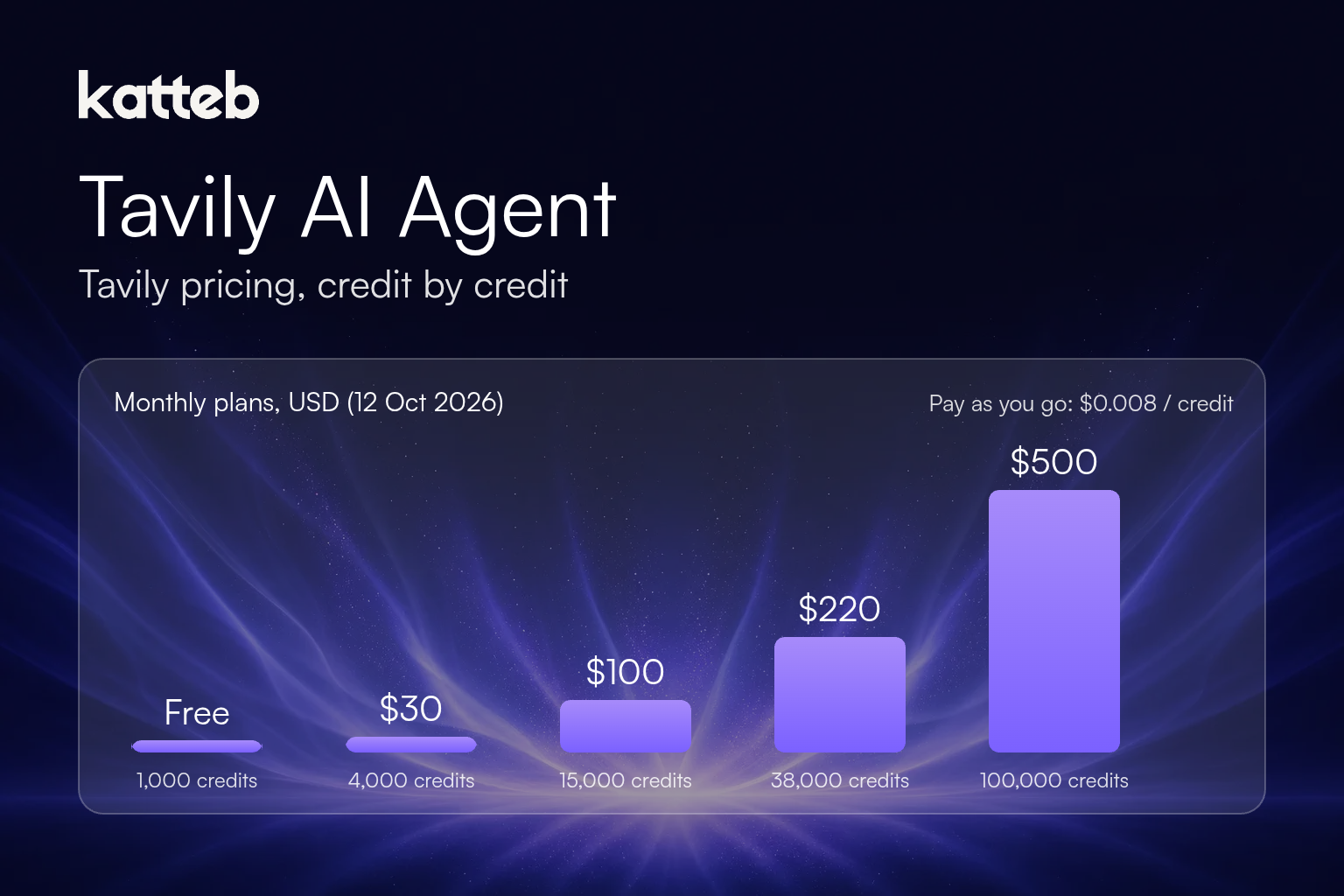
TL;DR. On 12 October 2026 the Tavily pricing page listed four ways to pay: a free Researcher plan with 1,000 API credits a month, pay-as-you-go at $0.008 per credit, a monthly Project plan whose slider runs from $30 (4,000 credits) through $100 (15,000) and $220 (38,000) to $500 (100,000), and custom Enterprise pricing. The Tavily credits documentation prices the work itself: a basic search is 1 credit, an advanced search 2, five successful page extractions 1 or 2 credits, ten mapped pages 1 or 2 credits, and a Research request anywhere from 4 to 250 credits. Tavily is the search layer an agent calls. A Tavily AI agent is the part that decides what to search, reads the results, and turns them into something you can act on. Below we price both, with the currency, period and every assumption written next to the number.
If you typed “tavily pricing” into a search box, you are probably at one of two moments. Either you are a developer about to wire web search into an app or an agent, and you want to know which plan your traffic lands on. Or you are not a developer at all, someone told you that “agents use Tavily to search the web”, and you want to know whether you need to pay for it to get research done. Those two people need different answers, and most pricing summaries only serve the first one.
This guide serves both. First it explains what Tavily actually sells and how its credits are spent. Then it lists the jobs a Tavily-powered research agent is used for, works through four priced scenarios, and is honest about where a ready-made agent such as Katteb costs more, costs the same or costs less than building on the API yourself. Where a figure was not published, we say so instead of filling the gap with a guess.
What is Tavily, and what are you paying for?
Tavily is a web search API designed to be called by AI models rather than read by people. You send a query; it runs the search and returns results already cleaned up for a language model: titles, URLs, relevant passages and, if you ask for it, the content of the pages. Around that core search endpoint Tavily has added four more: Extract (pull the readable content out of a list of URLs), Map (list the pages of a site), Crawl (map and extract in one call) and Research (a multi-step research request that searches, reads and writes a report for you).
What you pay for is credits. Every endpoint burns a different number of them, and the plan you choose decides how many you get each month and what each one costs. Nothing on the pricing page charges by seat or by user, so a team of one and a team of ten pay the same for the same volume.
Does Tavily include the AI that reads the results?
Partly. Search, Extract, Map and Crawl return data; your own model still has to read it, decide what matters and write the answer, and you pay that model provider separately. The Research endpoint is the exception: it does the reading and writing inside Tavily, which is why it costs far more credits per request. Keep that split in mind, because it changes every comparison later in this article.
Tavily pricing in October 2026: plans and credits
These are the figures as they appeared on the Tavily pricing page and in the Tavily credits documentation on 12 October 2026, in US dollars, before any tax. The pricing page shows the paid plan as a single “Project” card with a slider; the documentation gives each slider step its own name, so both are listed.
| Plan (docs name) | Credits per month | Monthly price (USD) | Price per credit |
|---|---|---|---|
| Researcher (Free) | 1,000 | $0 | – |
| Project | 4,000 | $30 | $0.0075 |
| Bootstrap | 15,000 | $100 | $0.0067 |
| Startup | 38,000 | $220 | $0.0058 |
| Growth | 100,000 | $500 | $0.005 |
| Pay as you go | Per usage | – | $0.008 |
| Enterprise | Custom | Custom | Custom |
Three details on that page matter more than the headline numbers:
- Credits reset on the first day of each month, whatever your billing date. Unused credits do not carry over, so buying a bigger plan “to be safe” wastes money every month you do not use it.
- When credits run out, requests stop until the reset or an upgrade, unless pay-as-you-go is switched on, in which case the docs say each extra credit is charged at $0.008 once the plan limit is reached.
- Students get free access, according to a banner on the pricing page. We did not test the eligibility process.
We found no yearly billing option on either page on the day we checked, so every Tavily figure in this article is a monthly figure, and yearly totals are simply twelve months.
How many credits does each Tavily call use?
The plan price only tells you what a credit costs. What you will actually spend depends on which endpoints your agent calls and how deep it asks them to go. From the Tavily credits documentation:
| Endpoint | Setting | Credit cost |
|---|---|---|
| Search | basic | 1 credit per request |
| Search | advanced | 2 credits per request |
| Extract | basic | 1 credit per 5 successful URLs |
| Extract | advanced | 2 credits per 5 successful URLs |
| Map | regular | 1 credit per 10 pages returned |
| Map | with instructions | 2 credits per 10 pages returned |
| Crawl | any | Map cost + Extract cost |
| Research | model=mini | 4 to 110 credits per request |
| Research | model=pro | 15 to 250 credits per request |
Failed extractions and failed map requests are not charged. The Research endpoint is priced dynamically between its minimum and maximum, so you only know the exact cost after the request finishes. That is the single biggest source of surprise bills, and we come back to it in Scenario D.
Want the research without wiring the API?
Describe the question you need answered every week in one sentence. Katteb searches, opens the sources in a real browser, writes the brief and sends it to you on a schedule.
What does a Tavily AI agent actually do?
“Tavily AI agent” usually means an agent that uses Tavily as its eyes on the web. The search is the cheap, fast part. The agent is everything that turns results into work. These are the jobs we see most often:
- Weekly market and competitor briefs. The agent searches for a set of competitors, product categories or regulations, reads what changed since last week and writes a one-page summary with links.
- Fact checking before you publish. Every claim in a draft is searched, the best two or three sources are opened, and anything unsupported is flagged rather than quietly kept.
- Lead and account research. For each company on a list, the agent finds the website, recent news, hiring signals and the right contact page, and writes a short note on why the account fits.
- Price and page monitoring. The agent crawls a handful of competitor pages on a schedule and reports only the differences: a new plan, a changed price, a removed feature.
- Answer engines inside a product. A support bot or a search box that has to answer from the live web rather than from a training cut-off calls Tavily on every user question.
- Deep research reports. A one-off question that needs twenty sources read and reconciled, such as “what do buyers in Germany say about our category”, handed to the Research endpoint or to an agent that does the same job step by step.
Jobs one to four are about a person getting work done. Job five is a product feature. Job six can be either. That split is what decides whether you should be buying credits, an agent, or both.
Which route fits which job?
| Job | Tavily API on its own | Ready-made agent (e.g. Katteb) |
|---|---|---|
| Search inside your own app | Yes, this is what it is built for | No: an agent is not an API for your users |
| Weekly brief for one person or team | Possible, but you build the loop, the model and the delivery | Yes, described in a sentence and scheduled |
| Fact checking a draft | Possible with code | Yes |
| Monitoring a few competitor pages | Crawl is cheap; diffing and reporting is your code | Yes, it opens the pages and reports changes |
| Research needing a signed-in site (your CRM, LinkedIn, a paid database) | No: the API reads public pages | Yes, it uses your own signed-in browser |
| High-volume structured data for a pipeline | Yes | No |
Four priced scenarios: Tavily credits vs a research agent
Assumptions for every scenario: US dollars; list prices read on 12 October 2026 from the Tavily pricing page, the Tavily credits documentation and the Katteb pricing page; prices before tax; one month = 30 days or 4.33 weeks as stated; Tavily billed monthly (no yearly option was shown); Katteb Lite at $19 a month or $190 a year, which includes 30 hours of agent time a week; staff time valued at $30 an hour where time matters. Language-model costs for a self-built Tavily agent are not included, because they depend on the model you choose; we say where that leaves the Tavily side understated. Engineering and hosting for a self-built agent are excluded too and named where they matter.
Scenario A: a founder’s weekly market brief
A founder wants 20 questions answered each week (“did competitor X change pricing”, “any new regulation on Y”). For each question the agent runs 3 advanced searches (3 x 2 = 6 credits) and extracts 10 pages at advanced depth (10 / 5 x 2 = 4 credits): 10 credits per question.
| Line | Calculation | Result |
|---|---|---|
| Credits per month | 20 questions x 10 credits x 4.33 weeks | 866 credits |
| Tavily plan needed | 866 is under the free 1,000 | Researcher, $0 |
| Tavily data cost | – | $0 a month |
| Katteb Lite | flat plan | $19 a month ($190 a year) |
| Difference in cash | $19 – $0 | Katteb costs $19 a month more |
| Break-even on time | $19 / $30 an hour | about 38 minutes a month |
Reading it honestly: on credits alone the API route is cheaper here, by $19 a month. But $0 is only the search bill. Someone still has to write the loop, pay for a model to read 866 credits’ worth of results and deliver the brief every Monday. If building and maintaining that takes the founder more than about 38 minutes a month, the $19 plan pays for itself; if they already have the script running, it does not, and we would not tell them to switch.
Scenario B: search inside a product
A startup adds live web answers to its app: 500 advanced searches a day for 30 days. That is 15,000 requests x 2 credits = 30,000 credits a month.
| Option | Calculation | Monthly cost (USD) |
|---|---|---|
| Pay as you go only | 30,000 x $0.008 | $240 |
| Bootstrap + overage | $100 for 15,000 + 15,000 x $0.008 | $220 |
| Startup | 38,000 credits included | $220 (8,000 credits spare) |
| Growth | 100,000 credits included | $500 |
Bootstrap with overage and the Startup plan land on exactly the same $220, so Startup is the better buy: same price, 8,000 credits of headroom for a busy month. Over a year that is $2,640, against $2,880 on pure pay-as-you-go, a $240 difference. Katteb is not priced against this scenario, because a product feature that answers your users in milliseconds needs an API, not an agent working in a browser. That is Tavily’s home ground.
Scenario C: watching five competitor sites every week
A marketing team wants to know when five competitors change their sites. Each site has about 200 pages and is crawled weekly with basic extraction: mapping 200 pages costs 200 / 10 = 20 credits and extracting them costs 200 / 5 = 40 credits, so 60 credits per site per crawl.
| Line | Calculation | Result |
|---|---|---|
| Credits per week | 5 sites x 60 | 300 |
| Credits per month | 300 x 4.33 | 1,299 |
| Over the free allowance | 1,299 – 1,000 | 299 credits |
| Tavily pay-as-you-go for the extra | 299 x $0.008 | $2.39 a month |
| Cheapest Tavily plan if PAYG is not used | Project | $30 a month |
| Katteb Lite | flat plan | $19 a month |
On data alone, Tavily with pay-as-you-go comes to $2.39 a month, which is $16.61 less than Katteb Lite. Against the $30 Project plan, Katteb Lite is $11 a month less, but only if the team would otherwise pick Project rather than switch pay-as-you-go on, so we do not lead with that number. The real question is the work after the crawl: comparing this week’s 1,000 pages with last week’s, ignoring noise such as dates and cookie banners, and writing “competitor B added a $49 plan”. That needs a model and code on the API side. If the agent saves more than about 33 minutes a month ($16.61 / $30 an hour), Katteb Lite costs less overall; if your team already has that pipeline, keep it.
Scenario D: twenty deep research reports a month
An analyst sends 20 questions a month to Tavily Research with model=pro. The docs give each request a range of 15 to 250 credits, so the month costs between 300 and 5,000 credits, and you cannot know which in advance.
| Case | Credits | Tavily cost (USD, monthly) |
|---|---|---|
| Every report at the minimum | 20 x 15 = 300 | $0 (inside the free 1,000) |
| Free 1,000 + pay-as-you-go for the rest | 1,000 + 2,375 | $19 at 3,375 credits |
| Every report at the maximum, free + PAYG | 5,000 | 4,000 x $0.008 = $32 |
| Every report at the maximum, Project + PAYG | 5,000 | $30 + 1,000 x $0.008 = $38 |
Against Katteb Lite at a flat $19, the break-even sits at about 3,375 credits a month, an average of roughly 169 credits per report. Below that average Tavily Research costs less; above it, Katteb Lite does, by up to $13 to $19 a month at the ceiling. The assumption that free credits combine with pay-as-you-go on the same account is ours: the docs describe pay-as-you-go as charging “once your plan’s credit limit is reached” but do not spell out the free-plan case. Because the per-report cost is only known afterwards, a flat plan mainly buys predictability here, not a guaranteed saving.
All four scenarios at a glance
| Scenario | Tavily route (USD/month) | Katteb Lite (USD/month) | Which costs less, on these assumptions |
|---|---|---|---|
| A. Weekly brief, 866 credits | $0 + model + build time | $19 | Tavily on cash; Katteb if it saves over 38 min |
| B. In-app search, 30,000 credits | $220 | not comparable | Tavily (API job) |
| C. 5 sites crawled weekly | $2.39 (PAYG) or $30 (Project) | $19 | Tavily on data; Katteb if it saves over 33 min |
| D. 20 pro research reports | $0 to $38 | $19 | Depends: break-even near 169 credits per report |
No single row lets anyone say “Katteb is cheaper than Tavily”, and we are not saying it. Tavily sells search at a fraction of a cent; Katteb sells the hours of reading, deciding and reporting around a search. Which one is cheaper for you depends on whose time you are paying for.
Price your own scenario in a sentence
Tell Katteb what you research every week and where the result should land: a sheet, an email, a Telegram message. It runs in a real browser, so it can also read the signed-in sites an API cannot.
How to set up a Tavily-style research agent without code
- Write the question as an outcome. Not “search competitors” but “every Monday, tell me which of these five competitors changed a price or launched a feature, with links”.
- List the sources you trust. Name the sites, newsletters or databases. An agent that knows where to look spends less time on noise.
- Say where the answer goes. A Google Sheet row per change, an email, or a message. A brief nobody opens is worth nothing.
- Set the schedule. Daily for prices, weekly for competitors, monthly for market reviews.
- Review the first two runs. Correct what it got wrong once; a good agent remembers the correction for every run after.
If you are building on the Tavily API instead, the same five steps apply. They just become a prompt, a domain filter, a webhook, a cron job and a test suite.
Common mistakes that inflate a Tavily bill
- Advanced depth everywhere. Advanced search costs twice as much as basic. Use it for the queries that need it, not by default.
- Extracting pages you will not read. If the snippets from search already answer the question, skip Extract. Ten extra pages per question is 2 to 4 credits each time.
- Crawling whole sites to watch three pages. Map once, then extract only the pricing and changelog URLs each week.
- Using Research for simple lookups. A minimum of 15 credits per pro request is 15 basic searches. Reserve it for questions that genuinely need many sources reconciled.
- Forgetting the reset date. Credits reset on the 1st, not on your billing date. Plan the heavy jobs around it.
- Not counting the model bill. A Tavily-only budget for an agent is incomplete; the language model that reads the results is often the bigger line.
When you do not need a Tavily AI agent at all
If your app needs search results in under a second for thousands of users, you need the API and an engineer, not an agent. If you only research something twice a month, the free 1,000 credits or a normal search engine and twenty minutes of your own time will do. And if the data you need lives behind your own logins, such as your CRM, ad accounts or a paid database, no public search API reaches it; that is a job for an agent that works in your signed-in browser, or for an export.
Frequently asked questions
Is Tavily free?
There is a free Researcher plan with 1,000 API credits a month and no credit card required, according to the Tavily pricing page on 12 October 2026. That is roughly 1,000 basic searches or 500 advanced ones. Students can apply for free access.
How much does the Tavily API cost per search?
A basic search costs 1 credit and an advanced search 2. At pay-as-you-go rates of $0.008 per credit that is $0.008 or $0.016 per search; on the Growth plan at $0.005 per credit it is $0.005 or $0.01.
What happens when I run out of Tavily credits?
Requests stop until your credits reset on the first of the month or you upgrade, unless pay-as-you-go is enabled, which charges $0.008 per extra credit.
Does Tavily offer yearly billing?
We did not see a yearly option on the pricing page or in the credits documentation on 12 October 2026. Check the billing page in your account before committing.
Is Katteb cheaper than Tavily?
Not as a rule. They sell different things: Tavily sells search credits, Katteb sells an agent that does the research work around the search. In our four scenarios the Tavily route was cheaper on cash in two, not comparable in one, and either way in the fourth depending on credit use. See the Katteb chat if you want to test the agent side on your own question.
Can a Katteb agent use my own Tavily key?
Katteb’s agents search and read pages themselves in a real browser, so they do not need a Tavily key to research. If your workflow depends on Tavily output, for example a dashboard your team already reads, the agent can work alongside it rather than replace it.
Sources
- Tavily pricing page (tavily.com/pricing), read 12 October 2026, plan slider read at each step.
- Tavily credits documentation (docs.tavily.com/documentation/api-credits), read 12 October 2026.
- Katteb pricing page (katteb.com/pricing), read 12 October 2026: Lite $19/month or $190/year; Business $99/month or $990/year.
The short version
Tavily pricing is simple once you translate it into credits per job: 1 or 2 per search, a fraction of a credit per page extracted, and a wide 4 to 250 for a research report. Pick the smallest plan that covers a normal month, turn on pay-as-you-go for spikes, and put the expensive Research endpoint only where it earns its cost. Add an agent when the slow part of your week is not the search but everything that comes after it.
Hand the research loop to an agent
One sentence is enough to start. Katteb plans the routine, runs it on schedule and reports back with sources you can click.

About Ahmed Ezat
Ahmed Ezat is the founder behind Katteb, an AI writing and SEO platform built to help businesses create fact-checked, search-ready content that ranks in both traditional search and AI-powered results. With more than a decade of hands-on experience in SEO, SaaS, and digital marketing, Ahmed has launched and scaled multiple AI products serving hundreds of thousands of users across the MENA region and globally.