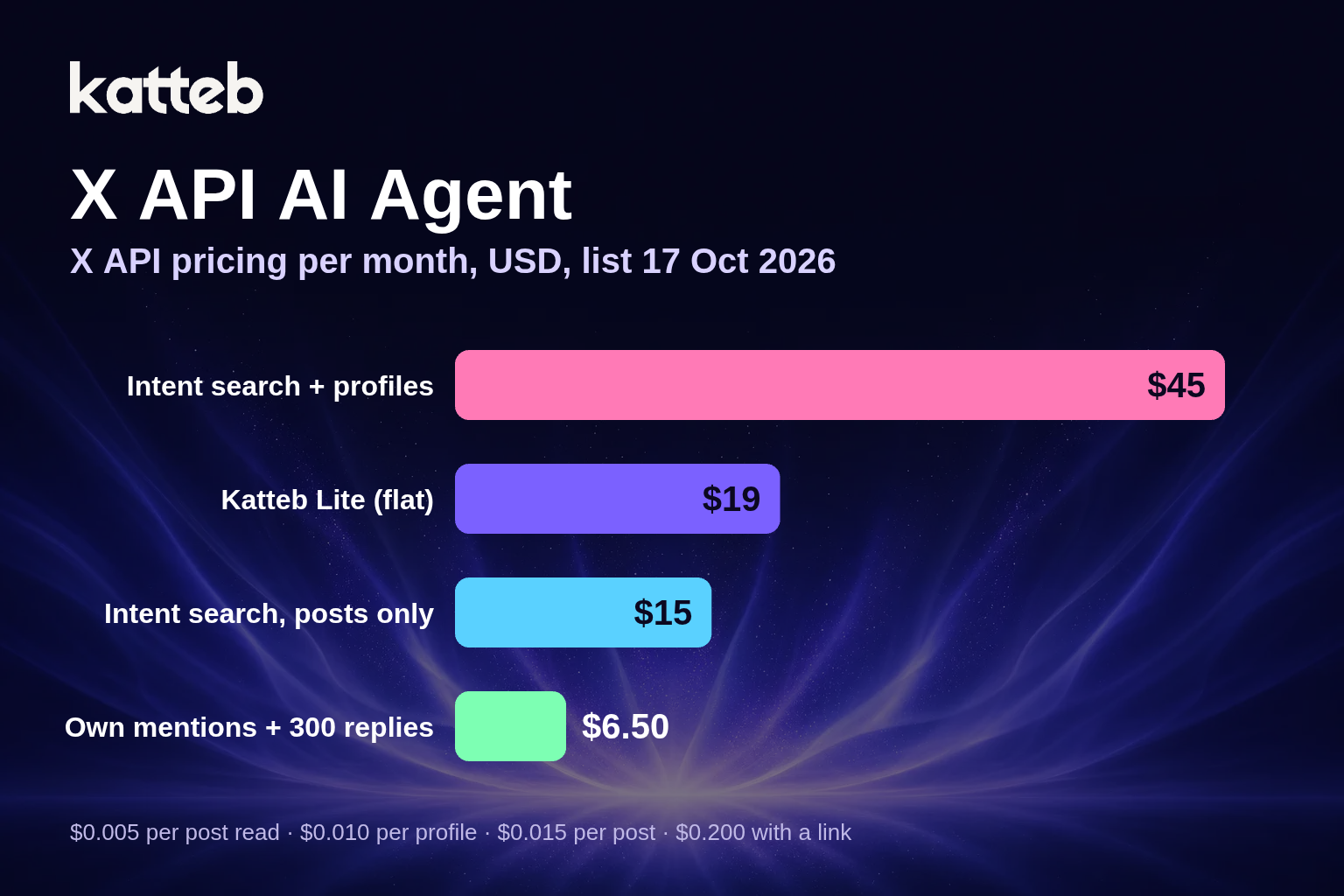
TL;DR. The X API no longer sells monthly tiers. On 17 October 2026 the official X API pricing page described pay-per-usage credits in US dollars, with no subscription, contract or minimum spend. Reads are billed per resource returned: $0.005 per post, $0.010 per user profile, $0.010 per follower or following record and $0.001 per like. Writes are billed per request: $0.015 to create a post, $0.200 to create a post that contains a URL, and $0.015 for a DM. Reads of your own data (“Owned Reads”) cost $0.001 each, the same resource is charged once per UTC day, and pay-per-usage is capped at 3 million post reads a month. The API gives you data and actions; it does not decide which posts matter or write the replies. Below are six priced scenarios with the arithmetic shown, and an honest answer to where an agent such as Katteb fits and where it does not.
Anyone typing “x api pricing” into a search box in 2026 is probably carrying an old number in their head: the flat monthly tiers that used to start at a few hundred dollars a month. That model is gone from the official documentation. What replaced it is a meter. You buy credits, every post you read and every post you publish takes a small amount off the balance, and the bill is whatever your code did that month.
A meter is good news for small jobs and a planning problem for everyone else, because the cost now depends on details that never mattered under a flat plan: whether you expand author profiles, whether your post carries a link, whether you poll the same timeline every hour, and whether the data you want is your own. This guide lists the published rates as they appeared on the day we checked, explains the billing rules that change the total, prices six realistic jobs, and for each one says whether an agent that works in the X app itself, like Katteb, is a better fit, an addition, or simply the wrong tool.
Want the shortlist, not the JSON?
Tell Katteb the job, for example “every morning, search X for people asking for a CRM recommendation, skip promo threads and builders, and send me the five worth answering with a draft reply”. It searches, reads and reports in plain language.
What does the X API cost per call in 2026?
Every price below is from the X developer documentation, read on 17 October 2026, in US dollars, before any tax. X notes that prices can change and that the Developer Console always shows the current rates, so check there before you commit a budget.
Read operations (charged per resource returned)
| Resource | Price | Per $1 |
|---|---|---|
| Post read | $0.005 | 200 posts |
| User profile read | $0.010 | 100 profiles |
| Following / followers read | $0.010 | 100 records |
| DM event read | $0.010 | 100 events |
| List, Space, Community, Note read | $0.005 | 200 items |
| Like, mute, block read | $0.001 | 1,000 items |
| Owned Reads (your own posts, mentions, followers, bookmarks, lists) | $0.001 | 1,000 items |
Write operations (charged per request)
| Action | Price |
|---|---|
| Create a post | $0.015 |
| Create a post that contains a URL | $0.200 |
| Create a post when summoned | $0.010 |
| Create a DM or a user interaction (follow and similar) | $0.015 |
| Delete an interaction | $0.010 |
| Recent post counts | $0.005 |
| Full-archive post counts, trends | $0.010 |
Webhook events from the Activity API are billed per event delivered, for example $0.005 for a new post event and $0.010 for a follow or a received DM. Sent DMs, deleted posts and typing indicators are not billed.
Which billing rules change the total?
The unit prices are only half of the bill. Five rules on the same page decide whether a job costs pennies or hundreds of dollars.
- Reads are per resource, not per request. A search that returns 20 posts is 20 post reads, $0.10, not one call. If you ask for author profiles in the same response, those profiles can add user reads on top. Plan with resources, never with request counts.
- Deduplication inside a UTC day. The same post or profile fetched twice in one 24-hour UTC window is charged once. Polling a timeline every ten minutes costs far less than ten-minute polling sounds, as long as the posts have not changed. X calls this a soft guarantee, so treat it as a discount you usually get, not a contract.
- The link premium. A post containing a URL costs $0.200, more than thirteen times a plain post at $0.015. For a brand that links every post to its site, this one line is most of the publishing bill.
- Owned Reads. Reading your own posts, mentions, followers, likes, bookmarks and lists costs $0.001 per item when the authenticated user owns the developer app. A personal or single-brand dashboard is a fifth of the price of the same data about someone else.
- The 3 million cap. Pay-per-usage is capped at 3 million post reads per monthly billing cycle. At $0.005 that ceiling is $15,000 of reads; above it, X points you to an Enterprise plan with no published price.
There are also incentives. New paying accounts receive $20 of X API credits after saving a card and making a first credit purchase, and the first auto-recharge is matched with free credits up to $50. Spending also earns xAI API credits (not X API credits) at 10% from $200 of cumulative spend in a billing cycle, 15% from $500 and 20% from $1,000. Auto-recharge fires at most once every five minutes, and a spending limit can block requests when you reach it.
What can an X AI agent actually do?
“X AI agent” covers two different things, and the X API is only one of them.
| Approach | How it reaches X | What you pay | Good at | Weak at |
|---|---|---|---|---|
| Your own agent on the X API | Official endpoints with a developer key | Per resource and per request, plus your engineering and hosting | Volume, streams, apps, datasets, exact counts | Judgement about intent; you write that layer |
| A browser agent such as Katteb | The X app, signed in as you, at a human pace | A flat plan (Katteb Lite $19 a month) | Reading threads, shortlisting, drafting replies and reports | Bulk data, real-time streams, anything another program consumes |
The common use cases for an X agent fall into five groups:
- Intent search. Finding people who are asking for a recommendation in your category, and separating them from promotional threads, repeat posts and builders who are describing the thing you sell. A keyword match is easy; a buyer is not in the text. That judgement step is where most of the value sits.
- Reply drafting. Reading the thread around a question before answering it, so the reply fits, and writing a different answer every time.
- Brand and mention monitoring. Watching your own mentions and replies, flagging complaints and questions, and drafting responses for approval.
- Competitor tracking. Following what a short list of rival accounts publish, how often, and what gets engagement, then writing a weekly summary.
- Research datasets. Collecting tens or hundreds of thousands of posts on a topic for analysis. This one belongs to the API.
How do you write an X search that finds intent?
Whichever route you choose, the query does most of the filtering, and a few operators beat a long natural-language phrase:
- Quote the asking phrase:
"looking for","any recommendations","alternative to". - Group the category with OR, using the words people type rather than your product category:
(crm OR "sales tool" OR pipedrive). - Remove amplification with
-filter:retweets, and use the Latest ordering rather than Top, because Top favours engagement and engagement favours marketing threads. - Deduplicate on normalised text, not on post IDs, because reposted promotions have different IDs.
Even a tight query leaves you with a page of keyword matches of which only a few are real questions from real buyers. On the API, every one of those posts is a paid read, and the reading and judging is still your job. That is the honest split behind every scenario below.
Let an agent read the thread before it answers
Katteb opens X in your own signed-in browser, reads each thread, skips the noise and drafts a reply you approve. No developer key, no credit balance to watch.
Six priced scenarios
Assumptions for every scenario: US dollars; X API list prices read on 17 October 2026; before tax; one monthly billing cycle of 30 days; no free-credit incentives unless a line says so; no deduplication discount unless stated; staff time valued at $30 an hour; your own engineering and hosting for an API agent are not included, which flatters the API side. Katteb is priced at the Lite plan, $19 a month or $190 a year, as shown on katteb.com/pricing on the same day; Lite includes 30 hours of agent time a week. A Katteb figure only holds if the job is one it can do in the X app within those hours.
Scenario A: a founder looking for buyers on X
Five intent searches a day, 20 posts each, every day of the month.
- Post reads: 5 × 20 × 30 = 3,000 × $0.005 = $15.00.
- If each result also expands the author profile: up to 3,000 × $0.010 = $30.00, so up to $45.00 before deduplication of repeat authors.
- Katteb Lite: $19.00.
Result: on posts alone, the API is $4.00 a month less than Katteb, and the $20 first-purchase credit would cover the first month entirely. With author profiles at the upper bound, Katteb is $26.00 a month less, provided the job is searching, reading and shortlisting rather than storing the data, and provided your agent on the API side would need those profiles. The break-even is simple: $19 buys 3,800 post reads, or 1,900 profile reads.
Scenario B: a brand publishing 60 posts a month
- 40 posts with a link: 40 × $0.200 = $8.00.
- 20 posts without a link: 20 × $0.015 = $0.30.
- API total: $8.30 a month. Katteb Lite: $19.00.
Result: for the act of publishing, the API is $10.70 a month less. Katteb only earns its place if the drafting and scheduling work it does saves more than about 21 minutes of staff time a month ($10.70 ÷ $30 × 60). If every post linked out, the API bill would be 60 × $0.200 = $12.00, still $7.00 below Lite. Writing the posts is not part of either price.
Scenario C: a small business answering its own mentions
- 2,000 mentions read as Owned Reads: 2,000 × $0.001 = $2.00.
- 300 replies posted: 300 × $0.015 = $4.50.
- API total: $6.50 a month. Katteb Lite: $19.00.
Result: the API is $12.50 a month less. This is where Owned Reads make the official route very cheap. Katteb is worth it only if drafting those replies, reading each thread first, saves more than 25 minutes a month ($12.50 ÷ $30 × 60). At one minute per hand-written reply, 300 replies are five hours, so the condition is usually met, but the arithmetic, not the label, should decide.
Scenario D: weekly competitor tracking for a marketing team
- 10 competitor accounts, about 5 posts each a day: 10 × 5 × 30 = 1,500 post reads × $0.005 = $7.50.
- One profile read per account per day for follower counts: 10 × 30 = 300 × $0.010 = $3.00.
- API data: $10.50. A person turning that data into a weekly summary, two hours a month: $60.00. Total: $70.50.
- Katteb Lite reading the accounts and writing the summary: $19.00, plus 30 minutes of human review: $15.00. Total: $34.00.
Result: Katteb is $36.50 a month less, on the condition that its summary is accurate enough to need only a 30-minute review. If you need exact engagement numbers in a dashboard rather than a written summary, keep the API.
Scenario E: a research dataset of 500,000 posts
- 500,000 × $0.005 = $2,500.00 for the month.
- That spend passes the $1,000 threshold, so it earns xAI API credits at 20%: about $500 in xAI credits, which can be spent on xAI models, not on X API reads.
- The 3 million post-read cap sits at $15,000; above it you need Enterprise.
Result: no Katteb comparison. A browser agent reading at a human pace is the wrong tool for half a million posts, and a dataset is something software consumes. Use the API, and use deduplication by fetching each post once per UTC day.
Scenario F: the annual view
X publishes no annual plan, so a year is twelve months of usage. Katteb Lite paid yearly is $190 instead of $228.
- Scenario A, posts only: $15 × 12 = $180 against $190, so the API is $10 a year less.
- Scenario A with author profiles at the upper bound: $45 × 12 = $540 against $190, so Katteb is $350 a year less, on the same conditions as above.
- Scenario C: $6.50 × 12 = $78 against $190, so the API is $112 a year less.
The numbers do not support a blanket claim that one route is cheaper. Light, structured, owned-data work is cheaper on the API; reading-heavy work that ends in a judgement or a written answer often costs less with a flat-priced agent, once staff time is counted.
| Scenario | X API per month | Katteb route per month | Lower cost |
|---|---|---|---|
| A. Founder intent search, posts only | $15.00 | $19.00 | API by $4.00 |
| A. With author profiles (upper bound) | $45.00 | $19.00 | Katteb by $26.00 (conditions apply) |
| B. 60 brand posts | $8.30 | $19.00 | API by $10.70 |
| C. Own mentions and 300 replies | $6.50 | $19.00 | API by $12.50 |
| D. Competitor tracking with summary | $70.50 incl. staff | $34.00 incl. review | Katteb by $36.50 (conditions apply) |
| E. 500,000-post dataset | $2,500.00 | Not comparable | API only |
When should you use the X API instead of an agent?
- Your product needs X data inside it: a dashboard, a widget, an alerting system.
- You need near real-time delivery through the filtered stream or webhooks.
- You need exact counts, full-archive search back to 2006, or a dataset for analysis.
- Your volume runs into thousands of posts a day.
- Your work is mostly your own data, where Owned Reads at $0.001 make the API very cheap.
When does an agent fit better?
- The output is a decision or a piece of writing: a shortlist of real buyers, a reply, a weekly summary.
- Reading the thread around a post matters more than the post itself.
- Nobody on the team wants to manage a developer key, a credit balance and auto-recharge rules.
- The job also touches other sites, such as checking a prospect’s website or LinkedIn page before replying.
Two cautions apply to any agent that acts on X. It works through your account, so it follows X’s rules and limits like a person would, and it should space public actions instead of posting in bursts. And replies should stay human in quality: read before you answer, write a different reply each time, and approve before anything goes out.
Price your own X job in a sentence
Describe what you want from X, such as “find 10 people a day asking for a bookkeeping tool and draft replies for me to approve”, and Katteb will run it on Lite for $19 a month.
How do you size an X API budget in five minutes?
- Count resources, not requests: searches × results per search × days.
- Add user reads if your code expands authors, and follower reads if it walks follower lists.
- Split your own data from other people’s data; your own is $0.001 per item.
- Count posts with links separately at $0.200 each.
- Subtract repeat fetches inside a UTC day, then set a spending limit at about 120% of the total.
- Price the reading and writing work separately, and compare that part against an agent before you build it.
Frequently asked questions
Is the X API free?
There is no free tier described on the pricing page read on 17 October 2026. New paying accounts get $20 of credits after their first purchase, and the first auto-recharge is matched up to $50.
Are there still Basic and Pro subscriptions?
The official pricing documentation now says “No subscriptions—pay only for what you use”, with an Enterprise plan above the 3 million post-read cap.
Why does a post with a link cost more?
X prices “Post: Create (with URL)” at $0.200 against $0.015 for a plain post. The page does not give a reason, so budget for it rather than guess.
Can Katteb replace the X API?
Not for apps, streams, datasets or anything at volume. For reading, shortlisting and drafting work at tens or hundreds of posts a day, Katteb Lite at $19 a month can do the job in the X app, as priced in Scenarios A and D.
Sources and date checked
- X API pay-per-usage pricing and credits (read, write and webhook prices, Owned Reads, deduplication, cap, incentives), read 17 October 2026.
- X API introduction (filtered stream, full-archive search), read 17 October 2026.
- Katteb pricing, read 17 October 2026.
- Monid guide on X intent search, used for structure only.
The short version
X API pricing in 2026 is a meter: half a cent per post read, a cent per profile, a cent and a half per post and twenty cents for a post with a link, with your own data at a tenth of a cent and a 3 million post-read monthly cap. Count resources, watch the link premium and lean on Owned Reads and deduplication. Keep the API for apps, streams and datasets. When the job is reading X and deciding what deserves an answer, hand Katteb the question and weigh the time it saves against $19 a month.

About Ahmed Ezat
Ahmed Ezat is the founder behind Katteb, an AI writing and SEO platform built to help businesses create fact-checked, search-ready content that ranks in both traditional search and AI-powered results. With more than a decade of hands-on experience in SEO, SaaS, and digital marketing, Ahmed has launched and scaled multiple AI products serving hundreds of thousands of users across the MENA region and globally.