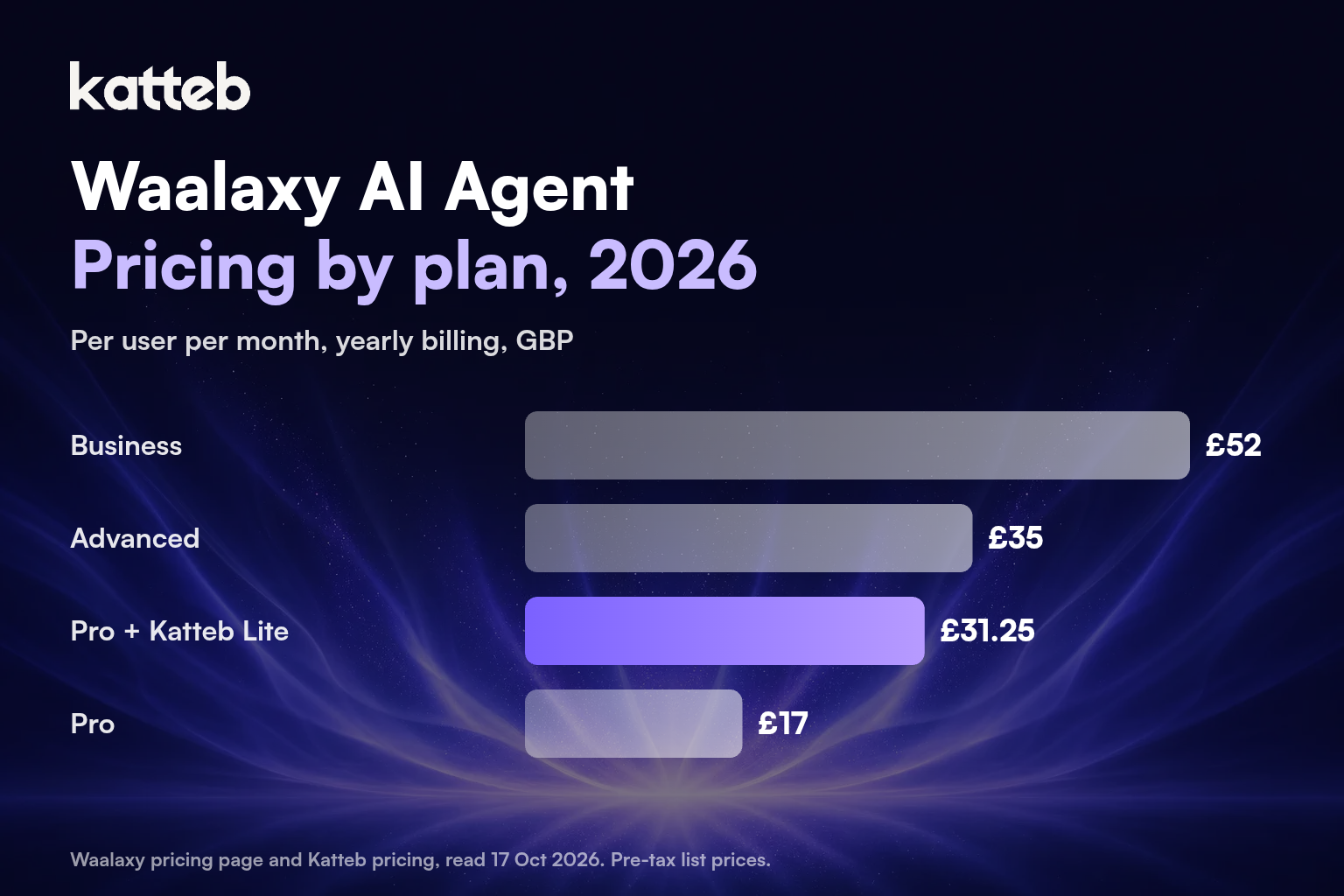
TL;DR. On 17 October 2026 the official Waalaxy pricing page listed three paid plans per user per month, shown to us in pounds sterling: Pro £34 (300 LinkedIn invitations a month), Advanced £69 (800 invitations, API access, Make, Zapier and n8n modules) and Business £104 (800 invitations plus cold email and 500 email finder credits). Paying quarterly cuts the monthly figure to £27, £56 and £86; paying yearly cuts it to £17, £35 and £52. Every plan has a 14-day free trial. Waalaxy sends and follows up; it does not decide who belongs on your list. Below are six priced scenarios with the arithmetic shown, the exchange rate we used for dollars, and a straight answer to where an agent such as Katteb fits beside Waalaxy and where it does not.
People who search for “waalaxy pricing” have usually already decided they want LinkedIn outreach on autopilot. What they are trying to work out is which plan, which billing period, and whether the extra pounds for Advanced or Business buy something they will actually use. Those are good questions, and they have exact answers once you write down three numbers: how many invitations you send a month, how many email addresses you need, and how many months you will keep the tool.
There is a fourth question most pricing pages skip, and it decides whether any of the money is well spent: who receives those invitations. A sending tool takes a list and works through it politely. It does not check that the people on it still hold the job you think they hold, or that the company is a fit. That preparation is where an agent like Katteb earns its place, and it is also where we will be careful not to claim more than the numbers support.
Waalaxy pricing at a glance (read 17 October 2026)
The table copies the plan cards and the comparison grid on the official page. Prices are per user per month, before any tax, and were displayed in GBP to our browser. A second request from a United States connection returned the page with euro prices, so Waalaxy localises the currency; check the figure in your own currency before you buy. Where we give dollars, we converted at the European Central Bank reference rates for 16 October 2026 (USD 1.1253 and GBP 0.84385 per euro), which gives £1 = $1.3335.
| Plan | Monthly billing | Quarterly (per month) | Yearly (per month) | Invitations / month | Email finder credits / month |
|---|---|---|---|---|---|
| Pro | £34 ($45.34) | £27 ($36.00) | £17 ($22.67) | 300 | 25 |
| Advanced | £69 ($92.01) | £56 ($74.68) | £35 ($46.67) | 800 | 25 |
| Business | £104 ($138.68) | £86 ($114.68) | £52 ($69.34) | 800 | 500 |
What each step up adds, in the page’s own words:
- Pro: unlimited campaigns, pre-built outreach sequences, automated follow-ups, CRM synchronization and team collaboration tools.
- Advanced: “maximum LinkedIn invitation limits”, API access, Make, Zapier and n8n modules, and live chat support (reply within 4 hours instead of 48).
- Business: cold email sequences, multichannel LinkedIn plus email campaigns, multiple sender accounts and 500 email finder credits a month.
- Inbox: a paid add-on on every plan for handling LinkedIn conversations, with “500 free conversations, no time limit”. The page does not print its price, so we leave it out of every sum below rather than guess.
Two practical readings of that grid. First, the jump from Pro to Advanced is mostly about volume (300 to 800 invitations) and integrations; the jump from Advanced to Business is about email, not LinkedIn, because the invitation limit stays at 800. Second, CRM synchronization is already in Pro, so you do not need Advanced just to push accepted connections into HubSpot or Pipedrive.
What the billing periods are worth
The discounts are labelled −20% for quarterly and −50% for yearly. In money, for one Pro seat:
| Billing | Cash per period | Cost for 12 months |
|---|---|---|
| Monthly | £34 a month | £408 ($544.07) |
| Quarterly | £81 a quarter (3 × £27) | £324 ($432.05) |
| Yearly | £204 a year (12 × £17) | £204 ($272.03) |
We assume the per-month figures on the cards are charged as one payment per period, which is what “quarterly” and “yearly” billing normally means; confirm at checkout. The yearly plan costs the same as six months of monthly billing (6 × £34 = £204), so it pays off only if you will still be sending in month seven. Against quarterly billing, yearly wins once you would have paid for a third quarter (3 × £81 = £243, more than £204).
Fill the list before you fill the sequence
Tell Katteb the job, for example “take these 120 LinkedIn profile URLs, check each person still works at the company on their profile, open the company site, and give me a table of the ones in a 20–200 person B2B SaaS with the reason in one line”. It reads, checks and reports in plain language, and you load only the keepers into Waalaxy.
What Waalaxy does, and the part you still have to supply
It helps to split LinkedIn outreach into four steps, because the tools that sell “outreach” mostly cover the last one.
| Step | What it needs | Who usually does it |
|---|---|---|
| 1. Find the people | A search or a list of profile URLs | You, Sales Navigator, an event list, a CRM export |
| 2. Check they are still a fit | Current title, company, company size and focus | A person with a browser, or an agent |
| 3. Find another way to reach them | A business email address | An email finder (Waalaxy includes 25 to 500 credits) |
| 4. Send and follow up | Sequences, daily limits, reply detection | Waalaxy |
Waalaxy is strong on step 4 and helps with steps 1 and 3: it imports from LinkedIn Basic, Sales Navigator and Recruiter Lite, and it finds emails within the credits of your plan. Step 2 is where campaigns quietly fail. A list built in March has people who changed jobs by June, companies that were acquired, and titles that looked right in a search but are not the buyer. Each of those still uses one of your 300 or 800 invitations.
At 300 invitations a month on Pro yearly, each invitation costs about 5.7p (£17 ÷ 300). On Pro monthly it is about 11.3p (£34 ÷ 300). The plan cost per invitation is small. The real cost of a wasted invitation is that it is gone for the month, and LinkedIn’s own weekly limits mean you cannot simply send more to make up for a weak list.
Six priced scenarios
Ground rules for every scenario: Waalaxy list prices read on 17 October 2026, per user, before tax, in GBP with dollars at £1 = $1.3335; Katteb Lite at its published $19 a month (£14.25) or $190 a year (£142.48), from the Katteb pricing page read the same day; staff time at $30 an hour; no promotions, affiliate discounts or the Inbox add-on. Where we say one option is “less”, the sum is printed beside it, along with the condition that has to hold for it to be true.
Scenario A: a consultant testing LinkedIn outreach for three months
A solo consultant wants to send about 250 invitations a month and is not sure the channel will work. Pro covers the volume.
- Monthly billing for three months: 3 × £34 = £102 ($136.02).
- One quarter: £81 ($108.01).
- Yearly: £204 ($272.03), of which nine months may go unused.
For a three-month test, quarterly is £21 ($28.00) less than monthly, and £123 less than buying a year you might abandon. The 14-day free trial comes first in every case, so the paid clock starts after you have seen the first acceptances. Katteb is not needed for the sending itself here; it only enters if the consultant is building the 750-person list by hand (see Scenario D).
Scenario B: you need 600 invitations a month
Pro stops at 300, so the plan choice is made for you: Advanced. On yearly billing that is £35 against £17 for Pro, so the extra 500 invitations cost £18 a month, about 3.6p each. On monthly billing the step is £35 (£69 − £34), about 7p each. If the higher volume is for one quarter only, quarterly Advanced at £168 for the quarter is £39 less than three months of monthly Advanced (£207).
A warning that has nothing to do with Waalaxy’s prices: 800 invitations a month is close to LinkedIn’s own weekly ceilings for many accounts. Advanced lifts Waalaxy’s limit; it does not lift LinkedIn’s. Plan the volume you can send without the account being restricted, then pick the plan.
Scenario C: 200 prospects a month who also need an email
A small agency sends 200 invitations a month and wants an email address for each prospect so it can follow up off LinkedIn. Pro and Advanced include 25 email finder credits a month; Business includes 500, plus cold email sequences inside Waalaxy.
| Option | Per month (yearly billing) | What you get |
|---|---|---|
| Waalaxy Business | £52 ($69.34) | 800 invitations, 500 email finder credits, cold email sequences in Waalaxy |
| Waalaxy Pro + Katteb Lite | £17 + £14.25 = £31.25 ($22.67 + $19 = $41.67) | 300 invitations, 25 credits, and an agent that looks up each company’s published contact details and writes the follow-up drafts |
The second option is £20.75 ($27.67) less per month, or £249 ($332.04) over a year, only if three things hold: 300 invitations are enough; a business address published on the company’s own site or contact page is good enough for your follow-up (Katteb reads the public web, it does not have Waalaxy’s email finder or a deliverability check behind it); and you are happy to send the follow-up emails from your own mailbox instead of Waalaxy’s sequences. If you need Waalaxy’s multichannel campaigns, or verified personal work addresses at volume, Business is the right plan and the comparison does not apply.
Scenario D: checking the list before it goes into Waalaxy
This is the step-2 job from the table above. A founder has 300 profile URLs a month to send to. Checking each one by hand (open the profile, confirm the current role, open the company site, decide fit) takes about two minutes.
- By hand: 300 × 2 minutes = 10 hours = $300 (£224.97) of time at $30 an hour.
- Katteb Lite does the reading and returns a table with a one-line reason per person: $19. Spot-checking 30 rows yourself (10%) at two minutes each is one hour, $30.
Total with Katteb: $49, which is $251 less than doing it all by hand, if the agent’s checks hold up in your spot check and the 300 profiles fit inside Lite’s agent time (Lite includes 30 hours of agent time a week). The break-even is low: Lite pays for itself if it saves 38 minutes of checking a month ($19 ÷ $30 × 60). This is an addition to Waalaxy, not a replacement; you still need a sender for step 4.
Hand over step 2, keep Waalaxy for step 4
Ask Katteb: “every Monday, read the 75 profiles in this sheet, drop anyone who changed company or is not a buyer, and write a first line for each keeper based on their latest post”. You get a cleaned list you can import into your campaign.
Scenario E: three SDRs on Advanced for a year
A sales team runs three seats on Advanced for the API and the higher limit.
- Monthly billing: 3 seats × £69 × 12 months = £2,484 ($3,312.41).
- Yearly billing: 3 seats × £420 = £1,260 ($1,680.21).
Yearly is £1,224 ($1,632.20) less over twelve months, on the condition that all three seats are still needed in month seven; the break-even per seat is six months, as in the billing table. If headcount is uncertain, put the seats you are sure of on yearly and the rest on quarterly.
Scenario F: you only wanted Advanced for the integrations
Some buyers step up to Advanced because it lists API access and the Make, Zapier and n8n modules. Check what you actually need. If the goal is to send accepted connections and replies to a CRM, Pro already lists CRM synchronization; staying on Pro yearly is £18 a month (£216, or $288.04, a year) less than Advanced yearly. If you need to trigger campaigns from another system or read Waalaxy data in your own code, the API is the reason to pay, and Advanced is correct.
We did not compare Katteb with the Waalaxy API. An API is for software talking to software; an agent is for reading, judging and writing. Pricing one against the other would be comparing different jobs.
Where Katteb fits, and where it does not
Katteb is a general AI agent: you describe a job in plain language, it works in a real browser, and it reports back. On the Lite plan it runs one goal with up to 30 hours of agent time a week for $19 a month. Against Waalaxy, that leads to a short and honest list.
- Use Katteb for: researching and checking prospects before they go into a campaign (Scenario D), writing personalised first lines from a profile and a company site, summarising replies, and finding published company contact details when a full email finder is more than you need (Scenario C).
- Use Waalaxy for: sending hundreds of invitations and follow-ups on a schedule, with daily limits, reply detection and CRM sync. That is its job, and Katteb Lite is not priced here as a replacement for it.
- Use neither: for buying a ready-made database of contacts, or for anything your local data rules or LinkedIn’s terms do not allow. Check both before you start.
Why this guide is built this way
The structure, separating the sending tool from the list it sends to, was inspired by a Monid guide to LinkedIn outreach tools. The prices, scenarios and arithmetic here are our own, read from Waalaxy’s and Katteb’s official pricing pages on 17 October 2026.
How to choose a Waalaxy plan in five steps
- Write down invitations per month. Up to 300 is Pro; more is Advanced or Business.
- Write down how many email addresses you need per month. Up to 25 fits any plan; up to 500, with cold email in the same tool, is Business.
- Decide whether you need the API or only CRM sync. CRM sync is in Pro.
- Estimate how many months you will run outreach. Under six, avoid yearly; three or more quarters, prefer yearly.
- Price the list-checking time separately, and compare that part against an agent before you hire it out or do it by hand.
Frequently asked questions
Does Waalaxy have a free plan?
The pricing page read on 17 October 2026 shows a 14-day free trial on Pro, Advanced and Business, and 500 free conversations on the Inbox add-on. It does not list a permanent free plan.
Why do I see a different currency?
The page localises prices. Our browser saw pounds sterling and a US connection saw euros. Use the price your checkout shows; our dollar figures are conversions at £1 = $1.3335, not Waalaxy prices.
How much is the Waalaxy Inbox?
It is listed as a paid add-on, but its price was not printed on the pricing page when we checked, so we did not include it in any total.
Can Katteb replace Waalaxy?
Not for automated invitation campaigns at volume. It can do the research, checking and writing around a campaign, as priced in Scenarios C and D, for $19 a month on Lite.
Sources and date checked
- Waalaxy pricing (plans, billing periods, invitation limits, email finder credits, Inbox add-on, trial), read 17 October 2026.
- ECB euro reference rates, GBP and USD, 16 October 2026.
- Katteb pricing, read 17 October 2026.
- Monid guide on LinkedIn outreach tools, used for structure only.
The short version
Waalaxy pricing in October 2026 is £34, £69 or £104 per user per month, halved on yearly billing, with the step from Pro to Advanced buying invitations and integrations and the step to Business buying email. Choose by invitations, email needs and months of use, and remember the yearly plan only pays off after six months. The money that is easiest to waste is not the plan; it is invitations sent to the wrong people. Let Katteb check the list first and weigh the time it saves against $19 a month.

About Ahmed Ezat
Ahmed Ezat is the founder behind Katteb, an AI writing and SEO platform built to help businesses create fact-checked, search-ready content that ranks in both traditional search and AI-powered results. With more than a decade of hands-on experience in SEO, SaaS, and digital marketing, Ahmed has launched and scaled multiple AI products serving hundreds of thousands of users across the MENA region and globally.