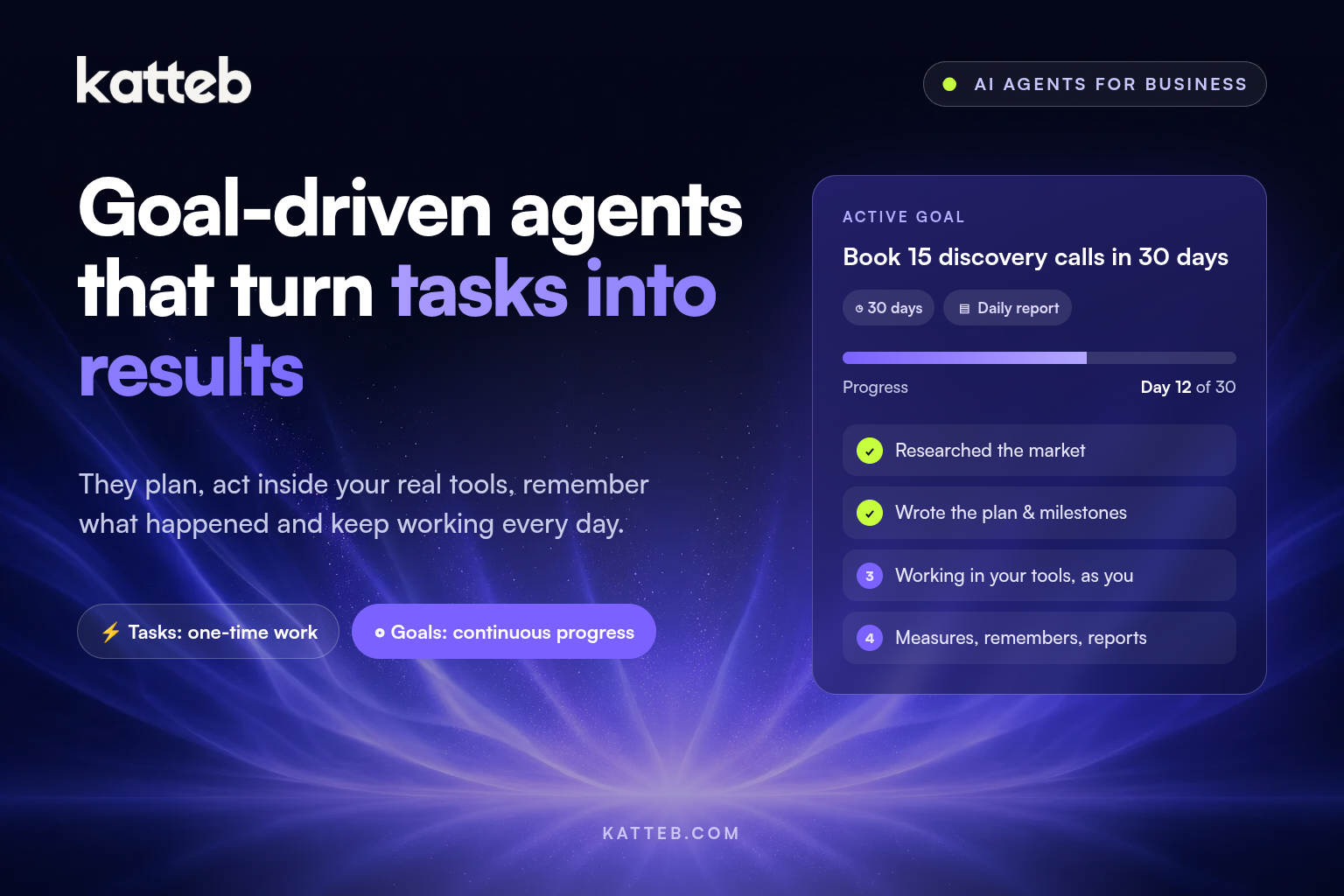
- AI agents for business are software workers that plan, act inside your real tools, remember what happened and keep going until an outcome is reached, instead of stopping after one answer.
- The useful split is between one-off tasks (pull a report, fill a form) and goals (book 15 calls in 30 days), which need a plan, a schedule, memory and an honest metric.
- Before you pick a platform, check five things: does it work in your own accounts, does it read numbers from your tools, does it remember contacts, does it respect sending limits, and does it report every day.
- Katteb lets you describe a goal in one sentence, writes the plan for free, then runs agents on a schedule for 14 to 180 days with a report every morning.
Most businesses have already tried AI. Someone on the team asks a chatbot to draft an email, summarise a call or brainstorm ten headlines, and it does a decent job. Then the window closes and nothing else happens. The email still has to be sent, the follow-up still has to be remembered, and next week somebody has to start the whole thing again from a blank prompt.
That gap between a good answer and a finished result is exactly what AI agents for business are meant to close. If you are comparing options right now, this guide explains what an agent actually does, where it earns its keep, how to judge one platform against another, and how Katteb’s goal-driven agents work in practice.
What an AI agent is, in plain business terms
An AI agent is a language model that has been given three things a chatbot lacks: the ability to take actions, a memory that survives between sessions, and a reason to keep working. Instead of producing text for you to act on, it opens the browser, signs in to the tools you already use, does the work and writes down what it did.
A practical way to think about it is the difference between a consultant and an employee. A consultant answers the question you asked and leaves. An employee owns an outcome, shows up again tomorrow, remembers what was tried last week and tells you when they are blocked. Business AI agents are useful to the degree they behave like the second one.
That definition rules out a lot of products that use the word “agent” in their marketing. A chatbot with a nicer interface is not an agent. A workflow tool that fires the same fixed sequence every time is automation, not an agent. The test is simple: can it decide the next step on its own, based on what happened in the last one, while staying inside the limits you set?
Tasks versus goals: the distinction that changes everything
When you start evaluating AI agents for your business, it helps to sort the work you want to hand off into two piles.
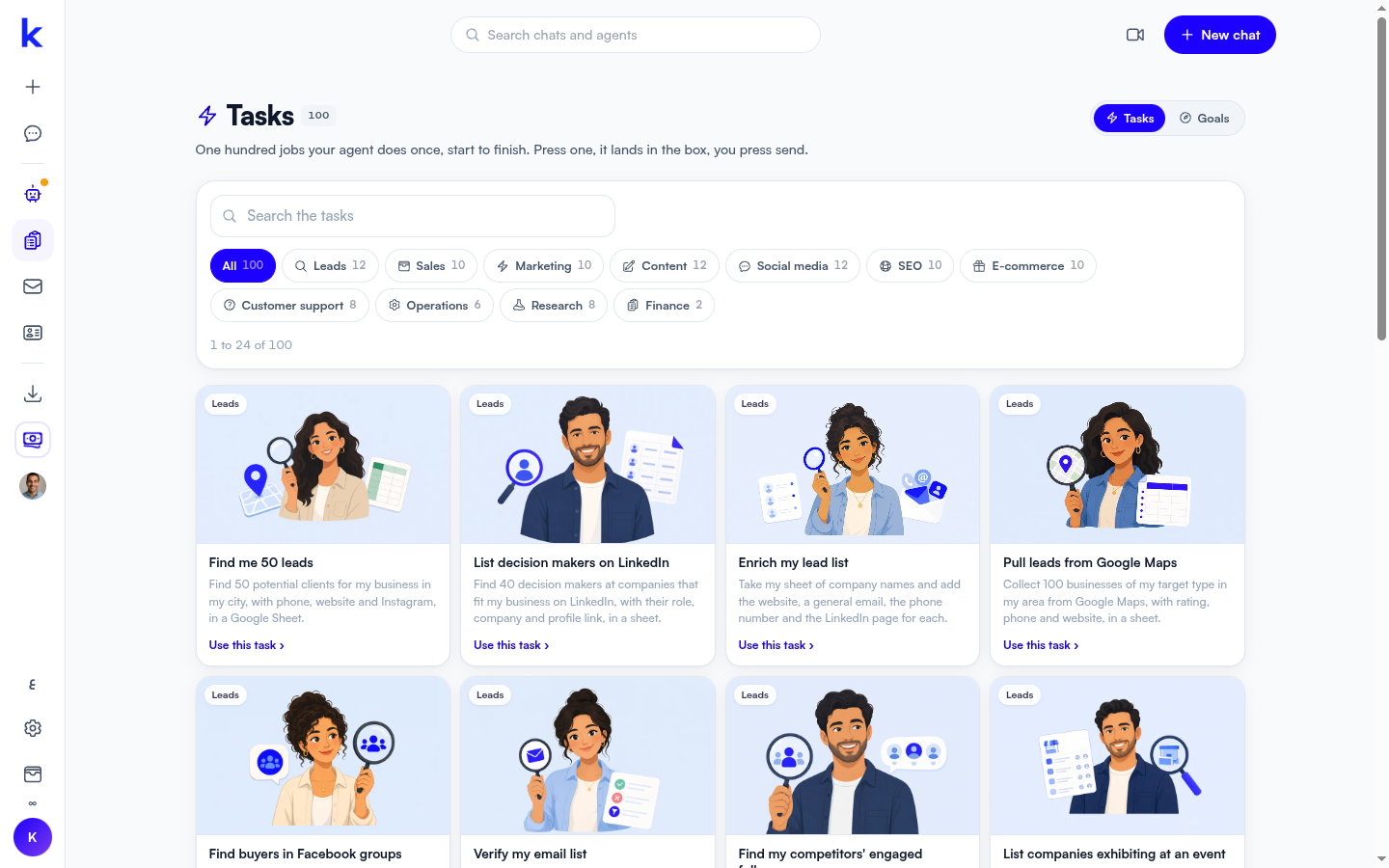
Tasks: one run, one result
A task is a single instruction with a clear end. “Pull last week’s Shopify sales into a Google Sheet.” “Find the contact email for these twenty companies.” “Rewrite this product page so it answers the delivery question at the top.” The agent runs once, delivers the result and stops. Nothing else happens until you ask again.
Tasks are the easiest place to start because the success criterion is obvious: either the sheet is filled or it is not.
Goals: an outcome, a number and a deadline
A goal is different in kind. “Book 15 sales calls in 30 days.” “Grow the store’s weekly sales 20% in 60 days.” “Bring in 50 qualified LinkedIn leads a week.” Nobody can achieve these in one sitting. They need research first, then a plan with milestones, then daily or hourly work, then a review of what is working and an adjustment when it is not.
This is where most AI tools fall apart, because they have no concept of tomorrow. A goal-driven agent, by contrast, is built around a metric it is trying to move and a calendar it is working against. Each run starts where the previous one stopped.
If your shortlist of platforms only handles tasks, you will end up being the project manager for your AI, re-briefing it every morning. That is still useful, but it is not the same as delegating an outcome.
Where AI agents pay off first
The best early use cases share a pattern: the work is repetitive, it happens inside web tools you already pay for, and progress can be counted. A few that consistently fit:
Lead generation and prospect research
Building a list of companies that match your ideal customer, finding the right decision maker at each, checking that the details are current and adding them to a sheet without duplicates is slow, careful work. An agent can review a hundred or more profiles in a session, keep only the ones that match the criteria you agreed, and write a short reason next to each so you can see why it was chosen.
Outreach and follow-up
Most deals are lost to silence, not to a competitor. An agent working from your own LinkedIn or email account can send first messages, follow up with people who did not reply, and, crucially, remember who it has already contacted so nobody gets the same pitch twice. A daily sending limit keeps the pace human and protects your accounts.
Ecommerce operations
Store owners hand agents jobs like rewriting product pages with weak copy, sending win-back emails to customers who have not ordered in 90 days, answering repetitive DMs about sizes and shipping, and reviewing best sellers and stock each week. Each of these feeds a number the owner already watches: orders, revenue, returning customers.
Paid ads housekeeping
Reading yesterday’s results, pausing ad sets whose cost per purchase is above your threshold and moving budget to the winners is a daily chore that rewards consistency more than brilliance. It is a natural fit for an agent that reads the numbers directly from the ads platform and reports what it changed.
Content and SEO
Keyword research, drafting articles, publishing them to WordPress and submitting them for indexing is a pipeline with many small steps across several tools. An agent can run that pipeline on a schedule, log which keywords are already covered so it never repeats one, and report how many pieces went live.
Notice what these have in common. None of them requires a brand-new piece of software. The agent works in the tools you already have, which is why setup is measured in minutes rather than months.
How to evaluate AI agent platforms for your business
The market is crowded and the demos all look impressive. These are the questions that separate a platform you can trust with real accounts from one that will create work for you.
1. Does it work inside your own accounts?
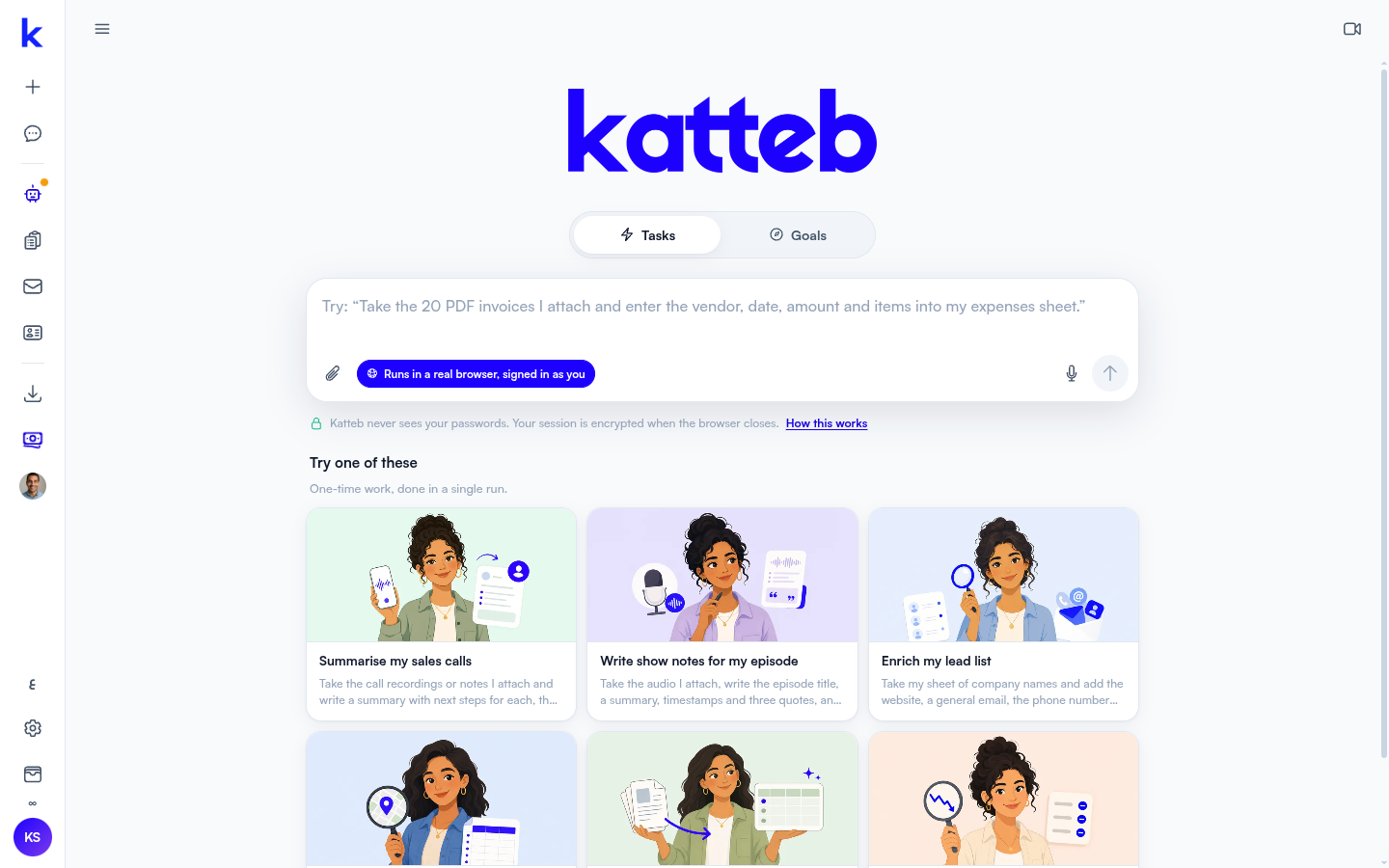
An agent that only produces text for you to copy is a chatbot. Ask whether it can operate a real browser signed in as you, in LinkedIn, Gmail, Shopify, Google Sheets, WordPress, your CRM and your ad accounts, without you building an API integration for each one.
2. Are the numbers read, or guessed?
An agent reporting “great progress” is worthless if the figure came from its own imagination. A trustworthy platform reads progress from the system of record, such as the CRM, the store dashboard or the analytics tool, and says plainly when it could not see a number rather than estimating one.
3. What does it remember?
Memory is what turns thirty separate runs into one campaign. Look for an agent that keeps track of what worked, what failed, which questions are waiting on you and what comes next, and that carries that memory forward when you change the plan.
4. What stops it from overdoing things?
Good guardrails are a feature, not a limitation. You want a daily cap on how many people it writes to, a rule that a contact is never messaged twice, and an automatic pause if runs keep failing, with an explanation of why. You also want it to stop and ask when it needs a decision only you can make.
5. How does it tell you what happened?
If you have to log in and dig through logs to find out what the agent did, you will stop checking within a week. The better pattern is a short daily report: what it did, what it learned, what is blocking it, what it will do next and anything it needs from you.
6. Can you change course in plain language?
Markets move. If the best responses are coming from operations managers rather than CEOs, you should be able to say so in one sentence and have the plan rewritten, without losing everything the agent has learned so far.
How Katteb’s goal-driven agents work
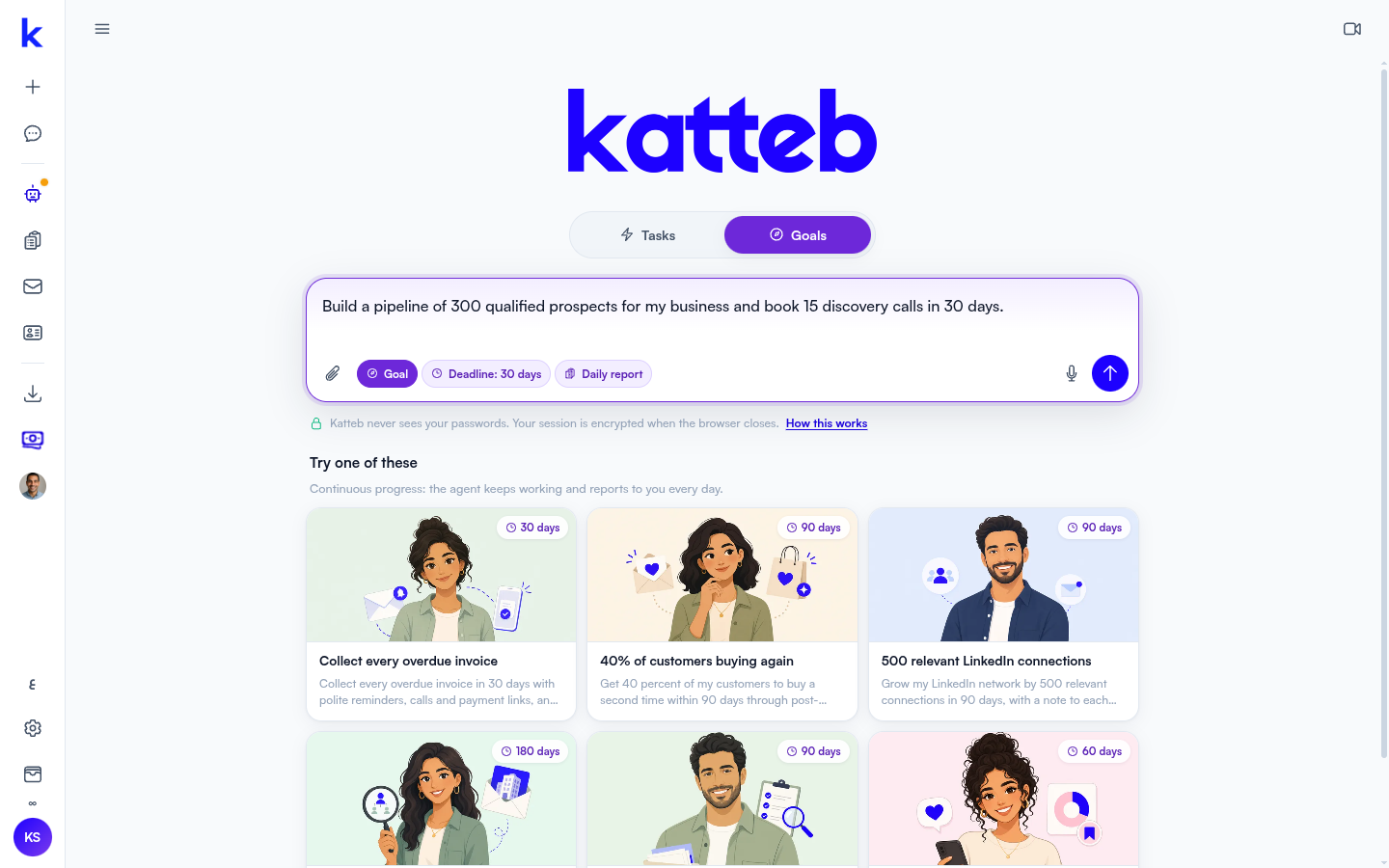
Katteb was built around the idea that most AI stops after one answer, while businesses need something that keeps working toward a result. It supports both modes described above: Tasks for one-time work and Goals for continuous progress. Here is what a goal looks like from start to finish.
Step 1: Say what should be true
You write one sentence with an outcome and a number, and choose a deadline of 14, 30, 60, 90 or 180 days. “Win 10 new B2B clients this quarter” is a complete brief.
Step 2: The agent studies your market
Before it plans anything, the agent searches the web to understand who buys, who makes the decision, what competitors charge and where your customers spend their time. That research shapes the plan rather than a generic template.
Step 3: It writes the plan, free
You get the outcome, the metric it will move, milestones with dates and up to three workflows that repeat every hour, day, week or month. For a B2B client goal that might be: find and score prospects daily, send messages and follow-ups daily, and review the pipeline weekly. You can read it, change it and only then press Start. Writing the plan costs nothing.
Step 4: It works in your tools, as you
Each run opens a real browser and works in the accounts you connected. It never contacts the same person twice and keeps to a daily sending limit, so your LinkedIn or inbox is not put at risk by an overenthusiastic script.
Step 5: It measures, remembers and reports
Progress is read from your own tools, never invented. What worked and what failed go into the goal’s memory, so day 20 starts where day 19 left off. At 8am in your time zone you get one report by email, Telegram or Slack, and the same report waits in the goal’s thread inside Katteb. A quiet day sends nothing, so every report is worth opening.
If you need to steer, you type the change in the goal’s thread, for example “focus on logistics companies in Dubai from now on”, and the agent writes a new version of the plan while keeping its memory. You can pause, resume or stop at any time, and if a run fails three times in a row the goal pauses itself and tells you why.
Examples of goals businesses run with agents
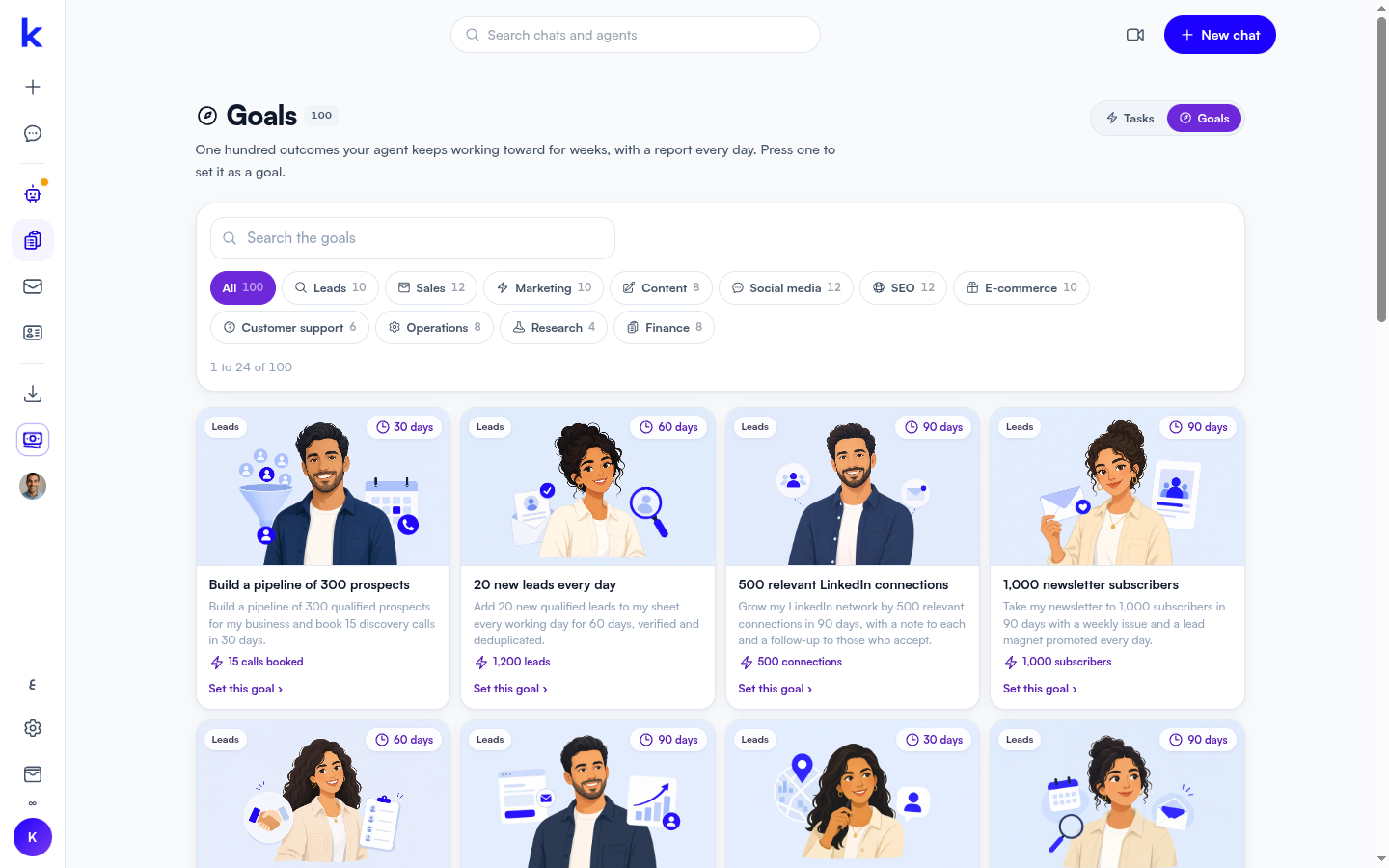
Katteb publishes a library of a hundred goals people ask for most. A few that show the range:
- Build a pipeline of 300 prospects and book 15 discovery calls in 30 days.
- Add 20 new qualified leads every working day for 60 days, verified and deduplicated.
- Answer every new inquiry within an hour for 30 days and log the response time and outcome of each.
- Reactivate 50 dormant customers who have not bought in a year, within 60 days.
- Double website traffic in 90 days with weekly content, daily social posts and technical fixes.
- Take ad campaigns to 3x return on ad spend in 60 days by testing creatives weekly and cutting what does not work daily.
No outcome is guaranteed, and a good agent will tell you honestly when a goal is behind schedule. What changes is that the work actually happens every day, and you can see it.
Choosing between a single agent and a team of agents
A solo founder with one pressing outcome, such as the first ten paying customers, is usually best served by one agent focused on one goal. Katteb’s entry plan covers that: goals start one at a time.
Once several outcomes matter at the same time, for example leads, store sales and ad efficiency, it makes sense to run them in parallel so that each has its own plan, memory and report. Katteb’s Goals plan runs up to ten agents at once, with hourly schedules, memory, a daily report and landing pages with lead forms. The right choice depends less on company size and more on how many measurable outcomes you want moving this quarter.
Common mistakes when rolling out AI agents
- Vague goals. “Grow the business” gives the agent nothing to measure. “50 qualified leads a week from LinkedIn” does.
- Skipping the plan review. The plan is free to write and takes minutes to read. Correct the ideal customer or the tone before the first message goes out, not after.
- Ignoring the “I need from you” line. Agents get blocked by things only you can provide, such as a price list, approval for a discount or two customer videos. Answering quickly is often the biggest lever on results.
- Measuring activity instead of outcomes. Messages sent is a means; calls booked or orders placed is the end. Point the metric at the end.
- Turning off the guardrails. Sending limits and the no-duplicate rule protect your accounts and your reputation. They are worth more than a slightly faster week.
Is your business ready for AI agents?
You are ready if you can answer three questions: what outcome do you want, how will you count it, and by when. You do not need an engineering team, a data warehouse or a new stack. If the work happens in web tools you already use and the result shows up as a number somewhere, an agent can start on it this week.
The fastest way to find out is to describe one goal and read the plan an agent writes for it. Because the plan is free, it is a low-risk way to see whether the approach fits how your business actually works.
Give Katteb a goal and get the plan, free
Write one sentence with an outcome, a number and a deadline. Katteb’s agent studies your market, writes the milestones and workflows, and starts only when you press Start.
Frequently asked questions
What is the difference between AI agents and AI automation?
Automation runs the same fixed steps every time. An AI agent decides the next step based on what happened in the last one, remembers results between runs and adjusts the plan toward a goal, within limits you set.
Do AI agents need access to my passwords?
Katteb agents work in a real browser in the accounts you connect, so they act as you inside tools like LinkedIn, Gmail or Shopify. You choose which accounts are connected, and you can pause or stop a goal at any time.
How long should a business goal run?
Katteb goals run for 14, 30, 60, 90 or 180 days. Short horizons suit quick wins like answering every inquiry within an hour; longer ones suit pipelines, wholesale buyers or corporate accounts.
Will an AI agent guarantee results?
No honest platform guarantees an outcome. What a goal-driven agent guarantees is consistent daily work, numbers read from your own tools and a clear report on whether the goal is on track or behind.
Can I change the goal after it starts?
Yes. Type the change in the goal’s thread in one sentence. The agent writes a new version of the plan and keeps everything it has learned so far.
AI agents for business are worth adopting when they behave like a dependable teammate: clear on the outcome, honest about the numbers and still working tomorrow. Start with one goal on Katteb and judge it by the first week of morning reports.

About Ahmed Ezat
Ahmed Ezat is the founder behind Katteb, an AI writing and SEO platform built to help businesses create fact-checked, search-ready content that ranks in both traditional search and AI-powered results. With more than a decade of hands-on experience in SEO, SaaS, and digital marketing, Ahmed has launched and scaled multiple AI products serving hundreds of thousands of users across the MENA region and globally.