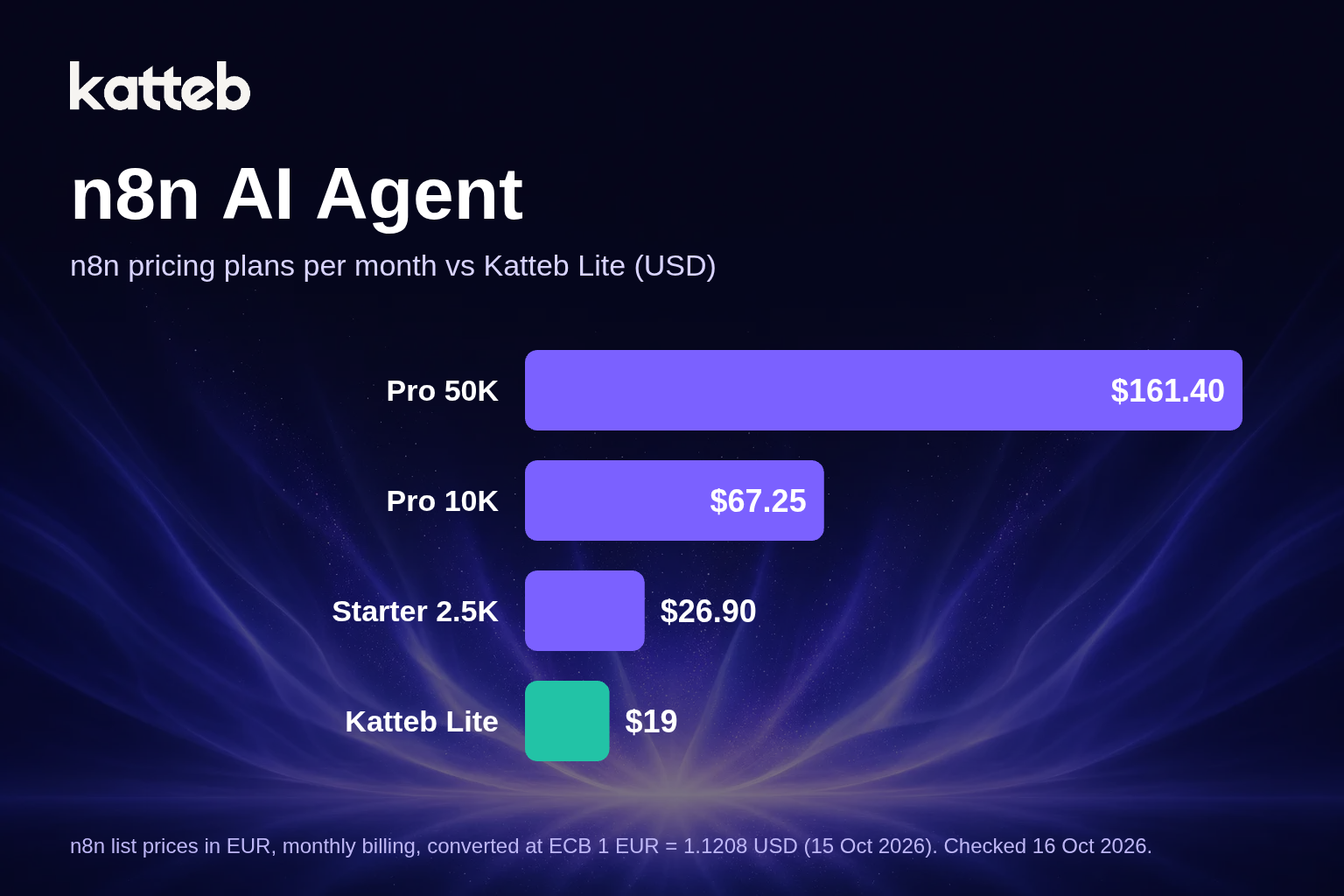
TL;DR. n8n sells workflow automation by the execution: one full run of a workflow, however many steps it has. On 16 October 2026 the n8n pricing page listed its plans in euros: Starter at €24 a month (or €20 a month billed annually) for 2,500 executions, Pro at €60 (€50 annually) for 10,000 or €144 (€120 annually) for 50,000, and the self-hosted Business plan from €800 (€667 annually) for 40,000. The self-hosted Community Edition is free. n8n runs the workflow you design; it does not decide what to research, read a page the way a person would, or write the judgement call at the end. Below are six priced scenarios, in euros with a US dollar conversion at the ECB reference rate of 15 October 2026 (1 EUR = 1.1208 USD), list price, taxes not included, with the arithmetic shown.
People who type “n8n pricing plans” into Google are rarely browsing. They have a workflow in mind, often several, and they want to know which tier holds it before the free trial ends. The hard part is that n8n does not bill the way most automation tools do. It does not count steps or tasks; it counts executions, and the number you need depends far more on how often a workflow fires than on how complicated it is.
This guide works through that arithmetic. It explains what an execution is and how schedules and webhooks turn into a monthly count, lists every plan the pricing page showed on the day we checked, and then prices six realistic jobs. For each one it also asks a second question: is this a job for a workflow engine at all, or is it a job for an agent like Katteb that opens a real browser, reads, and reports back? Sometimes the honest answer is that n8n is the right tool and Katteb adds nothing. We say so where that is the case.
Have a job that is more reading than wiring?
Tell Katteb the outcome in one sentence, for example “every Monday, check the pricing pages of my five competitors and send me what changed”. The agent does the browsing and writes the report, with no workflow to build.
What does n8n actually charge for?
n8n charges for workflow executions. The pricing page defines one execution as a single run of an entire workflow, from trigger to last node. A workflow with three nodes and a workflow with forty nodes both cost one execution per run, and so does a run that loops over a thousand items. That is the core of n8n’s pitch against tools that bill per step, and it is a real difference: a long enrichment workflow that would burn hundreds of tasks elsewhere is a single unit here.
What the execution model does not protect you from is frequency. A workflow that runs once a day costs about 30 executions a month. The same workflow on a five-minute schedule costs about 8,640. n8n’s own FAQ uses those exact examples, and they are the single most useful thing to understand before you choose a tier.
How schedules and webhooks turn into a monthly number
- Scheduled workflows: count the runs. Daily is 30 or 31. Hourly is about 720. Every 15 minutes is 2,880 in a 30-day month. Every 5 minutes is 8,640.
- Webhook workflows: one execution per incoming event. A form that receives 200 submissions a day is about 6,000 executions a month.
- Chat and agent workflows: one execution per message or per conversation turn that triggers the workflow, depending on how you build it.
- Sub-workflows and error workflows: plan for them as their own runs when you estimate, since they are triggered separately.
Add the workflows together and you have the figure to compare against each plan’s allowance.
n8n pricing plans on 16 October 2026
All prices below are as displayed on the n8n pricing page on 16 October 2026, in euros, before any tax the checkout may add. The page offers a monthly/annual toggle and labels annual billing “Save 17%”. We read the monthly and annual figures for each execution tier from the plan dropdowns.
| Plan | Executions / month | Monthly billing | Annual billing (per month) | Hosting |
|---|---|---|---|---|
| Starter | 2,500 | €24 | €20 | n8n Cloud |
| Pro | 10,000 | €60 | €50 | n8n Cloud |
| Pro | 50,000 | €144 | €120 | n8n Cloud |
| Business | 40,000 | €800 | €667 | Self-hosted |
| Business | 100,000 | €1,726 | €1,438 | Self-hosted |
| Business | 500,000 | €5,245 | €4,371 | Self-hosted |
| Enterprise | Custom | Contact sales | Contact sales | Cloud or self-hosted |
| Community Edition | No plan limit | Free | Free | Self-hosted |
Some details that change the maths:
- Starter includes 1 shared project, 5 concurrent executions, agents, MCP and AI nodes, and 1,600 Assistant credits a month. Maximum execution duration is listed as 5 minutes and log retention as 7 days.
- Pro adds 3 shared projects, up to 50 concurrent executions, admin roles, workflow history and metric-based evaluations, with a 40-minute maximum execution duration.
- Business is self-hosted only. It adds SSO and LDAP, multiple environments, Git version control and queue mode. Companies under 20 employees may qualify for a Start-up Plan at 50% off Business, according to the page.
- The free trial of n8n Cloud includes 1,000 executions, 5 concurrent executions and a 180-second execution timeout, with no credit card required.
- Community Edition is free to self-host. The n8n documentation lists what it omits: projects, sharing, SSO, environments, external secrets and Git version control, among others. You pay for your own server instead, which we do not price here.
Why the currency matters
When we loaded the pricing page, including through a US network exit, it showed euros. Katteb bills in US dollars. To compare the two we convert at the ECB euro reference rate for 15 October 2026, the latest published on the day we checked: 1 EUR = 1.1208 USD. Your card issuer will use its own rate and may add a fee, so treat every dollar figure below as an approximation that moves with the exchange rate.
| n8n price | In USD at 1.1208 |
|---|---|
| €24 / month (Starter monthly) | $26.90 |
| €240 / year (Starter annual) | $268.99 |
| €60 / month (Pro 10K monthly) | $67.25 |
| €600 / year (Pro 10K annual) | $672.48 |
| €144 / month (Pro 50K monthly) | $161.40 |
| €1,440 / year (Pro 50K annual) | $1,613.95 |
What Katteb costs, and what it is
On the Katteb pricing page on 16 October 2026, Lite was $19 a month or $190 a year, billed in US dollars. It includes one agent working on a goal every day, week or month (the page notes “no hourly”), 30 hours of agent time a week, unlimited chat, images and video within fair use, and one-press tasks. Business is $99 a month or $990 a year, with 10 agents, 120 hours a week and hourly schedules.
The two products overlap less than their marketing suggests. n8n is a deterministic engine: you draw the workflow, it runs it the same way every time, at whatever frequency you set, and it connects to hundreds of services through nodes. Katteb is an agent: you describe an outcome, and it opens a browser, searches, reads pages, fills forms and writes the report. It has no canvas and no nodes. That means some jobs belong clearly to one side, and a few sit in the middle where either can do them.
Which jobs belong to n8n, and which to an agent?
| Job shape | Better fit | Why |
|---|---|---|
| React to an event within seconds (form, payment, webhook) | n8n | Event triggers and real-time runs are what it is built for |
| Move records between two systems the same way every time | n8n | Deterministic mapping, retries and logs |
| Run something every few minutes | n8n | Katteb Lite schedules are daily, weekly or monthly |
| Read a set of web pages and say what changed or what matters | Katteb | Reading and judging is the work; no selectors to maintain |
| Research a list of companies or people and write notes | Katteb | Each item needs searching and reading, not a fixed call |
| Weekly report that combines several sources into prose | Either | n8n with an AI node, or an agent; compare the build time |
The middle row is where the price comparison is interesting, because both tools can produce the same output and the cost of getting there differs.
Want the report without building the workflow?
Katteb Lite is $19 a month. Give it a weekly or daily job in plain English and it reports back in your thread.
Six priced scenarios
Assumptions for every scenario, unless the scenario says otherwise: list prices on 16 October 2026; euros converted at 1.1208; taxes excluded; data-vendor API fees that an n8n workflow may call (scrapers, enrichment, model keys beyond n8n’s included credits) excluded; your own build and maintenance time excluded from the n8n side unless stated; staff time valued at $30 an hour where a break-even is shown.
Scenario A: a weekly competitor digest and a daily check (about 35 executions)
A founder wants two things: a Monday summary of what changed on five competitors’ pricing pages, and a daily look at new reviews on one review site. In n8n that is two workflows, one weekly (about 4 runs) and one daily (about 30 runs), roughly 35 executions a month. That fits comfortably in Starter.
| Option | Monthly | Annual |
|---|---|---|
| n8n Starter, monthly billing | €24 ≈ $26.90 | €288 ≈ $322.79 |
| n8n Starter, annual billing | — | €240 ≈ $268.99 |
| Katteb Lite | $19 | $190 |
Result: Katteb Lite is $7.90 a month less than Starter on monthly billing ($26.90 − $19), or $78.99 a year less on annual billing ($268.99 − $190). That holds only under three conditions: the job really is reading public pages and writing a summary, which an agent does without a scraper node; you do not need n8n’s integrations to push the result into other systems; and the n8n version would not need a paid scraping or model service on top, which would widen the gap. If you self-host the free Community Edition and already run a server, the n8n licence cost is €0 and Katteb is $19 a month extra. At $30 an hour, it earns that back only if it saves you more than 38 minutes a month of building, fixing selectors and reading output.
Scenario B: what polling frequency costs (2,160 to 8,640 executions)
A team polls an inbox or an API for new items. The schedule decides the plan:
| Schedule (30-day month) | Executions | Smallest plan that fits | Monthly price |
|---|---|---|---|
| Every 20 minutes | 2,160 | Starter (2,500) | €24 ≈ $26.90 |
| Every 15 minutes | 2,880 | Pro 10K | €60 ≈ $67.25 |
| Every 5 minutes | 8,640 | Pro 10K | €60 ≈ $67.25 |
Result: moving one workflow from every 15 minutes to every 20 minutes keeps you on Starter, which is €36 a month less (€60 − €24), about $40.35. We do not compare Katteb here: minute-level polling is a workflow engine’s job, and Katteb Lite does not run hourly schedules.
Scenario C: a webhook form intake (6,000 executions)
A clinic’s booking form posts 200 submissions a day to a webhook; each run validates the data, writes a CRM record and sends a confirmation. That is about 6,000 executions a month: too many for Starter, well inside Pro 10K.
Result: Pro 10K costs €60 a month (≈ $67.25) on monthly billing or €600 a year (≈ $672.48) on annual. There is no fair Katteb comparison: the job must react within seconds to each event and behave identically every time. An agent is the wrong tool, and we would not suggest replacing this workflow with one.
Scenario D: an agency running 45,000 executions
An agency runs client workflows that add up to about 45,000 executions a month. Two plans hold that volume: Pro at the 50K tier on n8n Cloud, and Business at the 50K tier, self-hosted.
| Plan | Monthly billing | Annual billing (12 months) |
|---|---|---|
| Pro 50K | €144 | €1,440 |
| Business 50K | €985 | €9,852 (12 × €821) |
Result: Pro 50K is €841 a month less than Business 50K on monthly billing, or €8,412 a year less on annual billing. That is true only if the agency does not need what Business adds (SSO, LDAP, Git version control, multiple environments, queue mode) and is fine with n8n hosting the instance. Business also carries your own hosting cost, which widens the gap. Katteb is not a substitute for 45,000 automated runs and is not compared.
Scenario E: monthly or annual billing
| Plan | 12 × monthly | Annual | Difference |
|---|---|---|---|
| Starter | €288 | €240 | €48 ≈ $53.80 |
| Pro 10K | €720 | €600 | €120 ≈ $134.50 |
| Pro 50K | €1,728 | €1,440 | €288 ≈ $322.79 |
Result: annual billing is 17% less on each tier, matching the label on the page. The equivalent figure for Katteb Lite is $228 a year on monthly billing against $190 on annual, $38 less. Commit to annual only when you know the workflow will still be running in a year; otherwise the monthly premium is the price of being able to stop.
Scenario F: n8n for the plumbing, an agent for the judgement
A sales team uses n8n Pro 10K to sync form leads into its CRM (Scenario C). Before a rep calls, someone reads the lead’s company website and recent news and writes three lines of context. That research is not a fixed API call: every company’s site is different, and the useful part is the judgement.
Result: n8n Pro 10K on annual billing (€600 ≈ $672.48) plus Katteb Lite annual ($190) totals about $862.48 a year. Katteb here is an addition, not a replacement, so the question is only whether $190 a year buys back enough time. At $30 an hour it breaks even at about 6 hours 20 minutes a year ($190 ÷ $30), roughly 32 minutes a month. If the research takes a rep ten minutes per lead and there are more than a handful of leads a month, it clears that comfortably; if there are three leads a month, it does not.
Pair your workflows with an agent that reads
Keep n8n for the wiring. Hand Katteb the research and the write-up, for example “for every new lead in today’s sheet, read their website and write three lines a rep can use”.
Where the data layer breaks, and why that matters for cost
Most n8n workflows that touch the open web depend on a data step: a scraper, an enrichment service or a social endpoint supplying the rows. That step belongs to someone else, and it fails quietly. A restricted page returns a login wall with a normal success code. A rate-limited call returns a shorter list instead of an error. A changed layout returns an empty field, and the next node writes that empty string over good data in your CRM.
None of this shows up on the n8n invoice, but it is the real cost of a web-reading workflow: the vendor fee for the data step, plus the hours spent noticing and fixing breakage. Two practical habits help on the n8n side:
- Assert on the field you consume, not the status code. One IF node that checks the value you will actually write, with a stop-and-error branch, catches most silent failures.
- Filter before you enrich. Put the cheap, per-company checks first so the expensive per-person or per-result calls only run on rows that qualify.
An agent sidesteps part of this because it reads the page the way a person does, so a layout change is not a broken selector. It does not sidestep everything: an agent can still hit a sign-in wall or a site that blocks automated visitors, and it is slower than an API call when you need thousands of identical records. That is why we keep it to the jobs where reading and judging is the work.
When n8n is the right choice on its own
- The work is triggered by events and must run within seconds.
- The same transformation runs thousands of times and must be identical each time.
- You need to connect many internal systems, with credentials stored in one place and logs you can audit.
- You have someone who enjoys building and maintaining workflows, which makes the free Community Edition hard to beat on licence cost.
When an agent is the better fit
- The job is mostly reading: competitor pages, reviews, job boards, directories, news.
- Each item needs a different path to the answer, so a fixed workflow keeps breaking.
- The output is prose or a judgement (a summary, a shortlist, a reply draft) rather than a record update.
- Nobody on the team wants to own a workflow, and the job runs daily or weekly, not every few minutes.
How to choose a tier in five minutes
- List every workflow and its trigger. Convert each to runs a month using the schedule table above.
- Add 20% for retries, tests and error workflows, then pick the smallest tier above the total.
- Check the limits that are not executions: concurrency (5 on Starter), execution duration (5 minutes on Starter), and shared projects.
- Decide whether you need Business features. If not, Pro’s 50K tier is a fraction of Business’s price for similar volume.
- Mark every workflow whose main job is reading the web and writing something. Price those against an agent before you build them.
Frequently asked questions
Is n8n free?
The self-hosted Community Edition is free to use, with some features reserved for paid plans. n8n Cloud has a free trial with 1,000 executions and no card required, then paid plans from €24 a month (€20 a month billed annually) on the day we checked.
Does a workflow with more steps cost more?
No. n8n bills per full execution regardless of the number of steps, according to its pricing page. Frequency, not complexity, drives the bill.
Are n8n prices in dollars?
The page we loaded showed euros, including through a US network exit. We converted at the ECB reference rate of 15 October 2026; your actual dollar charge depends on your card’s rate and fees.
Can Katteb replace n8n?
For event-driven, high-frequency or record-moving workflows, no, and we would not recommend trying. For daily or weekly jobs that are mostly reading web pages and writing a result, Katteb Lite at $19 a month can do the job without a workflow, as priced in Scenario A.
Sources and date checked
- n8n pricing page (plans, execution tiers, monthly and annual prices, trial terms), read 16 October 2026.
- n8n docs: Compare editions, read 16 October 2026.
- ECB euro reference rate, USD, observation for 15 October 2026 (1.1208).
- Katteb pricing, read 16 October 2026.
- Monid guide on the n8n data layer, used for structure only.
The short version
n8n pricing plans are about frequency: count runs, not steps. Starter at €24 a month holds a few daily and weekly workflows; Pro’s 10K and 50K tiers cover most teams; Business is for self-hosted companies that need SSO and environments. Annual billing takes 17% off. Keep n8n for event-driven and high-volume plumbing. For the daily and weekly jobs that are really about reading the web and writing something useful, give Katteb the job in one sentence and compare the time it saves with the $19 a month it costs.

About Ahmed Ezat
Ahmed Ezat is the founder behind Katteb, an AI writing and SEO platform built to help businesses create fact-checked, search-ready content that ranks in both traditional search and AI-powered results. With more than a decade of hands-on experience in SEO, SaaS, and digital marketing, Ahmed has launched and scaled multiple AI products serving hundreds of thousands of users across the MENA region and globally.