TL;DR. On 14 October 2026 the OpenRouter pricing page listed four tiers: Free (25+ free models, 50 requests a day), Standard pay as you go with a 5.5% fee on credit purchases, Business pay as you go with an 8% fee, and Enterprise on contract. Model tokens are billed at each provider’s list price on every tier, with no annual plan and no discount on inference. An OpenRouter key buys model calls; it does not buy a browser, signed-in sessions, a schedule or memory. Below are five priced scenarios comparing OpenRouter used directly with a ready-made agent such as Katteb. All figures are in US dollars, per month and before tax unless stated.
People type “openrouter pricing” into Google for two different reasons. The first group are developers who already call one model provider and want to know what it costs to put a router in front of it: is there a markup, what is the fee, and what happens to the bill at volume. The second group are founders, marketers and operators who keep hearing that OpenRouter gives you “every AI model with one key” and want to know whether that key is all they need to run an AI agent for their business.
Both questions have clear answers, and they are different answers. For the developer, OpenRouter’s pricing is unusually transparent: provider list prices plus a fee when you top up. For the operator, the more important fact is what the key does not include. A model is the reasoning half of an agent. The other half, the part that opens pages, signs in, remembers what happened last week and sends a report on Monday, has to come from somewhere else. This article prices both halves, using numbers read from OpenRouter’s own pricing page, its public models list and its documentation on 14 October 2026, and it says plainly where an agent costs more than the API.
Want the agent, not just the model key?
Describe the job in one sentence, for example “every Monday, check these 20 competitor pages and send me what changed”. Katteb picks the model for each step, works in a real browser and reports back.
How does OpenRouter pricing work?
OpenRouter sells access to models from many providers through one OpenAI-compatible API. On 14 October 2026 its public models endpoint returned 462 models, 14 of them free variants. You do not subscribe to OpenRouter in the usual sense. You buy credits, and every request deducts its cost from the balance at the provider’s posted per-token rate. OpenRouter’s income is a fee charged at the moment you buy credits, not a markup on each request. The pricing page states this directly: inference is billed at the provider’s list price on every plan.
| Tier | How you pay | OpenRouter fee | Models | Rate limits |
|---|---|---|---|---|
| Free | No purchase | N/A | 25+ free models, 4 free providers | 20 requests/minute, 50/day on free models |
| Standard | Pay as you go (card, AliPay, USDC) | 5.5% on credit purchases | 500+ models, 80+ providers | Passed through from providers |
| Business | Pay as you go, self-serve upgrade | 8% on credit purchases | 500+ models, 80+ providers | Passed through from providers |
| Enterprise | Contract, invoicing, prepaid commitments | Discounts available | 500+ models | Higher allowances |
The fee is on the top-up, not on the request
This is the detail most comparisons get wrong. If you buy $100 of credits on Standard, you pay $105.50 and get $100 of balance. A request that costs $0.06 at the provider’s list price deducts exactly $0.06. That makes the effective cost of everything you run through OpenRouter list price × 1.055 on Standard and list price × 1.08 on Business. The pricing page does not show a separate minimum fee per purchase, so the scenarios below apply the percentage only. If your card statement shows a different figure on small top-ups, use that instead.
Two other billing rules matter for agents. First, failed attempts are not charged for their model tokens: if OpenRouter falls back from one provider to another, you pay only for the attempt that answered. Second, streaming does not change the price. A token is a token whether it arrives all at once or word by word.
What do the popular models cost per million tokens?
These are the per-million-token prices returned by OpenRouter’s public models list on 14 October 2026. Input and output are priced separately, and output is usually five to six times more expensive, which is why agents that “think out loud” cost more than agents that read a lot and write little.
| Model (OpenRouter id) | Input $/1M tokens | Output $/1M tokens | Context |
|---|---|---|---|
| anthropic/claude-sonnet-5.5 | $2.00 | $10.00 | 1M |
| anthropic/claude-haiku-5.5 | $0.10 | $0.50 | 1M |
| anthropic/claude-opus-5.5 | $4.00 | $20.00 | 1M |
| openai/gpt-5.6-luna | $0.20 | $1.20 | 1.05M |
| openai/gpt-5.6-terra | $2.00 | $12.00 | 1.05M |
| google/gemini-3.8-flash | $0.75 | $3.75 | 1.05M |
Most models also have a :batch variant at half the price, for jobs that can wait. Prices change when providers change them; OpenRouter’s FAQ says a repriced model keeps serving and you are simply charged the new rate, so a cost estimate is only as current as the day you read the list.
Free models and their caps
The Free tier is genuinely free, but capped: 20 requests a minute and 50 requests a day on free models. Once an account has bought at least $10 of credits, the daily cap on free models rises to 1,000 requests. Failed attempts count toward that cap, and a negative balance blocks free models until you top up. For a student or a hobby project, a single $10 purchase ($10.55 with the Standard fee) is the cheapest way to get a usable daily allowance.
Web search and other tools
OpenRouter can attach a web search tool to any model. Its documentation lists the Exa engine at $0.007 per request in its instant, fast and auto modes (up to 10 results included), and $0.012 for the deeper modes; Parallel’s engine runs $1 to $5 per 1,000 requests depending on mode. These charges come out of the same credit balance. Search is the one “tool” OpenRouter sells by the call; everything else an agent does outside the model is your job to supply.
What does an OpenRouter key buy, and what does it not buy?
It helps to split an AI agent into its parts and ask which ones a model key covers.
- Reasoning and writing. Covered. This is what OpenRouter sells: hundreds of models, one API, one bill, fallbacks when a provider is down.
- Web search. Partly covered, through the paid search tool above.
- The agent loop. Not covered. Something has to decide the next step, call the model again, parse its answer and stop when the job is done. That is code you write or a framework you host.
- A browser and signed-in sessions. Not covered. Reading a dashboard behind a login, filling a form, uploading a file or posting from your account needs a real browser that holds your sessions.
- Schedules, memory and reports. Not covered. “Every Monday” needs a scheduler; “do not contact the same person twice” needs storage; “tell me what changed” needs a report somewhere you will read it.
None of this is a criticism of OpenRouter. A router that only routes is doing its job well. The practical consequence is that the OpenRouter bill is the smallest line of a self-built agent’s cost for most small teams. The larger lines are engineering time and hosting, and those are the lines a ready-made agent replaces.
What is an OpenRouter AI agent?
The phrase is used in two ways. The first is an agent built on OpenRouter: a developer writes the loop, plugs in tools and lets OpenRouter supply the models, often switching models per step to save money (a cheap model for reading, an expensive one for the final answer). The second is an agent that does the work around OpenRouter-style model access for someone who does not want to build anything: you describe an outcome and the agent picks the model, opens the pages and reports. Katteb is the second kind. It chooses the model for each step itself, so you never compare token prices, and it runs in a real browser on its servers.
Which one you need depends on whether you are shipping software or getting a job done. If an AI feature lives inside your own product and runs thousands of times a day, you need an API and OpenRouter is a strong choice. If the job is yours, recurring and involves websites, you need an agent, and a model key alone will not run it.
Seven use cases for an AI agent around OpenRouter
- Model selection and cost testing. Run the same prompt through Haiku, Gemini Flash and Sonnet, compare quality against cost, and keep a table of which model is good enough for each task.
- Weekly competitor monitoring. Open competitor pricing and feature pages, compare them with last week’s copy and report only the changes. This needs a browser and memory, not just a model.
- Research briefs with citations. Search, read ten sources, and write a brief with links. OpenRouter’s search tool covers the search; an agent covers reading pages that search snippets miss.
- Content production. Draft, check facts against the source pages and publish to a CMS you are signed into. The publishing step is where a model key stops.
- Lead research. Visit a company’s site, find the team page, summarise what it sells and draft a first message. Each step is a page visit plus a short model call.
- Support inbox triage. Read new messages, classify them, draft replies for approval. A developer would wire this with OpenRouter and a mail API; an operator would hand it to an agent.
- Spend monitoring for your own OpenRouter account. Read the activity export each week and flag the models or keys whose spend jumped. OpenRouter’s budgets and key limits do the enforcing; the agent does the explaining.
Run one of these jobs this week
Pick the use case that costs you the most hours, write it as one instruction, and let Katteb run it on a schedule. You see every step it took in the thread.
OpenRouter pricing vs Katteb: five scenarios with the arithmetic
Assumptions for every scenario. Currency: US dollars. Period: one month unless stated. Prices: list prices read on 14 October 2026 from the OpenRouter pricing page, OpenRouter’s public models list and its web search documentation, and the Katteb pricing page (Lite $19 a month or $190 a year, 30 hours of agent time a week; Business $99 a month). Taxes excluded. OpenRouter cost = token cost at list price × 1.055 (Standard fee), with no prompt caching and no batch discount. A person’s time is valued at $30 an hour where a break-even is shown. The cost of writing, hosting and maintaining your own agent code and browser is excluded from the OpenRouter side, which flatters OpenRouter; treat each OpenRouter figure as a floor.
Scenario A: a founder’s research assistant
A founder sends 100 research questions a month. Each request reads about 20,000 input tokens and writes 2,000 output tokens on Claude Sonnet 5.5, and uses three web searches.
- Tokens per request: 20,000 × $2 / 1M = $0.04 input, plus 2,000 × $10 / 1M = $0.02 output = $0.06.
- 100 requests = $6.00. Searches: 3 × $0.007 × 100 = $2.10.
- Usage $8.10 × 1.055 = $8.55 a month on OpenRouter.
- Katteb Lite: $19 a month.
Result: OpenRouter costs $10.45 a month less. Katteb is an extra cost here, and it is worth it only if it saves more than about 21 minutes of the founder’s time a month ($10.45 ÷ $30 per hour), for example by opening pages search snippets do not cover or by running the questions on a schedule. If the founder is happy typing questions into a chat window, OpenRouter alone is the cheaper route.
Scenario B: a recurring agent loop, priced on three models
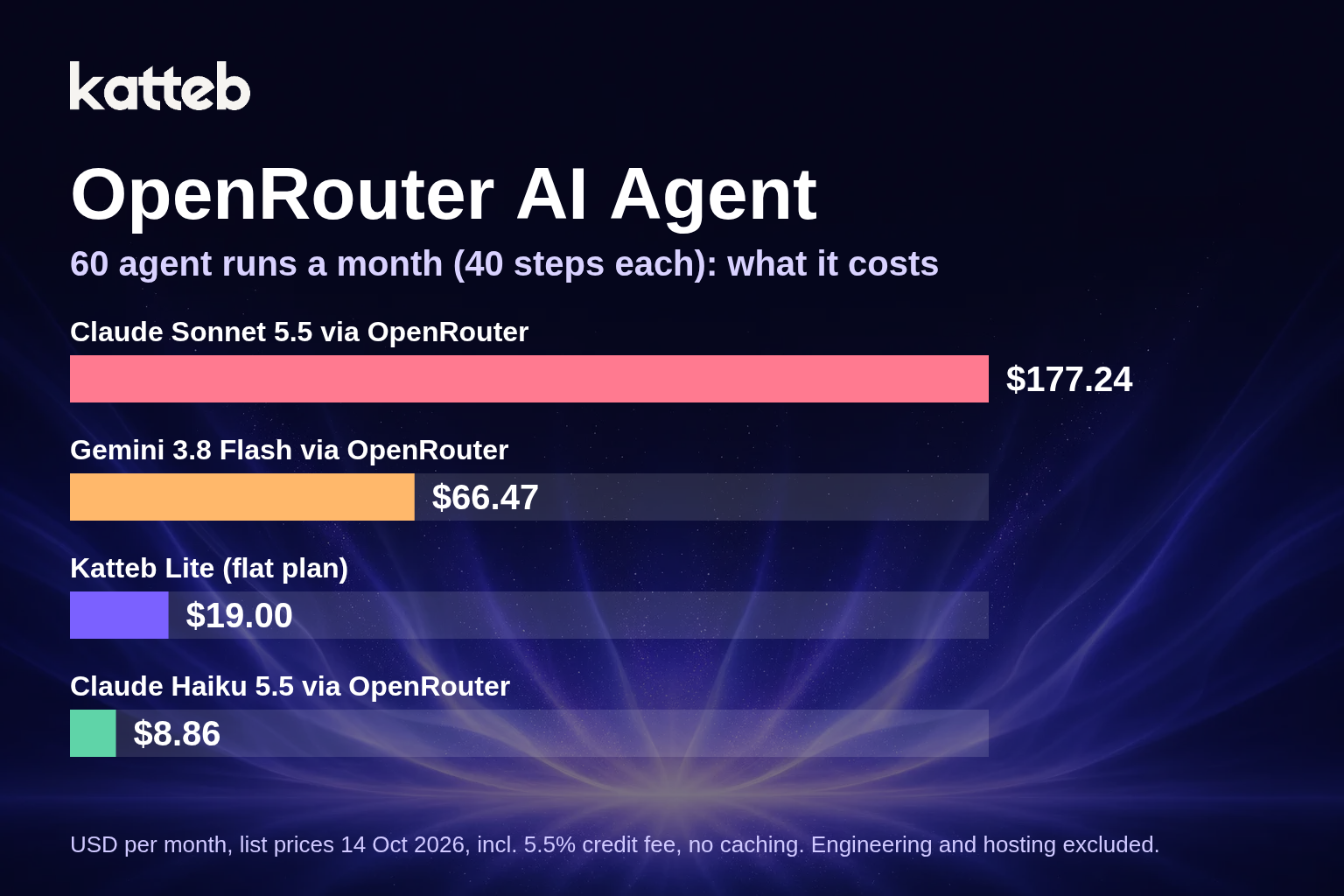
An operator runs an agent job twice a day, 60 runs a month. Each run takes 40 model steps; each step reads about 30,000 tokens of context and writes 1,000 tokens. That is a typical shape for a browsing agent that re-reads the page and its notes on every step.
| Model | Cost per step | Cost per run (40 steps) | 60 runs | With 5.5% fee |
|---|---|---|---|---|
| Claude Sonnet 5.5 | $0.06 + $0.01 = $0.07 | $2.80 | $168.00 | $177.24 |
| Gemini 3.8 Flash | $0.0225 + $0.00375 = $0.02625 | $1.05 | $63.00 | $66.47 |
| Claude Haiku 5.5 | $0.003 + $0.0005 = $0.0035 | $0.14 | $8.40 | $8.86 |
Katteb Lite is $19 a month for the same 60 runs, provided they fit inside Lite’s 30 hours of agent time a week (60 runs at about 15 minutes each is roughly 15 hours a month, well inside it).
Result: the model you choose decides the answer. On Sonnet 5.5, Katteb Lite costs $158.24 a month less than the OpenRouter token bill alone; on Gemini 3.8 Flash, $47.47 a month less. On Haiku 5.5, OpenRouter costs $10.14 a month less than Katteb. Each “less” holds only under the stated conditions: the job is one Katteb can do in its browser, it fits Lite’s agent time, you do not use prompt caching, and you ignore the engineering and hosting cost of your own loop. The break-even points: at Sonnet prices ($2.954 per run with the fee) Katteb’s flat $19 is lower from the 7th run of the month; at Haiku prices ($0.1477 per run) OpenRouter stays lower up to 128 runs a month.
Scenario C: an AI feature inside your own app
A developer ships a feature that makes 1,000,000 requests a month on GPT-5.6 Luna, each with 1,500 input and 300 output tokens.
- Input: 1.5 billion tokens × $0.20 / 1M = $300. Output: 300 million × $1.20 / 1M = $360. List price: $660.
- Standard: $660 × 1.055 = $696.30. Business: $660 × 1.08 = $712.80, so Business costs $16.50 a month more for EU and US in-region routing and 1,000 workspaces.
- Bring your own key (BYOK): you pay the provider $660 directly, and OpenRouter charges no fee on the first $25,000 of list-price inference a month on Standard and Business.
Result: Katteb is not a comparable product here and we do not price it. An AI feature inside software needs an API. Between OpenRouter’s own options, BYOK removes the fee at this volume if you already hold a provider account; Standard is $16.50 a month lower than Business if you do not need regional routing.
Scenario D: a student or a side project
Someone wants to experiment with free models every day. On the Free tier they get 50 requests a day. One $10 credit purchase ($10.55 with the fee) raises the free-model cap to 1,000 requests a day for as long as the balance stays above zero. Result: OpenRouter costs $0 to $10.55 once; Katteb Lite would be $19 every month. For pure experimentation with models, OpenRouter is the lower-cost route by a wide margin.
Scenario E: paying for a year
OpenRouter has no annual plan and, per its FAQ, does not discount inference outside Enterprise fee discounts, so a year costs twelve months of usage. Katteb Lite costs $190 a year paid annually versus $228 paid monthly (12 × $19), which is $38 less per year. That only matters if you have already decided you need the agent.
Summary of the five scenarios
| Scenario | OpenRouter (USD/month) | Katteb (USD/month) | What the numbers show |
|---|---|---|---|
| A. 100 research questions, Sonnet 5.5 | $8.55 | $19 | OpenRouter $10.45 less; Katteb pays off only above ~21 min saved |
| B. 60 agent runs, Sonnet 5.5 | $177.24 | $19 | Katteb $158.24 less, if the job fits Lite and no caching |
| B. 60 agent runs, Gemini 3.8 Flash | $66.47 | $19 | Katteb $47.47 less, same conditions |
| B. 60 agent runs, Haiku 5.5 | $8.86 | $19 | OpenRouter $10.14 less |
| C. 1M app requests, GPT-5.6 Luna | $696.30 (Std) / $712.80 (Bus) | Not comparable | Needs an API; BYOK removes the fee |
| D. Free-model experiments | $0 to $10.55 once | $19 | OpenRouter far lower |
| E. Annual billing | 12 × usage | $190/year | No OpenRouter annual discount |
Which route fits which job?
| Job | Best fit | Why |
|---|---|---|
| AI feature inside your product | OpenRouter API (or BYOK) | Volume, latency and code control |
| Choosing between models | OpenRouter | One key, side-by-side prices, fallbacks |
| Occasional questions in a chat window | OpenRouter chat or a free assistant | Pennies per question |
| Recurring browser work with a report | A ready-made agent | Needs browser, sessions, schedule and memory |
| Work behind your own logins | A ready-made agent | A model key cannot sign in for you |
| Long agent loops on frontier models | Compare both with Scenario B math | Token cost grows with every step |
When should you not use Katteb for this?
- When you are building a product. Katteb is not an API you can call a million times from your backend.
- When your workload is light and a cheap model is good enough. Scenario A and the Haiku row of Scenario B both come out lower on OpenRouter.
- When you need to pick the exact model and version for compliance or evaluation reasons. OpenRouter lets you pin a model id; Katteb chooses models for you.
- When you already have an engineer, a hosted browser and a scheduler running. Then the marginal cost of one more job on OpenRouter is just its tokens.
When is OpenRouter alone not enough?
- When the job involves pages behind your logins: analytics, CMS, CRM, social accounts.
- When the job repeats and must remember what it did last time.
- When nobody on the team wants to maintain an agent loop, retries, browser sessions and error handling.
- When your agent loops on a frontier model and the per-step context keeps growing, so the token bill becomes the problem rather than the solution.
Not sure which side of the math you are on?
Give Katteb one recurring job for a week and compare the time it saved with the numbers above. Lite is $19 a month and you can cancel any time.
FAQ
Does OpenRouter mark up model prices?
No. According to its pricing page, inference is billed at the provider’s list price on every plan. OpenRouter’s fee is 5.5% (Standard) or 8% (Business) on credit purchases.
Is OpenRouter free?
Partly. The Free tier gives 25+ free models at 20 requests a minute and 50 a day. Buying at least $10 of credits raises the free-model cap to 1,000 requests a day. Paid models always cost their per-token price.
Does OpenRouter have an annual plan?
No. Standard and Business are pay as you go with no minimum and no lock-in. Enterprise offers discounted OpenRouter fees on contract, but not discounted inference.
What does bring your own key cost?
On Standard and Business, the first $25,000 of list-price inference a month through your own provider keys carries no OpenRouter fee; above that, 5% of what the same request would cost on OpenRouter is deducted from your credits.
Can an OpenRouter key run an AI agent by itself?
It supplies the models and an optional web search tool. The loop, the browser, sign-ins, schedules and memory have to come from your own code or from a ready-made agent.
Is Katteb cheaper than OpenRouter?
Not in general. In our scenarios Katteb Lite cost less only for long agent loops on Sonnet-class or Gemini Flash models; OpenRouter cost less for light use, cheap models and free-model experiments, and Katteb is not a substitute for an API inside a product.
Sources
- OpenRouter pricing page and its FAQ, read 14 October 2026.
- OpenRouter public models list (per-token prices), read 14 October 2026.
- OpenRouter web search server tool documentation, read 14 October 2026.
- OpenRouter FAQ and credit and rate limit documentation, read 14 October 2026.
- Katteb pricing, read 14 October 2026.
The short version
OpenRouter pricing is provider list price plus a 5.5% fee on credit top-ups (8% on Business), with a free tier capped at 50 requests a day and no annual plan. For apps, light use and cheap models, OpenRouter alone costs less than an agent subscription in every scenario we priced. For a recurring browser job run as a long loop on a frontier model, the token bill can exceed a flat $19 agent plan from the seventh run of the month, before you count the code you would have to maintain. Run your own volumes through Scenario B, and if the agent side wins, test it on one job in Katteb.

About Ahmed Ezat
Ahmed Ezat is the founder behind Katteb, an AI writing and SEO platform built to help businesses create fact-checked, search-ready content that ranks in both traditional search and AI-powered results. With more than a decade of hands-on experience in SEO, SaaS, and digital marketing, Ahmed has launched and scaled multiple AI products serving hundreds of thousands of users across the MENA region and globally.