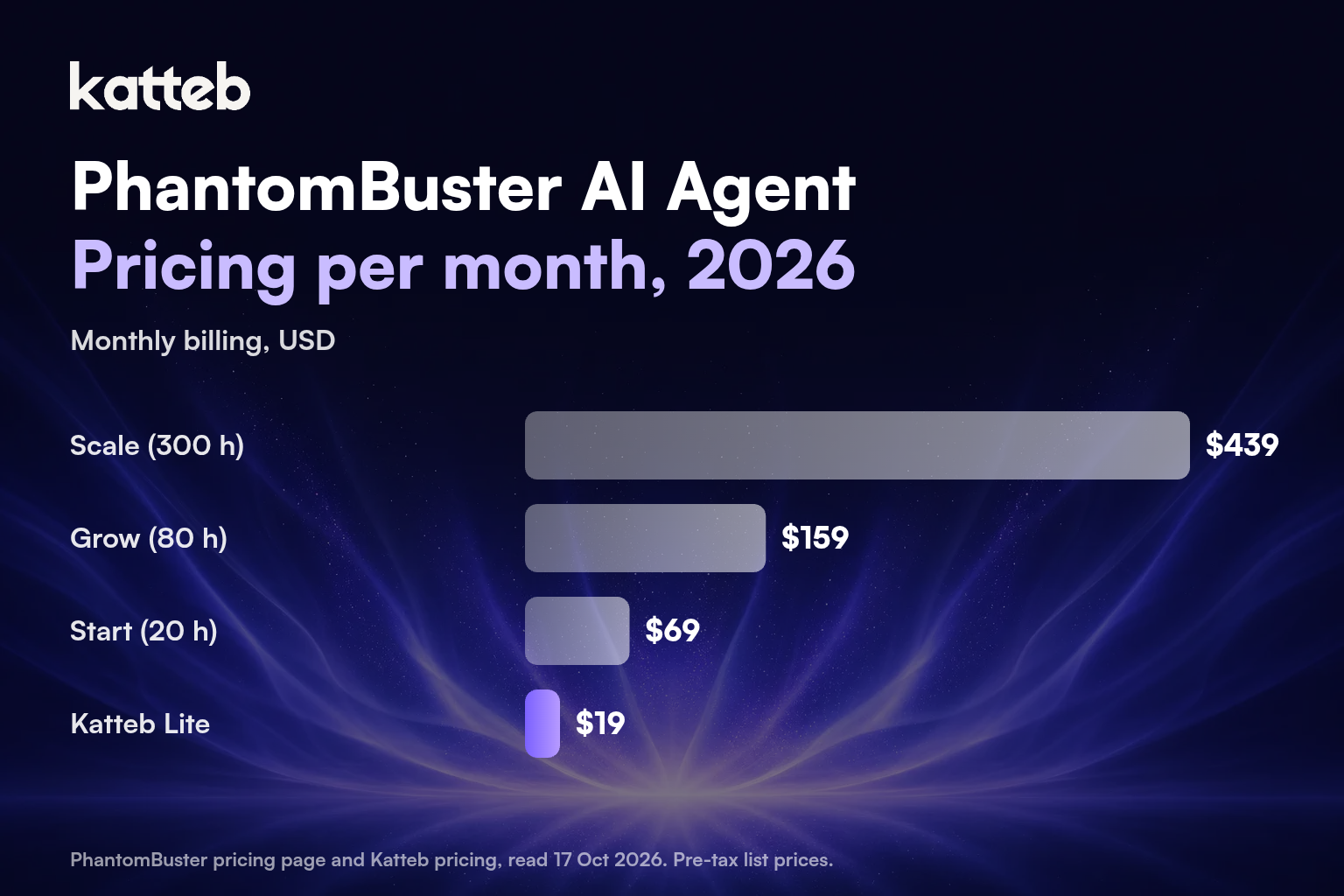
TL;DR. On 17 October 2026 the official PhantomBuster pricing page listed a free Trial and three paid plans in US dollars: Start $69 a month (20 hours of execution time, 5 automation slots, 500 email credits), Grow $159 (80 hours, 15 slots, 2,500 email credits) and Scale $439 (300 hours, 50 slots, 10,000 email credits). Annual billing brings them to $56, $128 and $352 a month, charged as $672, $1,536 and $4,224 a year. The Trial gives 2 hours of execution time and limits exports to 10 rows. PhantomBuster bills by the time your automations run, not by the row, so the right plan depends on hours and credits. Below: what you are paying for, six priced scenarios with the arithmetic, and where an agent such as Katteb fits next to it.
PhantomBuster is one of the oldest names in “growth automation”: cloud automations, called Phantoms, that extract profiles from LinkedIn and other platforms, enrich them with email addresses, and push the rows to a CRM. Anyone searching “phantombuster pricing” is usually comparing the plan cards and wondering how far 20 hours of execution time actually goes, or whether they need Grow at more than twice the price of Start.
Those questions have numerical answers, and we work them out below. We also answer a question the pricing page cannot: when the job is reading and judging a few dozen profiles rather than pulling thousands of rows, is a general agent like Katteb the cheaper and simpler fit? Sometimes yes, often no, and the conditions are printed next to every number.
PhantomBuster pricing at a glance (read 17 October 2026)
| Plan | Monthly billing | Annual billing | Execution time / month | Automation slots | Email credits / month | AI credits / month | URL finder credits / month |
|---|---|---|---|---|---|---|---|
| Trial | Free | Free | 2 h | 5 | 50 | 1k | 100 |
| Start | $69 | $56/mo ($672/yr) | 20 h | 5 | 500 | 10k | 1k |
| Grow | $159 | $128/mo ($1,536/yr) | 80 h | 15 | 2,500 | 30k | 10k |
| Scale | $439 | $352/mo ($4,224/yr) | 300 h | 50 | 10,000 | 90k | 20k |
All prices are in US dollars as shown on the page, before any tax. Every plan, including the Trial, lists unlimited users, an MCP server for Claude and ChatGPT, LinkedIn and Sales Navigator automation, profile and email enrichment, AI filtering and writing, LinkedIn outreach campaigns and multiple LinkedIn accounts. The Trial differs in one line that matters: exports are limited to 10 rows. The page states a 14-day free trial with no credit card.
The three meters behind the price
- Execution time. The FAQ defines it as “the total monthly time your automations can run”, consumed while Phantoms are actively working. When it runs out, automations pause until the reset or an upgrade, and “no overage charges are applied automatically”. That is a useful guarantee: the bill cannot surprise you, but the work can stop.
- Automation slots. How many automations can run at the same time. Five slots is enough for one person’s handful of workflows; agencies running a client per workflow hit it quickly.
- Email credits. Spent when a profile is enriched with an email address, and separate from execution time. The page says each enrichment “consumes credits based on usage” without printing a per-enrichment rate, so in the scenarios below we treat one found email as one credit at best and flag it as an assumption.
What an hour and a credit cost on each plan
Because every plan bundles several meters, there is no single unit price. Dividing the plan price by one meter at a time gives a ceiling, useful for comparing plans with each other:
| Plan | Per execution hour (monthly / annual) | Per email credit (monthly / annual) |
|---|---|---|
| Start | $3.45 / $2.80 | $0.138 / $0.112 |
| Grow | $1.99 / $1.60 | $0.064 / $0.051 |
| Scale | $1.46 / $1.17 | $0.044 / $0.035 |
Each figure is the plan price divided by that plan’s hours or credits (for example $69 ÷ 20 h = $3.45, $159 ÷ 2,500 = $0.064). These are not prices PhantomBuster charges per unit; they show that bigger plans make each hour and credit cheaper if you use them all.
Need thirty well-chosen leads, not three thousand rows?
Tell Katteb the job, for example “find 30 heads of operations at logistics companies in Texas with 50–500 staff, read each profile and company site, and give me a table with why each one fits and a first line I can send”. It researches in a real browser and reports in plain language.
What comes back from a Phantom, and the traps
A Phantom returns rows: profile fields, post engagement, search results, company details. That is the strength and the limit. Four things to expect before you plan a budget:
- Rows are not decisions. An extraction of everyone who liked a competitor’s post includes students, recruiters and the competitor’s own staff. Someone still has to read and filter, either with PhantomBuster’s AI credits and a prompt you tune, or by hand.
- Time, not rows, is billed. A slow source or a large scroll uses more execution time for the same number of rows. Run a small batch first and measure rows per hour before you pick a plan.
- Enrichment is a second meter. Email credits run out separately from hours. A plan that has enough time can still stop finding emails mid-month.
- It runs through your accounts. PhantomBuster states it works with publicly available data through your own accounts, within platform constraints. Your LinkedIn account’s limits still apply, and the rules for collecting personal data depend on your country and use.
The structure of this section, what an extraction returns and where it misleads, was inspired by a Monid guide to LinkedIn post scrapers. The prices and scenarios are our own.
Six priced scenarios
Ground rules: PhantomBuster list prices read on 17 October 2026, in USD, before tax; Katteb Lite at its published $19 a month or $190 a year from the Katteb pricing page read the same day, with 30 hours of agent time a week; staff time at $30 an hour; no promotions. Where we say an option is “less”, the subtraction is shown and the condition is next to it.
Scenario A: monthly or annual billing
| Plan | 12 × monthly | Annual | Difference |
|---|---|---|---|
| Start | $828 | $672 | $156 less on annual |
| Grow | $1,908 | $1,536 | $372 less on annual |
| Scale | $5,268 | $4,224 | $1,044 less on annual |
The annual plan is charged once a year, per the FAQ. The break-even is the number of months at which monthly billing would cost more than the annual charge: $672 ÷ $69 = 9.7 months for Start, $1,536 ÷ $159 = 9.7 months for Grow, and $4,224 ÷ $439 = 9.6 months for Scale. If you will not use the tool for ten months, pay monthly.
Scenario B: you keep running out of execution time on Start
Your workflows need about 25 hours a month and Start gives 20. There is no automatic overage, so the choice is to wait for the reset, trim the workflows, or move to Grow. On monthly billing Grow is $159 − $69 = $90 more for 60 more hours. If you only need 5 of them, those 5 hours cost you $18 each. Before upgrading, check the slow workflows: cutting one scroll-heavy extraction often recovers the 5 hours, and Start stays at $69. If you genuinely need 40 to 80 hours, Grow’s $1.99 an hour (monthly) is the better rate.
Scenario C: 2,000 enriched emails a month
A sales team wants email addresses for 2,000 extracted profiles a month. Assuming one credit per found email (the page does not print the rate), Start’s 500 credits cover a quarter of it. Grow’s 2,500 credits cover all of it at $159 a month or $128 on annual. Scale would be $439 for credits you would not use. Grow is the fit; Katteb is not priced here, because finding 2,000 verified emails is a data job, not a reading job.
Scenario D: a founder who needs 40 researched leads a month
The job: find 40 decision-makers who fit a narrow profile, read each profile and company site, and write a first line for each. No bulk export, no CRM sync.
| Option | Per month | Per year (annual billing) |
|---|---|---|
| PhantomBuster Start | $69 | $672 |
| Katteb Lite | $19 | $190 |
Katteb Lite is $50 a month less ($69 − $19), or $482 a year less on annual billing ($672 − $190), if three conditions hold: 40 leads fit comfortably inside Lite’s agent time; email addresses published on company sites are enough (Katteb reads the public web, it does not include PhantomBuster’s email credits); and you do not need scheduled extraction of hundreds of rows. On PhantomBuster’s free Trial you could test the same workflow, but exports stop at 10 rows, so it does not cover 40 a month.
Scenario E: copying 200 profiles by hand versus Start
An assistant copies 200 LinkedIn profiles a month into a sheet, at about 1.5 minutes each: 300 minutes, 5 hours, $150 at $30 an hour. PhantomBuster Start does the extraction for $69, so it is $81 a month less, on the condition that 200 profiles fit in 20 hours of execution time (they normally should; measure on the Trial first). This is the job PhantomBuster is built for, and an agent is the wrong tool for repetitive copying at that volume.
Scenario F: extraction plus judgement
A small agency extracts about 1,000 post engagers a month with PhantomBuster Start and then needs someone to pick the 50 worth contacting and write to them. Reading 1,000 rows at 30 seconds each is about 8.3 hours, $250 at $30 an hour; drafting 50 first lines at 3 minutes each is 2.5 hours, $75.
- Start alone, with the judgement done by staff: $69 + $250 + $75 = $394 a month.
- Start plus Katteb Lite doing the shortlist and drafts, with one hour of staff review: $69 + $19 + $30 = $118 a month.
The second line is $276 a month less, if the agent’s shortlist survives your one-hour review. PhantomBuster’s own AI credits can do part of the filtering inside Start too; try them first, and use an agent where the judgement needs the company site, the person’s recent posts and a written reason.
Keep the Phantom, add the judgement
Ask Katteb: “here is this week’s export of 250 people who engaged with our post; drop recruiters, students and our competitors, read the rest, and give me the 15 most likely buyers with a reason and a first line each”.
Where Katteb fits, and where it does not
- Use PhantomBuster for: scheduled extraction of hundreds or thousands of rows, email enrichment with its credits, auto-refresh of lists, and CRM sync. Scenarios C and E are its home ground.
- Use Katteb for: small, judgement-heavy research (Scenario D), and the shortlisting and writing that follows an extraction (Scenario F). You describe the job in a sentence; it works in a real browser and reports back.
- Use both: when the volume is large and the decision still needs a human-quality read. That combination is often less than paying staff to read raw exports.
How to pick a PhantomBuster plan
- Run your workflows on the Trial and note rows per hour (the 2 hours are enough to measure).
- Multiply by your monthly row target to get hours. Up to 20 is Start; up to 80 is Grow.
- Count emails you need. Over 500 a month points to Grow.
- Count workflows that must run at once. Over 5 needs Grow’s 15 slots.
- If you will use it ten months or more, pay annually.
- Price the reading and writing after the export separately, and compare that part against an agent.
Frequently asked questions
Is PhantomBuster free?
There is a free Trial with 2 hours of execution time, 50 email credits and exports limited to 10 rows. Paid plans start at $69 a month, or $56 a month billed annually.
What happens when execution time runs out?
According to the pricing FAQ, automations pause until the time resets or you upgrade, and no overage is charged automatically.
How many credits does an email cost?
The pricing page says credits are consumed “based on usage” and does not print a rate per enrichment, so measure it on the Trial. Our Scenario C assumes one credit per found email and says so.
Can Katteb replace PhantomBuster?
Not for bulk extraction or enrichment. For a few dozen researched leads a month, or for shortlisting an export, Katteb Lite at $19 a month can be the simpler fit, as priced in Scenarios D and F.
Sources and date checked
- PhantomBuster pricing and FAQ (plans, monthly and annual prices, execution time, slots, credits, trial, overage), read 17 October 2026.
- Katteb pricing, read 17 October 2026.
- Monid guide on LinkedIn post scrapers, used for structure only.
The short version
PhantomBuster pricing in October 2026 runs from a free Trial to $69, $159 and $439 a month, about 19% less on annual billing, with execution hours and email credits deciding which plan you need. Measure rows per hour on the Trial, pay annually only past ten months, and do not upgrade for a few missing hours before you trim slow workflows. When the job is choosing and writing to a few dozen people rather than exporting thousands, hand Katteb the brief and weigh it against $19 a month.

About Ahmed Ezat
Ahmed Ezat is the founder behind Katteb, an AI writing and SEO platform built to help businesses create fact-checked, search-ready content that ranks in both traditional search and AI-powered results. With more than a decade of hands-on experience in SEO, SaaS, and digital marketing, Ahmed has launched and scaled multiple AI products serving hundreds of thousands of users across the MENA region and globally.