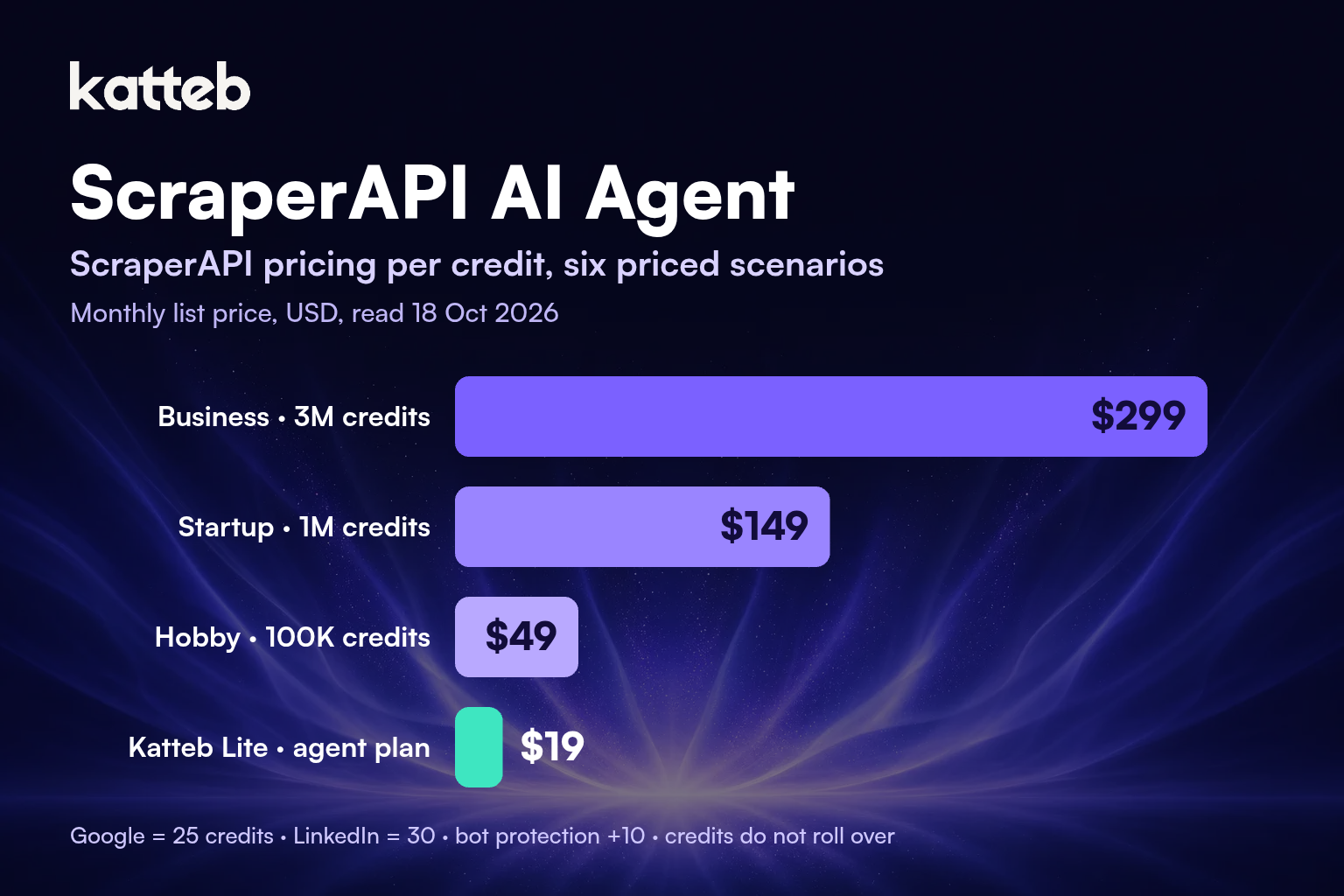
TL;DR. On 18 October 2026 the official ScraperAPI pricing page listed six self-serve plans in US dollars: Hobby $49 a month (100,000 API credits, 20 concurrent threads), Startup $149 (1,000,000 credits), Business $299 (3,000,000), Scaling $475 (5,000,000), Professional $975 (10,500,000) and Advanced $1,975 (21,500,000), with annual billing 10% lower and Enterprise priced by quote. A standard page costs 1 credit, but Amazon costs 5, Google and Bing 25, LinkedIn 30, and a page behind Cloudflare, DataDome or PerimeterX adds 10. Credits reset every cycle and do not roll over. So the plan you need is decided less by how many pages you fetch than by which sites they are on. Below: the credit math, six priced scenarios, and where an agent such as Katteb fits next to it, and where it does not.
ScraperAPI sells one thing: you send a URL, and it returns the page after handling proxies, browsers, retries and CAPTCHAs on its side. People searching “scraperapi pricing” have usually read the plan cards and want to know what 100,000 credits buys in pages they actually care about, whether they will be pushed from $49 to $149, and whether yearly billing is worth committing to.
All of those questions have numerical answers, and we work them out below with the arithmetic printed. We also take on a question the pricing page does not ask: when the real job is reading a few dozen pages and writing something useful about them, rather than feeding millions of pages into a pipeline, is a general agent like Katteb the simpler fit? Sometimes, under conditions we state next to each figure. For pipeline work, no.
ScraperAPI pricing at a glance (read 18 October 2026)
| Plan | Monthly billing | Annual billing (per month) | API credits / month | Concurrent threads | Geotargeting | Price per 1,000 credits (monthly) |
|---|---|---|---|---|---|---|
| Free | $0 | $0 | 1,000 | 5 | n/a | n/a |
| Hobby | $49 | $44.10 | 100,000 | 20 | US & EU | $0.49 |
| Startup | $149 | $134.10 | 1,000,000 | 50 | US & EU | $0.149 |
| Business | $299 | $269.10 | 3,000,000 | 100 | Country-level | $0.0997 |
| Scaling | $475 | $427.50 | 5,000,000 | 200 | Country-level | $0.095 |
| Professional | $975 | $877.50 | 10,500,000 | 300 | Country-level | $0.0929 |
| Advanced | $1,975 | $1,777.50 | 21,500,000 | 500 | Country-level | $0.0919 |
| Enterprise | Custom (contact sales) | 22,000,000+ | 500+ | Country-level | Quoted | |
Prices are in US dollars as shown on the page, before tax. The last column is simply the monthly price divided by the credits (for example $49 ÷ 100 = $0.49 per 1,000 credits; $149 ÷ 1,000 = $0.149), so it assumes you use every credit. On the day we read it, Professional and Advanced also carried a “limited offer” of 250,000 and 500,000 bonus credits; we leave those out of every calculation because they are temporary. The page also offers a 7-day trial with 5,000 API credits and no card, a free plan with 1,000 credits and 5 concurrent connections, and a 7-day no-questions refund.
Every plan lists the same core features: JavaScript rendering, premium proxies, JSON auto-parsing, rotating proxy pools, CAPTCHA and anti-bot handling, sessions, desktop and mobile user agents, automatic retries and unlimited bandwidth. What changes from plan to plan is credits, concurrency, geotargeting and the length of analytics history.
Why the credit is not a page
The single most important line on the pricing page is in the FAQ: one credit is the cost of a standard page request, “but what you actually consume depends on the site you’re scraping and the parameters you send”. The page then prints the rates that matter:
| Request | Credits | Requests that fit in Hobby (100,000 credits) | Cost per request on Hobby, fully used |
|---|---|---|---|
| Standard page | 1 | 100,000 | $0.00049 |
| Amazon | 5 | 20,000 | $0.00245 |
| Standard page behind bot protection | 1 + 10 = 11 | 9,090 | $0.00539 |
| Google or Bing | 25 | 4,000 | $0.01225 |
| 30 | 3,333 | $0.0147 |
Each row is 100,000 divided by the credits per request, and $0.49 per 1,000 credits multiplied by the credits per request. Two things follow. First, a Hobby plan is “100,000 pages” only if every page is an ordinary, unprotected one. Second, the bot-protection surcharge is the quiet multiplier: an ordinary page that happens to sit behind Cloudflare costs eleven times as much. Before you choose a plan, put your real target URLs through the Domain Cost Estimator in the dashboard, which the FAQ points to, and set max_cost on each request so no single page can cost more than you planned.
Three rules that change the bill
- No rollover. The FAQ says the credit balance resets when the subscription renews. A plan sized for your busiest month wastes credits every quiet month.
- Running out pauses you. By default scraping stops until credits renew. On Hobby to Professional you can opt into auto-upgrade, which moves you to the next plan when credits run out. Pay-as-you-go past the limit exists only on Scaling and above, at a per-credit rate the page does not print, up to a cap you set. Annual plans can renew early for a fresh batch.
- Concurrency is a hard wall, not a fee. Going over your thread count returns a 429; there is no charge, but the request is refused rather than queued. A job that needs 60 parallel requests will not run at full speed on Startup’s 50, whatever its credits.
Need the answer, not the HTML?
Tell Katteb the job in a sentence, for example “open the pricing pages of these 12 competitors every Monday, tell me what changed since last week and put it in a table”. It works in a real browser and reports in plain language, so there is no parser to maintain.
Why a scraper that works in your browser gets a 403
It helps to know what you are paying ScraperAPI to fix. When a script fetches a page that opens fine in Chrome and gets a 403 or an empty challenge page, the site is not refusing the URL; it is refusing the request. Protection layers look at much more than the user-agent string: the shape of the TLS handshake, which headers arrive and in what order, whether the address belongs to a cloud data centre or a home connection, and how regular the timing of many requests looks. A stock HTTP library fails several of those tests at once, which is why changing one header rarely helps.
There are three ways through, and they cost different things:
- Run real browsers yourself (Playwright, Puppeteer). The fingerprint is genuine, and you pay in servers and maintenance once you need concurrency.
- Assemble the parts: a proxy vendor, a fingerprinting library, your own retry logic. Cheap per request, expensive in the hours spent keeping three moving parts in step.
- Call an endpoint that does it for you. This is ScraperAPI’s model: you pay per credit and the browser, proxy rotation and retries are its problem.
None of the three makes every site open. A managed endpoint raises your success rate; it does not guarantee it, and some heavily protected pages will still come back as a block. Test your actual domains on the trial before you commit to a plan, and log which ones fail.
Six priced scenarios
Assumptions for all six, unless a scenario says otherwise: ScraperAPI list prices read on 18 October 2026 in US dollars, before tax; a 30-day month and 4.33 weeks a month; the credit rates above; no bonus credits or discounts; the engineering time to write and host your own scraper is not counted, which flatters the API side; staff time at $30 an hour; Katteb Lite at $19 a month or $190 a year from the Katteb pricing page, read the same day.
Scenario A: Amazon price watch, once or twice a day
A small brand watches 400 Amazon product pages. Once a day: 400 × 30 × 5 credits = 60,000 credits, inside Hobby at $49. Twice a day: 120,000 credits, which no longer fits, so the cheapest plan is Startup at $149. Doubling the cadence costs $100 a month more ($149 − $49), even though Startup’s extra 880,000 credits go unused. If twice a day matters for only part of the catalogue, checking the top 100 products twice and the rest once comes to (100 × 2 + 300) × 30 × 5 = 75,000 credits, and stays on Hobby. This is a data pipeline into a spreadsheet or a repricer, so we do not compare Katteb here: an API is the right tool.
Scenario B: rank checks on Google, daily or weekly
An SEO tracks 150 keywords on Google, which costs 25 credits a request. Daily: 150 × 30 × 25 = 112,500 credits, just over Hobby, so Startup at $149. Weekly: 150 × 4.33 × 25 ≈ 16,240 credits, comfortably inside Hobby at $49. The decision is again cadence, worth $100 a month. Note that at 25 credits a Google request, Hobby fits only 4,000 searches a month, about $0.012 each when fully used, so price a dedicated SERP product against it before deciding.
Scenario C: 2,000 pages on protected sites
A researcher collects 2,000 pages a month from sites behind Cloudflare. At 11 credits each that is 22,000 credits, so Hobby at $49 still covers it, with room for about 7,000 more protected pages (100,000 ÷ 11 ≈ 9,090 in total). The same 2,000 pages without protection would use 2,000 credits, still more than the free 1,000, but a fifth of the protected total. The lesson is to look at the protection on your targets first: it can multiply the credits a job needs by eleven on its own.
Scenario D: weekly competitor watch with a written summary
A marketing lead wants 25 competitor pages (pricing pages, feature pages, a few changelogs) checked every week, and a short note on what changed. Two cases:
- Some of the pages are protected. Treating all 25 as protected: 25 × 4.33 × 11 ≈ 1,190 credits, over the 1,000 free credits, so Hobby at $49. ScraperAPI returns pages, not conclusions, so someone still compares them and writes the note; at 1.5 hours a month that is $45. Total: $94 a month. With Katteb, the agent opens the pages in a browser and writes the comparison; Lite at $19 plus 30 minutes of review ($15) is $34. That is $60 a month less, on two conditions: the pages open for Katteb’s browser (it is not a guaranteed bypass, and a page that refuses it is reported as refused), and what you need is the written note rather than raw HTML for a database.
- None of the pages are protected. 25 × 4.33 ≈ 108 credits, inside the free 1,000 (the page does not say how often the free credits refresh; we assume monthly). The ScraperAPI side is then the 1.5 hours of writing, $45, against Katteb’s $34: $11 a month less for Katteb, under the same conditions. If your summary takes under 38 minutes a month, Katteb’s $19 does not pay for itself here.
Scenario E: researching 60 target accounts
A founder wants notes on 60 companies: what they sell, who they sell to, one recent signal. Reading each home page and about page is 120 standard requests, which fits the free credits, so ScraperAPI costs $0. Turning 120 raw pages into notes at about 10 minutes a company is 10 hours, $300. Katteb Lite at $19 plus an hour of checking the notes ($30) is $49: $251 a month less, if the agent’s notes pass that hour of review. If the founder enjoys doing the reading, or only needs 5 companies, the free credits and an afternoon are the cheaper option.
Scenario F: a production pipeline, and what bot protection does to it
A data team fetches 2.5 million ordinary pages a month. That fits Business (3,000,000 credits) at $299, or $269.10 a month on annual billing. Now suppose 30% of those pages sit behind bot protection: 1.75 million × 1 + 0.75 million × 11 = 10 million credits, which needs Professional at $975 (10,500,000 credits). The page count did not change; the bill went up by $676 a month ($975 − $299). This is squarely an API job, so we do not compare Katteb. The practical step is to measure the protected share with the cost estimator and max_cost before signing an annual contract.
Monthly or annual?
Annual billing is 10% off every plan, charged for the year:
| Plan | 12 × monthly | Annual (12 × discounted) | Difference per year |
|---|---|---|---|
| Hobby | $588 | $529.20 | $58.80 |
| Startup | $1,788 | $1,609.20 | $178.80 |
| Business | $3,588 | $3,229.20 | $358.80 |
| Scaling | $5,700 | $5,130 | $570 |
| Professional | $11,700 | $10,530 | $1,170 |
| Advanced | $23,700 | $21,330 | $2,370 |
Because the discount is 10%, an annual plan is the cheaper choice only if you would otherwise keep the monthly plan for more than about 10.8 months (for Hobby, $529.20 ÷ $49 ≈ 10.8). If your volume is still moving, the monthly plan’s freedom to move up or down from the billing page is worth more than $58.80 a year. For comparison only, Katteb Lite is $190 a year against $228 monthly; the two are not substitutes, as the scenarios show.
Have 60 companies to understand, not 60,000 pages to store?
Ask Katteb: “read the site of each company on this list, tell me what they sell, who to, and one recent signal, and give me a table I can sort”. It reads, judges and writes, and you review the result.
How to pick the right ScraperAPI plan in four steps
- List your domains and their weights. Count requests per month by type: ordinary, Amazon, Google or Bing, LinkedIn, protected. Multiply by 1, 5, 25, 30 and 11.
- Size for the busy month, then trim. Credits do not roll over, so find whether a lower cadence on the long tail (as in Scenario A) keeps you a plan lower.
- Check concurrency separately. If your job must finish in a window, divide pages by time to get parallel requests, and make sure the plan’s thread count covers it.
- Run the trial on real URLs. 5,000 trial credits are enough to measure the true cost per domain and which pages still fail.
What a ScraperAPI AI agent setup looks like
“ScraperAPI AI agent” usually means one of two things. In the first, ScraperAPI is a tool inside your own agent: your code (or an agent framework) decides which URLs to fetch, calls ScraperAPI, and passes the returned page to a model to extract or summarise. You pay ScraperAPI’s credits, your model provider’s tokens and your own engineering time. It is the right design when the output feeds a product, a database or a dashboard, and when volume runs into the hundreds of thousands of pages.
In the second, you skip the plumbing and give the whole job to a general agent. Katteb runs a real browser, opens the pages a person would open, and returns the finished work: a table, a comparison, a report. There is no credit table to manage, and agent time is included in the plan (Lite lists 30 hours of agent time a week). The trade-off is volume and form: an agent reads at a human-like pace and returns judgement, not a firehose of HTML. If a page refuses its browser, it says so rather than pretending.
Where Katteb fits, and where it does not
- Use ScraperAPI for pipelines: price monitoring into a repricer, SERP data into a dashboard, millions of pages into a warehouse, anything that needs JSON on a schedule at volume (Scenarios A, B, C and F).
- Use Katteb when the deliverable is the conclusion: a weekly competitor note, notes on target accounts, a shortlist with reasons (Scenarios D and E), and when nobody on the team wants to maintain a scraper.
- Use both when a pipeline already collects the pages and someone still has to read the result: let ScraperAPI fetch, and hand the export to Katteb to sort, judge and summarise.
- Do not use either to collect data a site’s terms forbid or personal data you have no lawful basis to process. Read the site’s terms and your local rules before you scrape at scale.
Frequently asked questions
How much does ScraperAPI cost per month?
On 18 October 2026: Hobby $49, Startup $149, Business $299, Scaling $475, Professional $975 and Advanced $1,975 a month, or 10% less on annual billing ($44.10 to $1,777.50 a month). Enterprise is quoted.
Is there a free ScraperAPI plan?
Yes: 1,000 free API credits with up to 5 concurrent connections, plus a 7-day trial with 5,000 credits and no card required.
Does one request always cost one credit?
No. A standard page is 1 credit, Amazon 5, Google and Bing 25, LinkedIn 30, and pages behind Cloudflare, DataDome or PerimeterX add 10 credits when the bypass is used.
Do unused credits roll over?
No. The balance resets when the subscription renews.
What happens when I run out of credits?
Scraping pauses until credits renew, unless you have opted into auto-upgrade (Hobby to Professional) or pay-as-you-go (Scaling and above, rate not shown on the pricing page).
Is Katteb cheaper than ScraperAPI?
It depends on the job. For pipeline volume, no, and they are not substitutes. For reading a few dozen pages and producing a written result, our Scenarios D and E show Katteb Lite at $19 a month coming in $11 to $251 a month below the ScraperAPI-plus-staff-time route, under the conditions stated there.
Sources and date checked
- ScraperAPI pricing and pricing FAQ (plans, monthly and annual prices, credits, threads, geotargeting, credit costs per domain, rollover, auto-upgrade, pay-as-you-go, concurrency, refund), read 18 October 2026.
- Katteb pricing (Lite $19 a month or $190 a year; Business $99 a month or $990 a year), read 18 October 2026.
- Monid guide on blocked scrapers, used for the outline of questions only.
The short version
ScraperAPI pricing runs from a free 1,000 credits to $49, $149, $299, $475, $975 and $1,975 a month, 10% less annually. The real cost is set by where your pages live: Google requests cost 25 credits, LinkedIn 30, and bot protection adds 10 to any page, so measure your domains on the trial before choosing. Credits do not roll over, so size for your real month and trim cadence on the long tail. When the job is the reading and the writing rather than the fetching, hand Katteb the brief and weigh it against $19 a month.

About Ahmed Ezat
Ahmed Ezat is the founder behind Katteb, an AI writing and SEO platform built to help businesses create fact-checked, search-ready content that ranks in both traditional search and AI-powered results. With more than a decade of hands-on experience in SEO, SaaS, and digital marketing, Ahmed has launched and scaled multiple AI products serving hundreds of thousands of users across the MENA region and globally.