TL;DR. On 13 October 2026 Bright Data’s request-based products (SERP API, Web Unlocker and Web Scraper API) all showed the same ladder: a free tier of 5,000 requests or records a month, pay as you go at $1.50 per 1,000, and a Scale plan at $499 a month with roughly 380,000 to 384,000 included and $1.30 per 1,000 after that. The Browser API is priced by bandwidth instead: 1 GB free, then $8 per GB, or $499 for 71 GB. Bright Data’s docs say the free 5,000 is one account-level pool. Below are five priced scenarios that compare Bright Data used directly with adding a ready-made agent such as Katteb. All figures are in US dollars, per month and before tax.
Two kinds of people search for “brightdata pricing”. The first is a developer who already scrapes and wants to know whether the bill will grow linearly or jump at a plan boundary. The second is a marketer, founder or analyst who was told that Bright Data “can get any web data”. They land on a pricing hub with eight product families and need to work out which one their job actually uses. This article is mainly for the second group, but it gives the first group the crossover numbers too.
We read every price below on Bright Data’s own pricing pages and documentation on 13 October 2026. Each scenario lists its assumptions, so you can swap in your own volumes. Wherever an agent costs more than the API, we say so.
Want the data job done, not a scraper to maintain?
Tell Katteb what you need in one sentence, for example “check the prices of these 30 competitor products every Monday and send me what changed”. It opens the pages in a real browser and reports back.
How does Bright Data pricing work?
The pricing hub lists eight product lines: proxy networks, Web Scraper API, Scraper Studio, Scraping Browser (now called Browser API), SERP API, Web Unlocker, datasets and Bright Insights. Each has its own pricing page, but they fall into three billing models:
- Per successful request or record: SERP API, Web Unlocker and Web Scraper API. You pay only when data comes back.
- Per gigabyte: Browser API and the proxy networks, where what you pay depends on how heavy the pages are, not on how many you open.
- Per dataset or subscription: ready-made datasets and Bright Insights, sold with an account manager.
| Product | Free tier | Pay as you go | Scale ($499/mo) | Enterprise |
|---|---|---|---|---|
| SERP API | 5K requests/mo | $1.50 per 1K requests | 380K requests, then $1.30/1K | Custom |
| Web Unlocker | 5K requests/mo | $1.50 per 1K requests | 383K requests, then $1.30/1K | Custom |
| Web Scraper API | 5K records/mo | $1.50 per 1K records | 384,000 records, then $1.30/1K | Custom |
| Browser API | 1 GB/mo (5K credits) | $8 per GB | 71 GB included | Custom |
Three details on those pages matter more than the headline figures. First, a “record” on the Web Scraper API is “one extracted item, shown as a row in the table, e.g., one LinkedIn profile”, and proxies, unblocking, parsing, storage and egress are all listed as included. Second, the MCP server documentation says the free tier is “the same account-level free tier of 5,000 credits per month, drawn from a single shared pool”, shared across all users on a team account. Using SERP API and Web Unlocker in the same month does not give you two free allowances. Third, the pages advertise a deposit match of up to $500 and, on the Web Scraper API page, 25% off for three months with a code. Those are promotions, so the scenarios below use list prices.
None of the pages we read offered annual billing for these products. The Scale plans are monthly, “cancel anytime”.
What is a Bright Data AI agent?
The phrase covers three different setups.
- Bright Data’s MCP server inside your AI client. It runs on Web Unlocker and can be hosted by Bright Data or run locally, and it plugs into Claude, Cursor and other MCP clients. The documentation recommends loading only the tool groups you need, because each tool definition takes up context. It draws on the same free pool.
- Your own agent that calls Bright Data APIs. You write the code, pick an LLM and pay for both. Bright Data handles the unblocking. You handle the logic, the parsing of anything that is not pre-built, and the maintenance.
- A task agent that does the whole job. An agent such as Katteb opens pages in a real browser, reads them, decides, and writes the output: a sheet, a summary, a draft email. Collecting the data is one step of the job, not the whole product.
These options can be combined. Teams that pull thousands of records a day should do that through an API like Bright Data’s. The agent is for the human-scale part of the work: judging, writing and following up.
Seven jobs people use Bright Data or an agent for
- Rank tracking on Google and other engines by country or city, through SERP API.
- Competitor price monitoring on product pages, either per record through Web Scraper API or as browser sessions.
- Lead lists from Google Maps, LinkedIn company pages or Crunchbase profiles, using the pre-built scrapers.
- Review mining on Amazon, Google Maps and app stores, to find complaints about a competitor.
- Training and RAG data for an LLM, where volume and clean structure matter most.
- AI answer monitoring, checking what ChatGPT, Perplexity or Grok say about your brand. Bright Data’s MCP catalogue includes tools for this.
- Research briefs, where an agent reads 20 to 50 pages and writes a summary with sources.
Jobs 1, 3 at volume and 5 are API jobs. Jobs 2 and 4 can go either way, depending on how many pages there are. Jobs 6 and 7 are mostly about what happens after the pages are read.
Check your competitors every week without a script
Give Katteb your list of competitor pages and what to watch: price, plan names, a new feature. It checks them on a schedule, remembers the last values and reports only what changed.
Bright Data pricing compared with an agent: five priced scenarios
Assumptions for every scenario: US dollars; list prices read on 13 October 2026; before tax; monthly; 4.33 weeks in a month; the 5,000 free credits are applied first and not used by any other product that month; Katteb Lite at $19 a month (or $190 a year) with 30 hours of agent time a week, from katteb.com/pricing; staff time valued at $30 an hour; LLM costs for self-built agents excluded. Where we write “less”, the subtraction below shows it.
Scenario A: weekly rank check for 200 keywords
- Requests: 200 keywords × 4.33 weeks = 866 SERP API requests a month.
- Bright Data: 866 is under the 5,000 free requests, so the cost is $0.
- Katteb Lite: $19. Here Katteb is an extra $19, not a saving.
- Break-even: $19 ÷ $30 an hour = 0.633 hours. The agent has to save about 38 minutes a month, for example by writing the weekly ranking summary for a client, to be worth it. If you already have a script and a dashboard, it is not worth it.
Scenario B: 20,000 product records a month
- Bright Data Web Scraper API: (20,000 − 5,000 free) × $1.50 ÷ 1,000 = $22.50 a month.
- Katteb: not a fair comparison. Lite includes 30 hours of agent time a week, about 30 × 4.33 = 130 hours a month. At roughly one minute per page in a real browser, 20,000 pages would need about 333 hours. This is bulk data collection, and the API is the right tool for it.
Scenario C: when does Scale cost less than pay as you go?
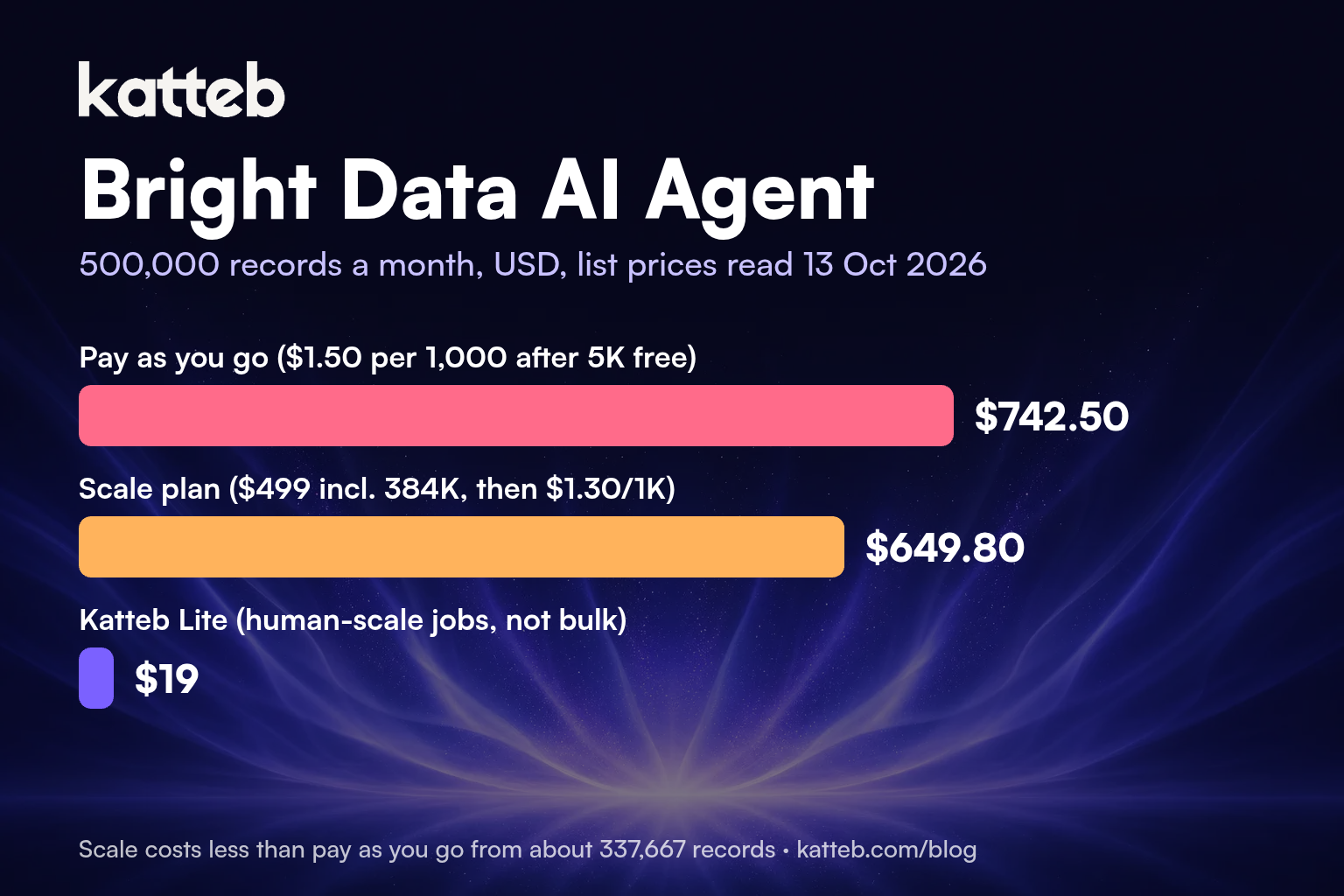
- Pay as you go equals $499 when (records − 5,000) × $1.50 ÷ 1,000 = $499, so at about 337,667 records a month.
- At 500,000 records: pay as you go = (500,000 − 5,000) × $1.50 ÷ 1,000 = $742.50; Scale = $499 + (500,000 − 384,000) × $1.30 ÷ 1,000 = $499 + $150.80 = $649.80.
- Difference: $742.50 − $649.80 = $92.70 a month less on Scale. We assumed the free 5,000 does not stack on top of Scale, because the page does not say it does.
Scenario D: watching 30 competitor pages every day in a browser
- Page loads: 30 pages × 30 days = 900 a month. Our assumption is 2 MB per page load, so 900 × 2 MB = 1,800 MB = 1.8 GB. Measure your own pages, because heavy pages change this a lot.
- Bright Data Browser API: (1.8 GB − 1 GB free) × $8 = $6.40 a month, plus the time to write and maintain the Playwright or Puppeteer script.
- Katteb Lite: $19. Katteb is an extra $19 − $6.40 = $12.60 a month. Break-even: $12.60 ÷ $30 = 0.42 hours, about 25 minutes a month of script maintenance or reporting it has to save.
Scenario E: a non-developer who needs 300 lead pages read and summarised
- Bright Data: 300 requests fit in the free tier, so the data costs $0. Someone still has to write the code, call an LLM and turn the output into a sheet and drafts.
- If that person’s own time comes to 1 hour a month (our assumption), it costs $30. Bright Data plus that hour = $30, against Katteb Lite at $19: $11 a month less with the agent, but only if that hour is real. If nobody on the team writes code, the API route is not available at any price.
| Scenario | Bright Data | Katteb Lite | Result (USD/month) |
|---|---|---|---|
| A. 866 SERP requests | $0 (free tier) | $19 | Katteb +$19; break-even 38 min |
| B. 20,000 records | $22.50 | Not suitable (about 333 h) | API is the right tool |
| C. 500,000 records | PAYG $742.50 / Scale $649.80 | n/a | Scale $92.70 less; crossover about 337,667 |
| D. 900 browser loads (1.8 GB) | $6.40 + script upkeep | $19 | Katteb +$12.60; break-even 25 min |
| E. 300 pages, no developer | $0 + 1 h ($30) | $19 | $11 less, only if the hour is real |
On annual billing, Katteb Lite is $190 a year against $19 × 12 = $228 on monthly billing, which is $38 less. Bright Data’s pages showed no annual option for these products.
When you do not need an agent for Bright Data
- Your job is bulk collection: tens of thousands of rows that go straight into a database. Use the API, and use Scale above about 337,000 records a month.
- Your volume stays under 5,000 requests and you already have a script and a dashboard. The free tier plus your existing setup is hard to beat.
- You need a fixed, documented schema for a data pipeline. A pre-built scraper gives you the same fields every time.
When an agent is the better fit
- The output is a decision or a message, not a table: “which of these 40 companies should I email, and what should I say”.
- The sites change often and you do not want to maintain selectors.
- The job needs your signed-in accounts, for example your LinkedIn or your shop dashboard, which a third-party scraper should not have.
How to run a web data job in Katteb
- Open Katteb and describe the outcome: which pages, what to extract, what to do with it, and how often.
- If a site needs your account, sign in once in the browser Katteb uses. It never asks for passwords in the chat.
- Ask for the result as a sheet, a summary or drafts that need your approval.
- Make it a goal to run it every day or week. The agent remembers the last run and reports only what changed.
Try one job before you build a pipeline
Run one competitor check or one lead list in Katteb. Then decide whether you still need a scraper and an LLM bill of your own.
Frequently asked questions
Is Bright Data free?
Bright Data has a free tier of 5,000 requests or records a month, with no card required, plus 1 GB a month on the Browser API. The docs describe it as one shared account-level pool.
How much is the Bright Data SERP API?
On 13 October 2026 it was $1.50 per 1,000 successful requests on pay as you go, or $499 a month for 380K requests on Scale, with additional requests at $1.30 per 1,000.
Does Bright Data charge for failed requests?
No. The SERP API, Web Unlocker and Web Scraper API pages all say “pay only for success”.
How much does the Bright Data MCP server cost?
The MCP server runs on Web Unlocker. It uses the same 5,000 free monthly credits and then Web Unlocker rates.
Is an AI agent cheaper than Bright Data?
It depends on the job. For pure data volume, Bright Data costs less in every scenario above. An agent only costs less when it replaces work someone would otherwise do, and the break-even above is 25 to 38 minutes a month. Test that on one job in Katteb.
Sources
- Bright Data pricing hub, read 13 October 2026.
- SERP API pricing, Web Unlocker pricing, Web Scraper API pricing and Browser API pricing, read 13 October 2026.
- Bright Data MCP server overview, read 13 October 2026.
- Katteb pricing, read 13 October 2026.
The short version
Bright Data pricing is $1.50 per 1,000 successful requests or records after a shared free 5,000, $8 per GB for browser sessions, and $499 Scale plans that cost less than pay as you go from about 337,667 records a month. For bulk data, the API costs less than an agent in every scenario we priced. An agent is worth adding only when it saves the human work after the data arrives, and at $19 a month it has to save 25 to 38 minutes of that work to pay for itself.

About Ahmed Ezat
Ahmed Ezat is the founder behind Katteb, an AI writing and SEO platform built to help businesses create fact-checked, search-ready content that ranks in both traditional search and AI-powered results. With more than a decade of hands-on experience in SEO, SaaS, and digital marketing, Ahmed has launched and scaled multiple AI products serving hundreds of thousands of users across the MENA region and globally.