TL;DR. On 13 October 2026 the Crunchbase pricing page listed three ways to buy: Pro for individuals at $49 a month billed annually (a first-year price, shown against a struck-through $79) or $99 billed monthly, with a 7-day free trial; Business for teams starting at $199 a month billed annually through sales; and Custom Data Solutions, which is where the API lives, at custom pricing only. A free account still exists, with usage limits Crunchbase does not publish. Below, four priced scenarios compare Crunchbase on its own with adding a ready-made agent such as Katteb, in US dollars, list prices before tax, and one scenario we refuse to price because the number is not public.
People type “crunchbase pricing” into Google for one of three reasons. A founder wants a list of investors or recently funded companies and needs to know whether the free account is enough. A salesperson or analyst has been told to “pull it from Crunchbase” and wants to know whether Pro covers exports. And a developer wants the data inside an app or an agent and is trying to find an API price that is not on the page. Each of these people ends up paying for something different, and only one of them is well served by a subscription seat.
This article does three things. It lays out what each Crunchbase tier costs and contains as of 13 October 2026, read from the official pricing page and the developer documentation. It explains what “a Crunchbase AI agent” can mean, because the phrase now covers Crunchbase’s own MCP connector, an agent you build against the API, and a task agent that does the research job end to end. And it prices four realistic jobs, with every assumption written down so you can redo the arithmetic with your own numbers.
Need the funded-company list, not another seat?
Tell Katteb the job in one sentence, for example “find 30 fintech startups in Europe that raised a seed or Series A this year and draft a first email to each”. It reads the pages in a real browser, builds the sheet and reports back.
How much does Crunchbase cost in October 2026?
The pricing page now leads with the line “Crunchbase’s private market data, now headless”, which tells you where the company is pointing: at agents and workflows as much as at people clicking through profiles. The plans themselves are simple to list and harder to compare, because only one of them has a full public price.
| Tier | Who it is for | Price shown on 13 Oct 2026 | What you can buy without sales |
|---|---|---|---|
| Free account | Anyone | $0, “usage limits apply” | Yes |
| Pro | One person | $49/mo billed annually (first year, list $79 struck through) or $99/mo billed monthly | Yes, with a 7-day free trial |
| Business | Teams of 2+ seats | “Starting at $199 per month billed annually” | No, “Talk to sales” |
| Custom Data Solutions (API, bulk, warehouse delivery) | Organisations and applications | “Custom Pricing” | No, sales only |
Two details on that page change the arithmetic. The annual Pro price carries the label “Save 38% on Annual first Year”, and $49 is 38% below $79, so the $49 figure is a first-year rate. The page does not say what the second year costs; the struck-through $79 is the only hint, and we treat it as an assumption, not a quoted renewal price. The second detail is in the FAQ: data exports only become available once the paid subscription begins, so a trial is for looking, not for downloading a list.
What does each Crunchbase tier actually give you?
The free account
According to the FAQ on the Crunchbase pricing page, a free account “provides access to company profiles, search results, AI-powered research, and Crunchbase MCP. Usage limits apply.” Crunchbase does not publish what those limits are, and the comparison table on the same page marks full private company profiles, valuation insights, forecasts, saved lists and exports as Pro features. In practice the free account answers “does this company exist and what does it do”, and starts to run out when you need amounts, dates and investors for many companies.
Pro
Pro is a seat for one person. The comparison table lists full private company profiles, market and valuation insights, private company forecasts, AI Search, Crunchbase Scout, saved lists and searches up to 100 each, market maps, the Chrome extension, 2,000 export rows a month, search results up to 1,000 per search, and “base” MCP usage so you can ask about Crunchbase data from ChatGPT or Claude while signed in as yourself. There is no CRM integration and no team management on Pro.
Business
Business adds what a team needs: 2 or more seats, higher Scout, MCP and profile-view allowances, unlimited lists and saved searches, 5,000 export rows a month, integrations with Salesforce, HubSpot, Zapier and Outreach, and seat management. Its price is a floor (“starting at $199 per month billed annually”) and the purchase goes through sales, so you cannot know from the page what three seats will cost.
Custom Data Solutions and the API
The Crunchbase API documentation states that access to the full API “requires an Enterprise or Applications License”, that holders of the older “Crunchbase Basic” plan are limited to the Basic APIs, and that every call needs a user key. The welcome page splits the API into Fundamentals, Insights and Predictions packages and sends you to sales for which one fits. No per-call or per-month price is published anywhere we could find on 13 October 2026. The pricing page also says that a “shared, unattended, or backend agent or application” that needs Crunchbase without an individual signing in should talk to sales about programmatic access through Custom Data Solutions. In other words, the MCP access included in Pro is for you, in your own chat client; an agent that runs on a server for your product is a licensing conversation.
Is Crunchbase Pro or the API the right purchase?
The useful line between them is the kind of question you are asking. A seat answers database questions: “show me every Series A in climate software in Germany this year”, “which investors led seed rounds in Saudi fintech”. The API answers lookup questions at volume inside software: “for each of these 5,000 accounts in our CRM, what is the last funding type and employee band”. Most people who search for Crunchbase pricing are asking the first kind of question a few times a month, which is exactly what Pro is shaped for and exactly what the free account rations.
There is a third question that neither product answers on its own: “find the companies, then do something with them”. A list of thirty funded startups is the start of the work. Somebody still has to open each website, find the right person or contact page, check whether the company already uses a competitor, and write a first message that mentions the round. That is the part where an agent earns or fails to earn its fee.
What is a Crunchbase AI agent?
The phrase is used for three different set-ups, and they cost different amounts.
- Crunchbase MCP in your own chat client. Included in Pro and Business (and in the free account with limits). You connect ChatGPT, Claude or Perplexity with your own Crunchbase login and ask questions in plain language. It is research assistance inside the data; it does not visit other websites or send anything.
- Your own agent built on the API. A backend service that calls Crunchbase endpoints, an LLM and your CRM. This needs a Custom Data Solutions licence, engineering time, and model costs, none of which have public prices.
- A task agent that does the whole job. An agent such as Katteb opens public pages in a real browser (Crunchbase’s public profiles, company websites, press releases, LinkedIn company pages you are signed into), assembles a sheet, and drafts the follow-up. It does not replace Crunchbase’s licensed fields such as valuation estimates or forecasts.
Seven jobs a Crunchbase agent is actually used for
- Fundraising target lists. Find investors who led rounds in your category and stage in the last 12 months, then check each fund’s site for a thesis and a contact route.
- Selling to recently funded companies. A company that just raised is hiring and buying. The agent finds this month’s rounds in a niche, opens each company site, and drafts an opener that names the round.
- Competitor watch. Every week, check a fixed list of competitors for new rounds, acquisitions and leadership changes and send a short summary.
- Partner and supplier research. Build a shortlist of companies of a given size band and region in a category, with a one-line note on what each sells.
- M&A and investment screening. Narrow a sector to companies that have not raised in two years, as a first pass before an analyst opens Pro for valuation fields.
- Recruiting at growing startups. List companies that raised Series A or B in a city and check their careers pages for the roles you place.
- CRM hygiene. Check which accounts in a list have closed, been acquired or changed their domain.
Jobs 1, 2, 3 and 6 are mostly about the work after the list. Job 5 depends on licensed fields and belongs in Pro. Job 7 at volume is an API job.
Turn this week’s funding rounds into a sales list
Katteb can check your niche every Monday, list the companies that raised, open each website and draft a first email for you to approve. It reports what it found every day.
Crunchbase pricing compared with an agent: four priced scenarios
Assumptions for every scenario: US dollars; list prices read on 13 October 2026; before tax; monthly billing unless stated; Crunchbase Pro annual at the $49 first-year rate; Katteb Lite at $19 a month or $190 a year and Katteb Business at $99 a month, from katteb.com/pricing; staff time valued at $30 an hour where time matters; LLM and engineering costs for self-built agents excluded. Where we write “less”, it is because the subtraction below shows it, under the stated condition.
Scenario A: a founder who needs 30 recently funded companies a month
The job: each month, find 30 startups in one niche that raised recently, note the round type, the website and a contact route, and draft an email. No valuation fields, no forecasts, no export file needed because the agent builds the sheet itself.
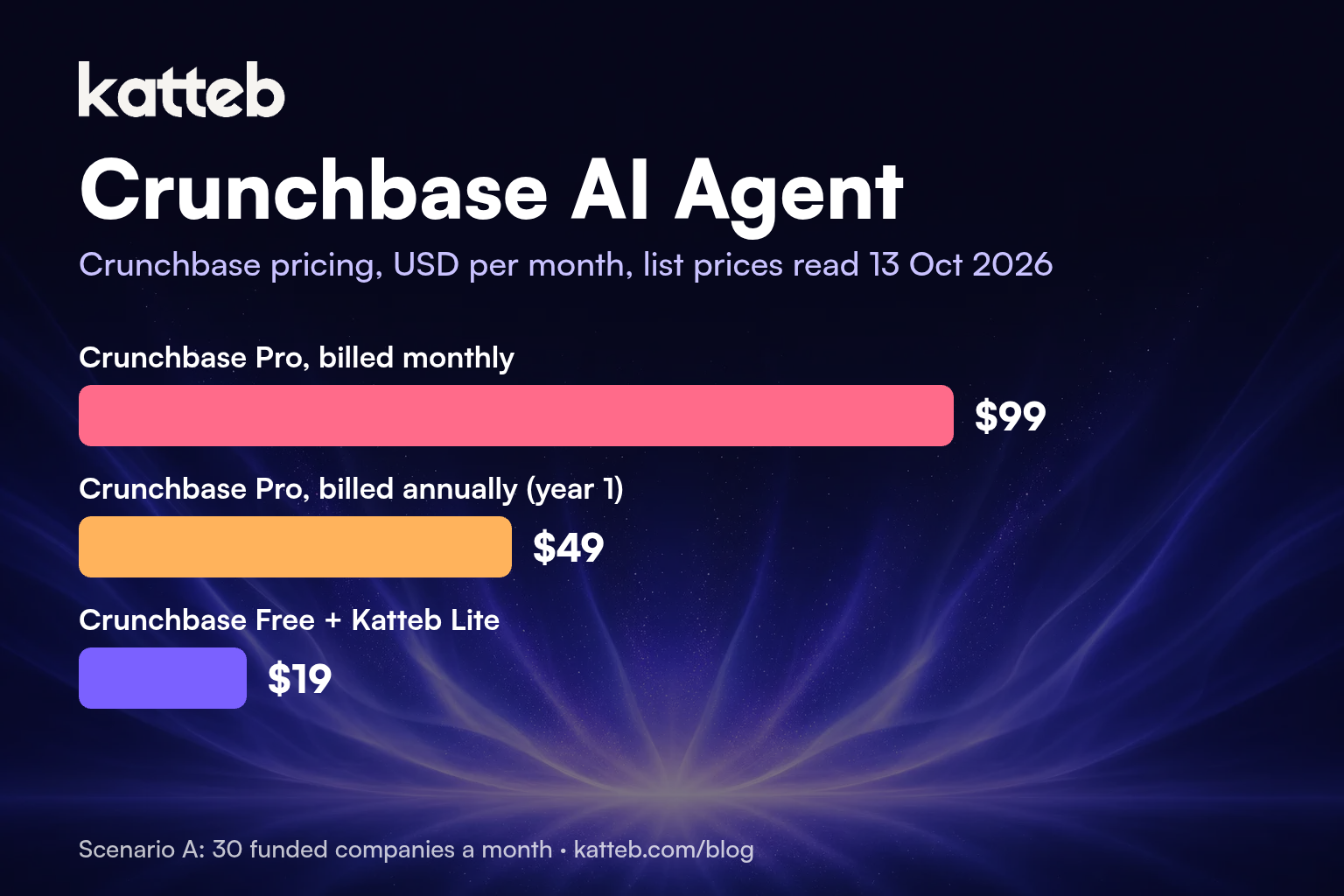
- Crunchbase Pro, monthly billing: $99 a month.
- Crunchbase free account plus Katteb Lite: $0 + $19 = $19 a month.
- Difference: $99 − $19 = $80 a month less. On annual billing, Pro is $49 × 12 = $588 in the first year against Katteb Lite at $190 a year, so $588 − $190 = $398 less in the first year.
Condition: this only holds if the free account’s unpublished usage limits cover 30 profile views a month and if round type (not round amount) is enough for your outreach. If you need amounts, dates and lead investors for every company, those are Pro fields and Scenario B applies.
Scenario B: an analyst who needs Pro anyway
The job: weekly sector screens with funding amounts, valuations and up to 2,000 exported rows a month. Pro is required; the only question is whether an agent on top is worth it.
- Crunchbase Pro annual: $49 a month.
- Pro plus Katteb Lite: $49 + $19 = $68 a month. Katteb is an extra $19 a month here, not a saving.
- Break-even: $19 ÷ $30 an hour = 0.633 hours, so the agent has to save about 38 minutes of work a month (opening websites, writing summaries, drafting emails) to pay for itself.
Scenario C: Pro on monthly versus annual billing
- Monthly: $99 × 12 = $1,188 a year.
- Annual, first year: $49 × 12 = $588. That is $1,188 − $588 = $600 less in year one.
- If the second year renews at the struck-through $79 (our assumption; the page does not state the renewal price), annual becomes $79 × 12 = $948, still $1,188 − $948 = $240 less than monthly.
The catch is commitment: annual Pro is paid for 12 months. If you need Crunchbase for one fundraising sprint of two months, monthly costs $99 × 2 = $198, which is $390 less than a year of annual Pro.
Scenario D: a three-person sales team
- Three separate Pro seats, annual first year: 3 × $588 = $1,764 a year, with no CRM integration and no shared lists.
- Business: “starting at $199 per month billed annually”, so at least $199 × 12 = $2,388 a year, but the page does not say how many seats that floor buys.
We do not put a difference here, because comparing three Pro seats with a Business floor of unknown seat count would be a made-up comparison. If your team needs the HubSpot or Salesforce sync, ask sales for a three-seat quote and compare it with $1,764. Katteb Business at $99 a month includes 3 users and 10 agents, but it is a different product: it does the research and outreach work, not licensed data.
The scenario we cannot price: an agent on the Crunchbase API
If you want an agent in your own product to look up Crunchbase data for your users, you need a Custom Data Solutions licence. Crunchbase publishes no number for it, the documentation says the full API requires an Enterprise or Applications licence, and the pricing page says unattended or backend agents need programmatic access agreed with sales. We will not invent a per-call figure. What we can say is that this is the one case where neither Pro nor a task agent is the right purchase.
| Scenario | Crunchbase route | Agent route | Result (USD) |
|---|---|---|---|
| A. 30 funded companies/mo | Pro monthly $99 | Free + Katteb Lite $19 | $80/mo less, if free limits and round type suffice |
| B. Analyst needs Pro | Pro annual $49 | Pro $49 + Lite $19 = $68 | Katteb +$19; break-even 38 min/mo |
| C. Monthly vs annual Pro | $1,188/yr | $588/yr (first year) | Annual $600 less in year one |
| D. 3-person team | 3 Pro = $1,764/yr | Business from $2,388/yr, seats unknown | Not priced: floor only |
| API agent | Custom, sales only | n/a | Not priced: no public number |
When you do not need an agent for Crunchbase
- You look up a handful of companies a month and read the profiles yourself. The free account and ten minutes are enough.
- Your work depends on valuation estimates, forecasts or full funding histories. These are licensed Pro fields; an agent reading public pages will not reproduce them.
- You need thousands of lookups a month inside software. That is the API, and a licence conversation.
- Your team already lives in Salesforce or HubSpot and needs automatic sync. That is Business.
How to run a Crunchbase research job in Katteb
- Open Katteb and describe the outcome: niche, region, stage, time window, and what each row should contain.
- Sign in once to any site the job needs (for example LinkedIn) in the browser Katteb uses; it never asks for your password in the chat.
- Ask for the result as a sheet plus drafts, and say whether drafts need your approval before anything is sent.
- Turn it into a goal if you want it every week; the agent remembers which companies it already covered and reports each day.
Try it on one niche first
Give Katteb one niche and one region, and judge the sheet it builds before you decide between Pro, the free account or both.
Frequently asked questions
Is Crunchbase free?
There is a free account with company profiles, search results, AI research and Crunchbase MCP, subject to usage limits Crunchbase does not publish. Exports and full profiles are paid.
How much is Crunchbase Pro per month?
On 13 October 2026: $99 billed monthly, or $49 a month billed annually for the first year ($588), shown against a struck-through $79.
Does Crunchbase Pro include the API?
No. Pro includes MCP usage in your own AI chat client. The full REST API requires an Enterprise or Applications licence through Custom Data Solutions, at custom pricing.
Is there a Crunchbase free trial?
Yes, a 7-day trial of Pro on monthly or annual billing. Exports only unlock when the paid subscription starts.
Can an AI agent replace Crunchbase?
Not for licensed fields such as valuations and forecasts. It can replace the manual work around the data: finding public announcements, opening websites, building the list and drafting outreach. Try that part in Katteb.
Sources
- Crunchbase product pricing (plans, comparison table and FAQ), read 13 October 2026.
- Crunchbase API: Using the API, read 13 October 2026.
- Welcome to Crunchbase Data, read 13 October 2026.
- Katteb pricing, read 13 October 2026.
The short version
Crunchbase pricing has one public seat price (Pro, $49 a month annually in year one or $99 monthly), one floor (Business from $199 a month annually) and one blank (the API). If you only need funded-company lists to act on, the free account plus an agent at $19 costs $80 a month less than monthly Pro, as long as the free limits hold. If you need Crunchbase’s licensed fields, buy Pro and judge an agent by the minutes it saves: 38 a month is the break-even.

About Ahmed Ezat
Ahmed Ezat is the founder behind Katteb, an AI writing and SEO platform built to help businesses create fact-checked, search-ready content that ranks in both traditional search and AI-powered results. With more than a decade of hands-on experience in SEO, SaaS, and digital marketing, Ahmed has launched and scaled multiple AI products serving hundreds of thousands of users across the MENA region and globally.