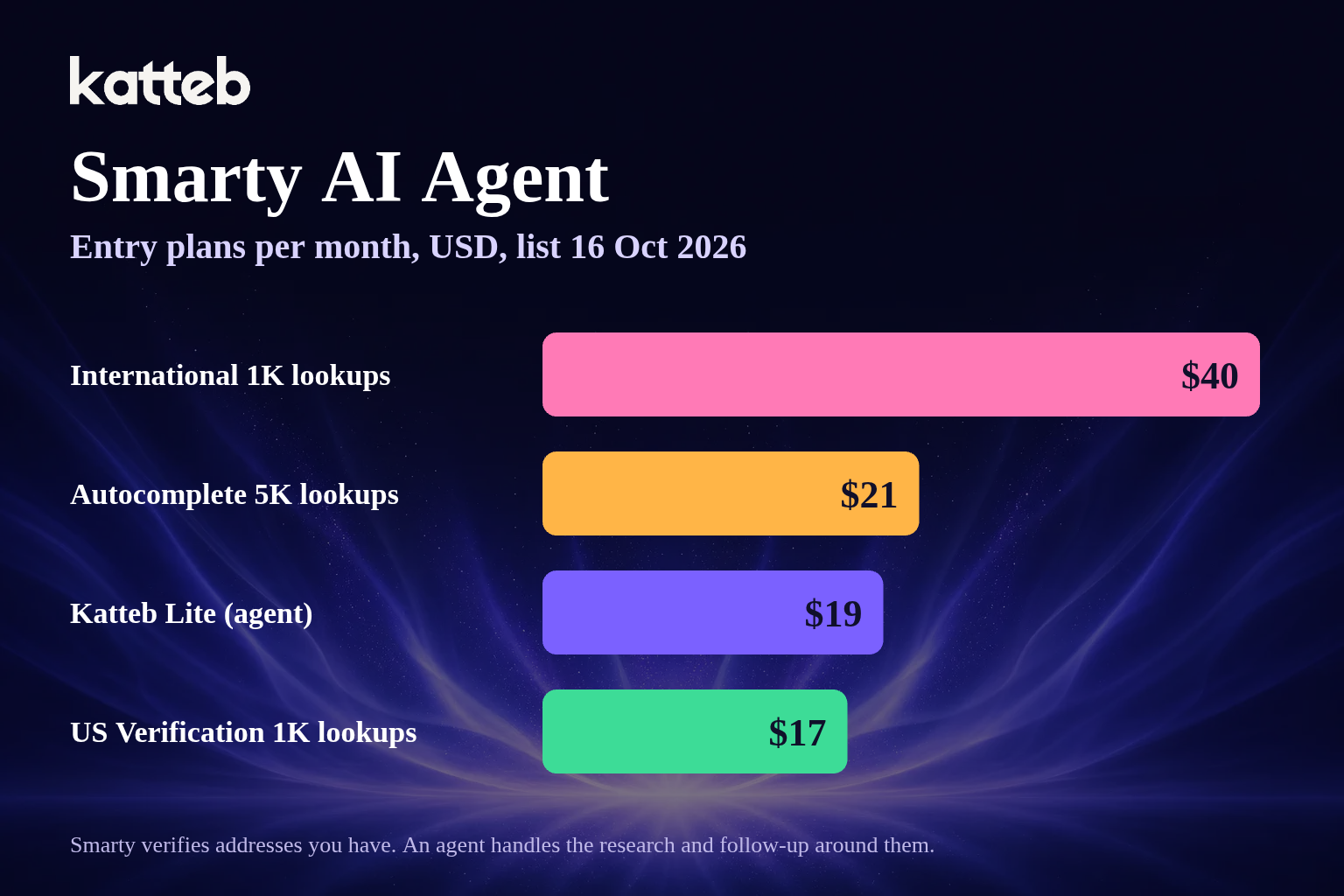
TL;DR. Smarty (formerly SmartyStreets) sells address lookups: you send an address, it parses it, standardises it to postal format and tells you whether it is deliverable. On 16 October 2026 the Smarty US Address Verification pricing page offered a 42-day free trial with 1,000 lookups, monthly plans from $17 for 1,000 lookups to $485 for 170,000, and yearly plans from $195 for 12,000 to $4,980 for 2,000,000. International verification starts at $40 a month for 1,000, and US autocomplete at $21 a month for 5,000 keystroke lookups. A plan ends when its lookups or its time run out, whichever comes first. Smarty checks an address you already have; it does not find a missing one, chase a customer about a typo or clean the rest of the record. Below are six priced scenarios in US dollars, list price, before tax, with the arithmetic shown.
Someone who types “smarty address lookup” into Google usually has a concrete problem. Parcels are coming back marked undeliverable, a CRM export is full of half-written street names, or a checkout form keeps accepting addresses that the courier cannot find. They already know an address verification service exists. What they want to know is what it costs for their volume, which of Smarty’s several products they actually need, and whether something else, such as an AI agent, should sit around it.
This guide works through those questions with numbers. It explains what an address lookup returns and which part of the answer you should trust, lays out Smarty’s price tables as they appeared on 16 October 2026, prices six common jobs, and is plain about where an AI agent like Katteb adds value and where it only adds a line to the bill. Every comparison states its assumptions next to the result, so you can swap in your own volumes.
Need the messy part of address data handled?
Tell Katteb the job in one sentence, for example “every Monday, take last week’s returned orders from the store export, look up each business address on the customer’s own website, and give me a sheet of corrections to approve”. The agent works in a real browser and reports back.
What does a Smarty address lookup actually return?
An address lookup sounds like a yes-or-no question. It is really three jobs done in sequence, and knowing them explains both what you are paying for and why two tools can disagree about the same address.
Parsing
The first job is splitting a line of free text into parts: house number, street name, street suffix, unit, city, state and ZIP. “12b main st apt 4 springfeld il” has to become a primary number, a street, a secondary designator and a city before anything else can happen. Parsing failures are where most bad data starts, because a form that stores the whole line in one field leaves every later system guessing.
Standardising
The second job is rewriting those parts into the form the postal service uses: “Street” becomes “ST”, “Apartment” becomes “APT”, the city spelling is corrected and the ZIP gets its four-digit add-on. Standardising is what makes two records for the same customer match when you deduplicate a list, which is often the quiet reason people buy a lookup service in the first place.
Verifying
The third job is checking the standardised address against a reference database. Smarty says its US product covers USPS addresses plus over 20 million non-postal addresses, and returns up to 55 points of metadata, including the delivery point validation code, the residential or commercial indicator, county, carrier route, time zone, congressional district and vacancy status. That metadata is the part many teams end up using most: a residential flag changes shipping rates, and a vacancy flag is a strong hint that a parcel will come back.
Which field tells you the address is real?
This is where most integrations go wrong. A lookup that returns a tidy, standardised address has not necessarily confirmed that mail can be delivered there. Standardisation can succeed on a street that exists while the house number does not. The field to branch on is the deliverability code, the delivery point validation (DPV) result, not the presence of a formatted address in the response.
In practice that means writing your logic in three bands. A full match goes through. A match that is missing the secondary unit, an apartment or suite number, goes to a short follow-up asking the customer for the unit. A no-match goes to a human or to a step that looks the address up from another source. Keep the raw response for every lookup, because when a courier disputes a delivery or a customer insists their address is right, the stored metadata is your evidence.
How much does Smarty cost in October 2026?
Smarty prices each product separately and sells it in blocks of lookups. These tables are the list prices shown on the Smarty US Address Verification pricing page and its product sub-pages on 16 October 2026, in US dollars, before tax. The per-lookup column is the price divided by the block size, so it is only true if you use the whole block.
US Address Verification, monthly plans
| Lookups per month | Price per month | Per lookup if fully used |
|---|---|---|
| 1,000 | $17 | $0.0170 |
| 5,000 | $50 | $0.0100 |
| 10,000 | $88 | $0.0088 |
| 25,000 | $173 | $0.0069 |
| 50,000 | $258 | $0.0052 |
| 85,000 | $380 | $0.0045 |
| 170,000 | $485 | $0.0029 |
US Address Verification, yearly plans
| Lookups per year | Price per year | Per lookup if fully used | Same volume on monthly plans |
|---|---|---|---|
| 12,000 | $195 | $0.0163 | 1K × 12 = $204 |
| 60,000 | $552 | $0.0092 | 5K × 12 = $600 |
| 120,000 | $1,020 | $0.0085 | 10K × 12 = $1,056 |
| 300,000 | $2,040 | $0.0068 | 25K × 12 = $2,076 |
| 600,000 | $3,060 | $0.0051 | 50K × 12 = $3,096 |
| 1,000,000 | $3,720 | $0.0037 | 85K × 12 = $4,560 (1.02M) |
| 2,000,000 | $4,980 | $0.0025 | 170K × 12 = $5,820 (2.04M) |
Two rules from the pricing FAQ matter more than the prices. First, a subscription ends when the lookups or the time run out, whichever comes first. Second, there is no overage billing: when a yearly block is used up early, the API answers with a 402 “payment required” error unless you have switched on auto-renewal, in which case Smarty charges for a new block at the same level and restarts the year from that date. Monthly plans have no cancellation fee. Smarty also states that you may keep the verified data after you stop paying, except rooftop geocodes, which are tied to an active geocoding subscription.
International verification and US autocomplete
| Product | Entry plan | Other listed tiers |
|---|---|---|
| International Address Verification | $40 / month for 1,000 (trial: 100 lookups, 42 days) | 2.5K $95, 5K $185, 10K $350 monthly; yearly 12K $410, 45K $1,350, 60K $1,740, 120K $3,300 |
| US Address Autocomplete | $21 / month for 5,000 keystroke lookups (trial: 1,000) | 25K $65, 50K $110, 125K $220, 250K $325, 425K $475, 850K $610 monthly; yearly 60K $245, 300K $690, 600K $1,275, 1.5M $2,550 |
Autocomplete is counted differently. Smarty’s own FAQ says each partial query counts as one lookup and that sending one per keystroke can use around ten lookups per address. That multiplier is why autocomplete volume needs its own budget line.
Katteb, for the comparisons
On the Katteb pricing page, read the same day, Lite is $19 a month or $190 a year, with one agent working on a goal and up to 30 hours of agent time a week. Business is $99 a month or $990 a year with ten agents. Katteb does not sell address lookups, so in every comparison below it is priced as a separate line for separate work, never as a cheaper verifier.
Six priced scenarios
Assumptions for all six: US dollars, list prices read on 16 October 2026, before tax, no promotional or competitor-credit discounts, staff time valued at $30 an hour, and engineering time to integrate the API not counted. Where a scenario uses different assumptions, they are written beside it.
Scenario A: a small store verifying 400 US orders a month
400 orders a month is 4,800 lookups a year. The free trial covers the first 42 days (about 560 lookups at this rate) for $0. After that the choice is the 1,000-a-month plan at $17, which is $204 a year, or the 12,000-a-year plan at $195. The yearly plan is $9 less over a year, but it buys 12,000 lookups to use 4,800, so the real cost per used lookup is $195 ÷ 4,800 = about $0.041. Either way the bill is under $20 a month.
Where Katteb fits: it does not verify at checkout, so adding it here is $19 a month on top. It earns that only if it saves more than 38 minutes of staff time a month ($19 ÷ $30 × 60), for example by going through the week’s returned parcels, matching them to orders and drafting the customer follow-ups for you to approve.
Scenario B: a one-off clean-up of 8,000 CRM addresses
For a single list, the 10,000-a-month plan at $88 covers the job in one month; switch off auto-renewal and it ends. The smallest yearly plan that would cover it is 12,000 for $195, so the monthly route is $107 less for a one-off.
Assume 5% of the list fails to match, 400 records, and that fixing each by hand takes two minutes: that is 800 minutes, or $400 of staff time. If a Katteb agent, at $19 for the month, takes on even a tenth of that fix-up work (looking up a business address on the company’s own site, flagging duplicates, writing the corrections into a sheet), it covers its cost. The total for both is $107. That conclusion depends on the failure rate and on someone checking the agent’s corrections before they go back into the CRM.
Have a list that will not clean itself?
Give Katteb the export and the rule, for example “for every row Smarty could not match, find the address on the company website and put the source link next to it”. You approve the sheet before anything is changed.
Scenario C: a mid-size store with 40,000 US lookups a month
That is 480,000 a year. The 50,000-a-month plan costs $258 × 12 = $3,096. The 600,000-a-year plan costs $3,060, so it is $36 less and leaves 120,000 lookups of headroom. The 300,000-a-year plan at $2,040 looks tempting but would run out in about seven and a half months, after which auto-renewal buys another $2,040 block, $4,080 in total. If volume is seasonal, monthly plans let you step down in quiet months, which can outweigh the $36. This is an API job inside a checkout, so Katteb is not compared here.
Scenario D: autocomplete plus verification on 2,000 checkouts a month
Using Smarty’s own estimate of about ten keystroke lookups per address, autocomplete needs 20,000 lookups a month, which fits the 25,000 plan at $65. Verifying the final 2,000 addresses needs the 5,000 plan at $50. Monthly total: $115, or $1,380 a year. On yearly plans, 240,000 autocomplete lookups fit the 300,000 plan at $690 and 24,000 verifications need the 60,000 plan at $552 (the 12,000 plan is too small), so $1,242 a year, $138 less. Debouncing the input to fewer queries per address only helps if it drops you a tier: to fit the $21 autocomplete plan you would need 2.5 lookups or fewer per address.
Scenario E: 300 international orders a month
3,600 lookups a year. Monthly: the 1,000 plan at $40, so $480 a year. Yearly: the 12,000 plan at $410, $70 less, although only 30% of it is used, which puts the real cost near $0.114 per used lookup. International lookups cost more than twice as much as US ones at the entry tier ($40 versus $17 per 1,000), so it is worth checking how many of your “international” orders are really domestic addresses typed in an unusual format.
Scenario F: a sales team that needs 150 business addresses a month
Here the problem is different: the addresses are missing, not wrong. Smarty verifies an address you already have; it does not find one. Doing it by hand, at three minutes per company to find the address on its website and paste it into the CRM, is 7.5 hours, or $225 of staff time a month. A Katteb Lite agent at $19 can search each company’s site and record the address with its source link, and the 1,000-lookup Smarty plan at $17 can verify the result: $36 a month together. That is less than the manual figure only if the agent’s results are accurate enough that checking a sample takes far less than 7.5 hours; budget time for that check.
Yearly side by side
Smarty’s 12,000-lookup yearly plan is $195 and Katteb Lite yearly is $190. The prices are close but the products are not substitutes: one is a verification API, the other is an agent that does browser work. Compare each against the work it replaces, not against the other.
How do you standardise a list of addresses step by step?
Whether a developer, a spreadsheet person or an agent does the work, the same four steps keep a clean-up honest.
Step 1: pick one product and stick to it
US-only lists go to US Address Verification; mixed lists are split by country first, so you pay international prices only for the rows that need them. Write one adapter or one column mapping and reuse it, rather than mixing outputs from two services whose field names do not match.
Step 2: branch on deliverability, not on formatting
Sort the results into the three bands described earlier: confirmed, missing a unit, not found. Only the first band goes straight back into your system.
Step 3: keep the raw response
Store the full response for every row next to the original input. It costs nothing extra and answers every future question about why a record was changed.
Step 4: expect failures in any batch
Network errors, timeouts and a depleted plan returning 402 will all appear in a long run. Log failed rows separately and retry them, instead of treating a transport error as “address invalid”.
Which product should you use for which job?
| Job | Use | Why |
|---|---|---|
| Stop bad addresses at checkout | US Autocomplete + US Verification | Suggestions reduce typos; verification confirms the final pick |
| Clean a one-off CRM export | US Verification, monthly plan | Buy one month, switch off renewal |
| Steady high volume | US Verification, yearly plan | $36 to $840 a year less than twelve monthly blocks at the tiers above |
| Orders from abroad | International Verification | US product does not cover them |
| Find addresses you do not have | Research first (manual or an agent), then verify | Verification needs an input |
| Follow up with customers about unclear addresses | Your team or an agent drafting messages for approval | A lookup cannot ask the customer which unit they live in |
Where does a Katteb AI agent fit around Smarty?
Katteb runs agents in a real browser. You describe an outcome in plain words, the agent works toward it on a schedule and reports what it did. For address data that means the work around the lookup, not the lookup itself:
- Finding missing addresses. For B2B lists, the agent opens each company’s own site or listing and records the address with a link to where it found it.
- Triaging failures. After a Smarty run, it takes the unmatched rows, checks them against the source and proposes corrections in a sheet you approve.
- Returned-parcel follow-up. Each week it matches returns to orders and drafts the message asking the customer to confirm the address.
- Reporting. It summarises the week’s match rate, vacant flags and international share, so you know whether you are on the right tier.
Katteb does not replace an address verification API inside a checkout, does not hold postal reference data, and should not change customer records without your approval. If your problem is purely “is this address deliverable”, Smarty on its own is the lower cost.
Want the follow-up work done every week?
Set a goal such as “keep our returned-order rate under 1%” and let a Katteb agent do the weekly checks, lookups and drafts, reporting each day what it did.
When should you not use Smarty, or an agent?
- If you verify fewer than a few hundred addresses a year, the free trial plus a manual check may be all you need.
- If your addresses are almost all outside the US, compare the international price per lookup with local postal services in your main markets before committing to a yearly block.
- If you need rooftop coordinates you can keep forever, note that Smarty ties stored rooftop geocodes to an active geocoding subscription.
- Do not add an agent when the only task is a single API call per order; the $19 buys nothing there.
- Do not let an agent, or a script, overwrite customer records without a review step.
FAQ
Is there a free Smarty plan?
There is a 42-day free trial with 1,000 US verification lookups, or 100 international lookups, and no credit card required. After that every plan is paid.
What happens when I run out of lookups?
Without auto-renewal the API returns a 402 error. With auto-renewal Smarty buys a new block at the same level and restarts the period. Smarty emails a warning at 90% use.
Does one batch upload count as one lookup?
No. Each address submitted counts as one lookup, whether it is sent alone or in a batch.
Is Katteb cheaper than Smarty?
Not for address verification; Katteb does not sell lookups. In the scenarios above Katteb is an extra line, and it is lower than the alternative only in Scenario F, where it replaces manual research time, and only under the stated assumptions.
Monthly or yearly?
Yearly is $9 to $840 a year less than twelve matching monthly blocks at the listed tiers, but you pay up front and unused lookups expire. If your volume swings with the seasons, monthly plans may cost less overall.
Sources
- Smarty US Address Verification pricing page (monthly and yearly tiers, FAQ on renewals, overage and data retention), read 16 October 2026.
- Smarty International Address Verification pricing, read 16 October 2026.
- Smarty US Address Autocomplete pricing (keystroke counting), read 16 October 2026.
- Monid guide on address validation APIs, used for structure only.
- Katteb pricing, read 16 October 2026.
The short version
Smarty costs between a quarter of a cent and under two cents per US lookup depending on the block, more for international, and autocomplete multiplies lookups by the number of queries per address. Buy monthly for one-off clean-ups, yearly for steady volume, and branch on deliverability rather than on a tidy formatted address. The costly part of address data is the research and follow-up around the failures, and that is the part an agent can take. If that is where your hours go, give Katteb your next address clean-up.

About Ahmed Ezat
Ahmed Ezat is the founder behind Katteb, an AI writing and SEO platform built to help businesses create fact-checked, search-ready content that ranks in both traditional search and AI-powered results. With more than a decade of hands-on experience in SEO, SaaS, and digital marketing, Ahmed has launched and scaled multiple AI products serving hundreds of thousands of users across the MENA region and globally.