- An AI agent for SEO does more than suggest keywords. It researches, writes or fixes pages, publishes in your CMS, checks the result and repeats the cycle on a schedule.
- The jobs that suit an agent best are the recurring ones teams fall behind on: keyword research, briefs and drafts, refreshing old pages, internal links, technical checks, indexing requests and reporting.
- Judge any SEO agent on where its numbers come from, whether it can act in your real tools, how it protects quality, and whether it remembers what it already published.
- Katteb runs SEO as Goals: “Double my website traffic in 90 days” becomes a free plan, then daily or weekly work in your own accounts and a report every morning.
Most SEO problems are not knowledge problems. Teams usually know what they should be doing: publish useful pages on topics people search for, keep older pages current, fix the technical issues that block crawling, link related content together and watch the numbers. What breaks is the routine. Content calendars slip, refreshes never happen, the crawl report sits unread and the monthly review becomes a quarterly one.
That is why so many people are now searching for an AI agent for SEO. They are not looking for one more tool that produces suggestions. They want something that does the work, every week, and shows what changed. This guide explains what an SEO agent is, which jobs it can take over, what should stay with a person, how to compare the options and how to run one toward a traffic target you can measure.
What is an AI agent for SEO?
An AI agent is software that receives an objective, decides the next step, acts in real tools, checks the outcome and continues. An SEO agent applies that loop to organic search. Instead of answering “give me ten keyword ideas”, it is responsible for an outcome such as more organic visitors or more pages ranking for commercial terms, and it carries out the steps that lead there.
The difference with the AI features already inside SEO software is practical:
- An SEO assistant answers when asked: a title suggestion, a meta description, a content outline. You still do the research, the publishing and the follow-up.
- An SEO agent works on a schedule and acts: it opens your keyword tool, picks a target, writes the page, publishes it in your CMS, requests indexing, records what it did and comes back tomorrow.
If you have ever had a stack of good recommendations that nobody implemented, you already understand why that difference matters.
The SEO jobs an agent handles well
Agents are best at work that repeats, follows clear rules and can be checked afterwards. In SEO that is most of the operational load.
Keyword research with intent in mind
An agent can open a keyword tool, read volume, difficulty and search intent, and choose terms that match what the business sells. The useful habit is to favour commercial and problem-solving intent over pure traffic, so the pages it writes attract people who can become customers. It should also keep a list of keywords already used, so two pages never compete for the same search.
Briefs, drafts and publishing
Writing is where most AI SEO tools stop. An agent continues: it formats the page for your CMS, adds headings, internal links and a call to action, sets the SEO title and description, and publishes, or saves a draft for approval if that is how you prefer to work.
Refreshing pages that are slipping
Older pages lose rankings when facts date or competitors publish something better. Refreshing them is high-value and almost always postponed. An agent can work through the list each week: update outdated details, expand thin sections, improve the title and add links from newer posts. Katteb’s own store example shows the same idea applied to commerce, with a report line reading “Rewrote 12 product pages” as part of a sales goal.
Internal linking
Every new article is a chance to link to related pages and to receive links from them. Agents are good at this because they can read the whole site and remember what exists.
Technical checks
Broken links, pages accidentally set to noindex, missing canonicals and slow templates can be found by a recurring check, and the simple ones fixed or flagged.
Indexing requests and monitoring
Publishing is not the end of the job. An agent can inspect a new URL in Google Search Console, request indexing and later confirm whether the page was indexed.
Reporting
Finally, the agent reads clicks, impressions and visitors from the tools you already use and writes a short report: what was done, what moved, what is blocked and what comes next.
What should stay with a person
Some decisions should not be delegated. Positioning, claims about your product, pricing, legal statements and anything that speaks for your brand in a sensitive area need human approval. So do bigger structural changes: deleting pages, changing URL structures, redirects across a whole section or edits to robots rules. A good SEO agent asks before anything it cannot undo, and it never invents facts to make a page longer. Experience is also something only you can add: real examples, customer stories, numbers from your own business. The best results come when the agent handles the routine and the owner adds the parts only they know.
Four kinds of AI SEO help, compared
| Type | What it does | Who it suits |
|---|---|---|
| AI writing tool | Produces drafts and outlines when prompted | Writers who want a faster first draft |
| SEO suite with AI features | Audits, keyword data and suggestions inside the platform | Specialists who will act on the data themselves |
| Automation workflow | Connects tools so set steps run on a trigger | Teams with a fixed process and someone to maintain it |
| Goal-driven SEO agent | Researches, plans, acts in your CMS and tools on a schedule, measures and reports against a target | Owners and small teams who want the work done and the number moved |
These options are not mutually exclusive. Many teams keep their SEO suite for data and give an agent the job of turning that data into published, indexed pages each week.
Six questions to ask before you choose an AI SEO agent
1. Can it act in your real tools?
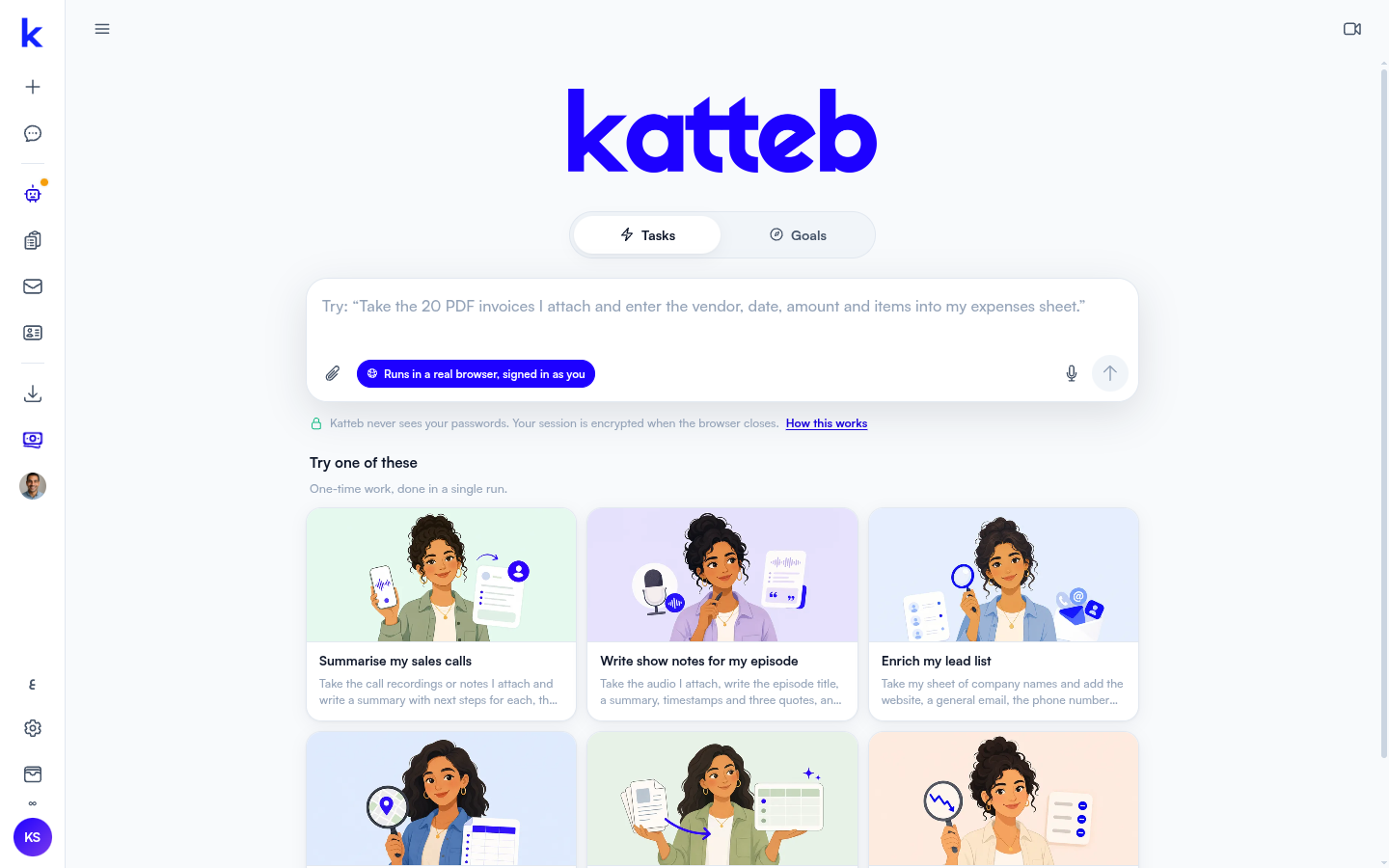
An agent that cannot log into your CMS, keyword tool and Search Console can only hand you more suggestions. Katteb runs in a real browser signed in to the accounts you connected, so it works where your site actually lives.
2. Where do the numbers come from?
Traffic, impressions and rankings should be read from your analytics and Search Console, not estimated. Katteb’s principle is that numbers are read from your own tools, never guessed, and each report names where they came from.
3. Does it remember what it already did?
Without memory an agent will happily write the same article twice or target a keyword you already rank for. Look for a record of published pages, used keywords and past results that every run reads before it acts. In Katteb, what worked and what failed go into the goal’s memory, so day 20 starts where day 19 left off.
4. How does it protect quality?
Ask how it checks facts, what sources it uses about your own product and whether it verifies the published page: word count, links, images and calls to action. Thin or inaccurate pages hurt more than they help.
5. Can you approve before it publishes?
Some teams want every draft reviewed; others are happy for routine posts to go live. The agent should support both and respect the choice.
6. Can you see the plan before paying for the work?
A clear plan with a metric, milestones and the workflows that will repeat makes it easy to judge whether the approach fits. Katteb writes the goal plan for free, and nothing runs until you press Start.
Give an AI agent your SEO target
Describe the result you want, such as “Double my website traffic in 90 days”. Katteb studies your market and writes the plan for free before anything runs.
How to run SEO as a goal
The simplest way to use an SEO agent well is to give it an outcome rather than a list of chores. Katteb’s goal library includes “Double my website’s monthly visitors in 90 days with weekly content, daily social posts and technical fixes” and “Double the inquiries from my website contact form in 90 days by improving the pages, adding calls to action and following up on each one.” Both show the pattern: a number, a deadline and the kinds of work that will move it.
Step 1: Say what should be true
Write one sentence with an outcome, a number and a deadline of 14, 30, 60, 90 or 180 days. Organic search moves slowly, so 90 or 180 days is usually the honest horizon for traffic goals.
Step 2: Let the agent study the market
Before it plans, the agent searches the web: who buys, what competitors publish and charge, and where your customers look for answers. For SEO that research shapes which topics are worth winning.
Step 3: Read and adjust the plan
The plan lists the outcome, the metric it will move, milestones with dates and up to three repeating workflows, for example a daily article on a new commercial keyword, a weekly refresh of pages that lost clicks, and a weekly review of Search Console data. Change anything you disagree with, then press Start.
Step 4: Let it work and read the report
Each run works in your tools as you, records what it published and which keywords it used, and the 8am report tells you what was done, what moved, what is blocked and what it needs from you.

A sample weekly rhythm for an SEO agent
- Every day: pick one unused keyword with commercial or problem-solving intent, write a complete article that answers it, link it to related pages, publish and request indexing.
- Twice a week: refresh one older page that has lost clicks: update facts, improve the title and description, add links from newer posts.
- Weekly: run a technical check for broken links, noindex mistakes and missing canonicals; review which new pages were indexed and which were not.
- Every morning: a short report with pages published, indexing requests sent, clicks and impressions from Search Console, and anything that needs a decision.
This is roughly the routine a disciplined in-house SEO would keep. The difference is that the agent keeps it on the weeks when everyone else is busy.
Tasks or goals for SEO work
Katteb separates one-time work from continuous progress. A Task runs once and returns a result: audit one page, pull last month’s Search Console queries into a sheet, write meta descriptions for twenty product pages. A Goal runs every day for 14 to 180 days toward a number and reports each morning: grow organic visitors, publish a set of articles on commercial keywords, raise inquiries from the site. Use tasks for clean-up and investigations, and goals for anything that needs steady effort to show results.
Mistakes to avoid with AI SEO agents
- Chasing volume alone. A page that ranks for a search nobody buys from does little for revenue. Prefer commercial, comparison and problem-solving intent.
- Letting pages compete with each other. Keep a record of used keywords and angles, and give each page a distinct one.
- Publishing without verifying. Check the live page: length, links that work, images that load and a call to action that is visible.
- Forgetting indexing. New pages on smaller sites can wait a long time to be discovered. Request indexing and check back.
- Judging too early. Organic results lag. Watch leading signals such as indexed pages and impressions in the first weeks, and traffic over months.
- Removing the human voice. Add your own examples and experience where you can. Agents do the routine well; your knowledge is what makes a page worth citing.
How to measure whether it is working
Track three layers. First, output: pages published, pages refreshed and indexing requests sent, which tell you the routine is happening. Second, visibility: pages indexed and impressions in Search Console, which usually move within weeks. Third, outcomes: organic clicks, sign-ups or inquiries from organic visitors, which move over months. A report that shows all three every morning makes it easy to see where the process is stuck. If output is high but indexing is low, the problem is technical or quality; if impressions grow but clicks do not, titles and descriptions need work.
Plans and where to begin
Goals on Katteb start with the Lite plan, one goal at a time. The Goals plan runs ten goals at once, with hourly schedules, memory and a daily report, plus landing pages with lead forms. Writing a plan is free, so the easiest first step is to describe your SEO target and read the plan the agent proposes. Goals are not guaranteed, and you can change or stop one at any time.
For the wider picture, see our guides to choosing an AI agent platform and AI agents for business, or browse the Katteb goal library.
Frequently asked questions
What does an AI agent for SEO do?
It carries out SEO work on its own: researching keywords, writing and publishing pages, refreshing old content, adding internal links, running technical checks, requesting indexing and reporting results, usually on a schedule toward a traffic or lead target.
Is an AI SEO agent the same as an AI writing tool?
No. A writing tool produces text when you ask. An agent decides what to write, publishes it in your CMS, checks the live page, requests indexing and measures the result.
Will Google penalise content written by an AI agent?
Google’s guidance focuses on whether content is helpful and original, not on how it was produced. Pages that are accurate, specific and genuinely useful are what matter, which is why quality checks and your own expertise remain important.
Can an AI agent request indexing in Google Search Console?
Yes, if it can work in a browser signed in to your Search Console property. It can inspect the new URL and press Request Indexing, then check back later.
How long does it take to see results?
Indexing and impressions often show within weeks; meaningful traffic usually takes months. That is why SEO goals are best set on 90 or 180 day horizons.
Should I let the agent publish without approval?
That is your choice. Many teams start with drafts for review, then allow routine articles to go live once they trust the quality, while keeping approval for anything sensitive.
An AI agent for SEO earns its place when it turns the routine you already know you should follow into work that happens every week and numbers you can check. Set your SEO goal on Katteb and judge it by the pages it ships and the reports it sends.

About Ahmed Ezat
Ahmed Ezat is the founder behind Katteb, an AI writing and SEO platform built to help businesses create fact-checked, search-ready content that ranks in both traditional search and AI-powered results. With more than a decade of hands-on experience in SEO, SaaS, and digital marketing, Ahmed has launched and scaled multiple AI products serving hundreds of thousands of users across the MENA region and globally.