TL;DR. On 14 October 2026 the ZeroBounce pricing page offered three ways to pay: Freemium ($0, 100 validation credits a month for business-domain signups), Pay-As-You-Go credit packs from $39 for 2,000 credits down to $3,199 for 1,000,000, and the ZeroBounce ONE subscription from $99 a month for 10,000 credits. One credit validates one address, Email Finder costs 20 credits per successful find, and “unknown” results are free. A ZeroBounce key checks addresses; it does not find the companies, read their sites or write the outreach. Below are five priced scenarios comparing ZeroBounce on its own with ZeroBounce plus a ready-made agent such as Katteb. All figures are US dollars, list price, before tax, per month unless stated.
People search for “zerobounce pricing” for one of two reasons. Some already have a list, often a few thousand addresses from a CRM export or an event, and want to know whether to buy a credit pack or subscribe. Others are building outreach from scratch and keep hearing that an “AI agent” can find prospects, check their emails and draft the first message, and they want to know which part of that ZeroBounce actually covers and what the whole stack costs.
This guide answers both. It prices ZeroBounce from the numbers its own calculator showed on 14 October 2026, it explains where the credits go, and it says plainly in which scenarios adding an agent costs more than using ZeroBounce alone. Where a price was not shown, it says so rather than guessing.
Need the prospects found, not just checked?
Describe the job in one sentence, for example “every week, find 20 dental clinics in Dubai with a booking page, check their contact email and draft a first message”. Katteb works in a real browser and reports back.
What does ZeroBounce pricing look like in October 2026?
ZeroBounce sells one currency, the credit, and three ways to buy it. The calculator on the pricing page takes a number of credits and returns a price. We entered each volume below on 14 October 2026 and copied the result. A promotion running from 12 to 16 October (25% off with a promo code) was ignored, because it ends this week and would make every number below wrong by Monday.
Pay-As-You-Go credit packs
| Credits | Pack price | Price per credit |
|---|---|---|
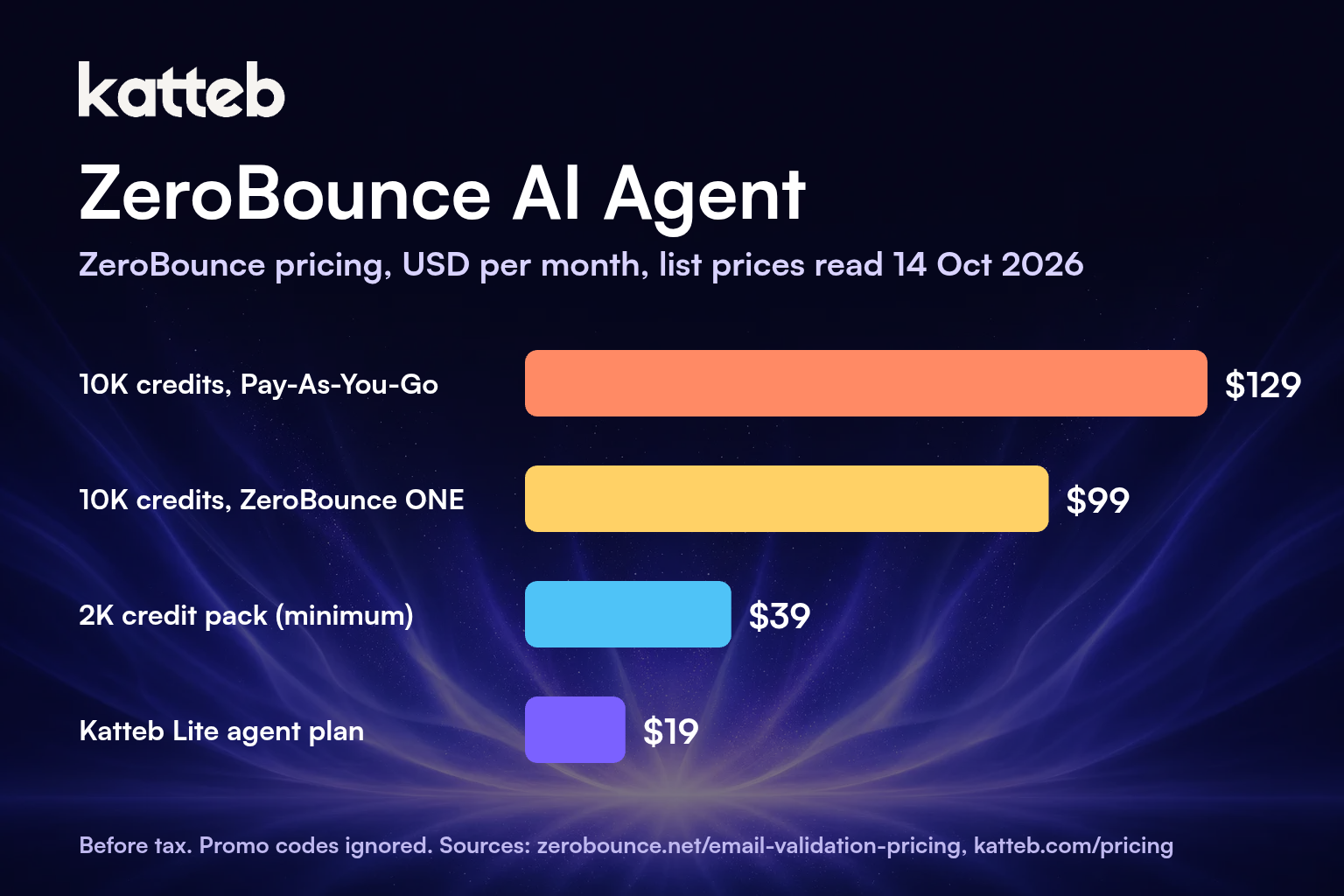
| 2,000 (minimum) | $39 | $0.0195 |
| 5,000 | $69 | $0.0138 |
| 10,000 | $129 | $0.0129 |
| 25,000 | $274 | $0.01096 |
| 50,000 | $499 | $0.00998 |
| 100,000 | $649 | $0.00649 |
| 250,000 | $1,299 | $0.005196 |
| 1,000,000 | $3,199 | $0.003199 |
Above one million credits the page asks you to contact sales. The per-credit price falls by a factor of six between the smallest and the largest pack, so the size of the pack matters more than any other choice you make.
ZeroBounce ONE subscription
| Credits per month | Monthly price | Price per credit |
|---|---|---|
| 10,000 (minimum) | $99 | $0.0099 |
| 25,000 | $199 | $0.00796 |
| 50,000 | $379 | $0.00758 |
| 100,000 | $449 | $0.00449 |
| 250,000 | $999 | $0.003996 |
ONE adds tools that the packs do not: warmup seeds, inbox placement tests, blacklist and DMARC monitors, activity data, faster file processing and higher API rate limits. Its credits never expire while the subscription is active, and the FAQ says unused credits roll over each month. The page also shows a “Monthly / Annually (Save 20%)” switch. When we switched it, the calculator kept showing the same monthly figures, so we could not read a confirmed annual price. If the 20% applies as labelled, $99 a month would become $79.20 a month; treat that figure as unconfirmed until the checkout shows it.
Freemium
The free account gives 100 validation credits a month, one inbox test, one email server test, one blacklist monitor and 10 Email Finder searches. Credits refill monthly. The pricing page says the 100 monthly validations apply when you sign up with a business or premium domain, so a free webmail signup may not qualify.
How are ZeroBounce credits counted?
This is where most budgets go wrong, so it is worth reading the FAQ rather than the headline price.
- Validation: one credit per address, whether you upload a file or call the real-time API.
- Scoring: one more credit per address. Validate and score the same address and you spend two.
- Email Finder: twenty credits per successful find. An “unknown” result costs nothing.
- Free results: “unknown” validation results and duplicate addresses removed from your file are not charged.
- Expiry: credits never expire while ZeroBounce ONE is active. Without ONE, the FAQ says expiry rules “may apply” depending on when the account was created or the credits were bought, and points to the terms.
The twenty-credit Email Finder is the number to watch. Finding 100 people costs 2,000 credits, which is the entire smallest pack. If your plan is to find addresses as well as check them, size the pack for finds, not for validations.
What does a ZeroBounce key buy, and what does it not buy?
A ZeroBounce API key, or a CSV upload, answers one question very well: will mail to this address bounce? It returns a status, a sub-status and, on ONE, activity data. That is valuable, because hard bounces damage sender reputation and every email platform punishes a high bounce rate.
What the key does not do is everything before and after that check:
- It does not decide which companies are worth contacting.
- It does not open a company’s website, find the team page or read the contact page.
- It does not tell you whether the person is still in the role.
- It does not write the message, schedule the follow-up or record who replied.
- It cannot fully protect you from spam traps. A trap is a real, monitored mailbox; a verifier may call it valid because it is. Role addresses such as info@ and sales@ carry more risk, and ZeroBounce flags them, but list hygiene is still your job.
That split is the whole reason the “ZeroBounce AI agent” question exists. The verification step is cheap and solved. The hours sit in the steps around it.
Let an agent do the steps around verification
Katteb can research companies, read their sites, collect the contact details they publish, and hand you a checked list with a draft message for each. Try one list first.
What can a ZeroBounce AI agent do? Six use cases
By “ZeroBounce AI agent” we mean an AI agent that does the research and outreach work and uses ZeroBounce, or an equivalent check, as one step. These are the jobs where that pairing shows up most often.
- Weekly prospect list for a founder. The agent searches for 20 to 40 companies that match a description, opens each site, records the published contact address and the decision maker’s name where it is public, then validates the addresses before anyone sends.
- Event or webinar list clean-up. After an event, a marketer exports 3,000 registrations. The agent removes duplicates and obvious test entries, runs the file through ZeroBounce, and splits the result into “send”, “do not send” and “role address, review”.
- CRM decay check. Once a quarter, the agent pulls contacts that have not opened in six months, validates them, and marks those that now bounce so the CRM stops mailing them.
- Signup form gate. A developer calls the real-time API on the signup form so typos never enter the database. This is an API job, not an agent job, and it appears in Scenario D below because it is the main reason companies buy large volumes.
- Agency client audits. An agency running email for several clients checks each list before a campaign and writes a short deliverability note per client, using ONE’s inbox placement and blacklist tools.
- Reply-ready outreach drafts. Once an address is valid, the agent writes a first message that references something specific on the company’s site, so the check is followed by work that a verifier cannot do.
Which route for which job?
| Job | Best fit | Why |
|---|---|---|
| Under 100 checks a month | ZeroBounce Freemium | $0, if your signup domain qualifies |
| One list now and then | Pay-As-You-Go pack | No monthly commitment |
| 10,000+ checks every month | ZeroBounce ONE | Lower price per credit, credits roll over |
| Real-time check on a form | ZeroBounce API | Needs code in your app; an agent adds nothing |
| Finding who to contact and writing to them | An agent, plus a verifier | The verifier cannot do the research |
Five priced scenarios: ZeroBounce alone vs ZeroBounce with Katteb
Assumptions for every scenario: US dollars; list prices read on 14 October 2026; before tax; monthly billing unless stated; the 12-16 October promotion ignored; Katteb Lite at $19 a month (or $190 a year) from katteb.com/pricing, which includes up to 30 hours of agent time a week; staff time valued at $30 an hour; the cost of writing and hosting your own code is not counted. Change any of these and recompute; every number below can be checked with a calculator.
Scenario A: a founder verifying 80 addresses a month
80 validations use 80 credits. That fits inside Freemium’s 100 monthly credits.
- ZeroBounce alone: $0.
- ZeroBounce Freemium + Katteb Lite: $19.
Here Katteb is an extra $19 a month, not a saving. It is worth it only if the agent saves more than 38 minutes of work a month ($19 ÷ $30 an hour = 0.63 hours ≈ 38 minutes), for example by researching and drafting for those 80 contacts. If you already have the addresses and only need them checked, ZeroBounce alone is the cheaper choice.
Scenario B: an agency cleaning 10,000 addresses
B1, every month. Pay-As-You-Go 10,000 credits: $129. ZeroBounce ONE 10,000: $99. ONE is $30 less a month ($129 − $99), or $360 less a year ($30 × 12).
B2, once a quarter. Pay-As-You-Go four times a year: 4 × $129 = $516. ONE all year: 12 × $99 = $1,188. Pay-As-You-Go is $672 less a year ($1,188 − $516). ONE only wins when you clean every month.
An agent does not change either number, because the clean itself is a file upload. Katteb belongs in this scenario only if someone is spending time preparing the files and writing the client reports; at $19 it needs to save 38 minutes a month to pay for itself.
Scenario C: 40 new prospects a month with Email Finder
40 successful finds × 20 credits = 800 credits. Validating the 40 found addresses adds 40, for 840 credits. Freemium’s 100 credits and 10 finds do not cover this, so the smallest paid option is the 2,000-credit pack at $39.
- C1, ZeroBounce pack alone: $39. You still choose the 40 companies and write to them yourself.
- C2, ZeroBounce pack + Katteb Lite: $39 + $19 = $58. Katteb is an extra $19, worth it if it saves more than 38 minutes of research and drafting.
- C3, Katteb Lite + ZeroBounce Freemium, using published addresses only: the agent reads each company’s site and records the address the company publishes, then you validate up to 100 of them free. Cost: $19, which is $20 a month less than C1 ($39 − $19).
The $20 difference holds only if a published address is good enough for your outreach and you stay within 100 validations. Published addresses are often role addresses (info@, hello@), which reach a shared inbox rather than a named person and carry more spam-trap risk. If you need a named decision maker’s mailbox, C3 does not do the same job, and C2 is the honest comparison.
Scenario D: a real-time check on a signup form
A SaaS product with 100,000 signups a month: Pay-As-You-Go 100,000 credits $649 each month vs ONE 100,000 $449. ONE is $200 less a month, $2,400 a year. At 250,000 a month: $1,299 vs $999, so ONE is $300 less a month.
We did not put Katteb in this scenario. A form check has to run inside your application in milliseconds, which is what an API is for. An agent is the wrong tool, and comparing their prices would not be fair.
Scenario E: annual billing
Katteb Lite yearly is $190 against $228 for twelve monthly payments, so the yearly plan is $38 less. For ZeroBounce ONE we could not read a confirmed annual price, as explained above. If the labelled 20% applies to the $99 tier, a year would cost 12 × $79.20 = $950.40 instead of $1,188, a difference of $237.60, but confirm it at checkout before you rely on it.
Summary of the scenarios
| Scenario | ZeroBounce alone | With Katteb Lite | Which costs less |
|---|---|---|---|
| A. 80 checks | $0 | $19 | ZeroBounce alone, by $19 |
| B1. 10K monthly | ONE $99 | $118 if added | ONE alone; ONE beats packs by $30 |
| B2. 10K quarterly | Packs $516/yr | n/a | Packs beat ONE by $672/yr |
| C. 40 finds | $39 | $19 (published addresses) or $58 | Katteb + Freemium by $20, only with published addresses |
| D. 100K form checks | ONE $449 | Not comparable | ONE beats packs by $200 |
Run Scenario C on your own market
Tell Katteb who you sell to and how many prospects you want each week. It finds the companies, collects the published contact details and drafts the first message for you to approve.
When you do not need an AI agent for ZeroBounce
- You already have the list and only need it cleaned. Upload it to ZeroBounce; an agent adds cost and nothing else.
- You need a check inside your product. Call the API.
- Your volume fits in 100 checks a month and nobody spends time on research. Freemium is $0.
- Your team already has a working prospecting tool that supplies named contacts. Adding a second layer only makes sense if it removes real hours.
When an agent earns its place
- The slow part of your week is deciding who to contact, not checking addresses.
- You want the same job done every week without remembering to do it: a list, a check, a draft and a report.
- Your prospects are local or niche businesses whose details live on their own websites rather than in a contact database.
- You want the validation result and the outreach draft in the same place, so nobody sends to an address that failed.
Common questions about ZeroBounce pricing
Is ZeroBounce free?
There is a Freemium account with 100 validation credits a month and 10 Email Finder searches. The page says the 100 monthly validations apply to signups with a business or premium domain.
What is the minimum purchase?
The Pay-As-You-Go minimum is 2,000 credits for $39. ZeroBounce ONE starts at 10,000 credits for $99 a month.
Do credits expire?
Not while ZeroBounce ONE is active. Without it, the FAQ says expiry rules may apply depending on account and purchase dates; check the terms for your account.
Am I charged for unknown results?
No. Unknown results and removed duplicates are free.
How much does Email Finder cost?
Twenty credits per successful find. At the $39 pack price that is about $0.39 per found address ($0.0195 × 20).
Is Katteb cheaper than ZeroBounce?
They do different jobs. In our scenarios ZeroBounce alone costs less whenever you already have the addresses. Katteb with Freemium cost $20 a month less than a paid pack only in Scenario C, and only when published addresses are acceptable.
Sources
- ZeroBounce pricing page (calculator for Pay-As-You-Go and ZeroBounce ONE, Freemium card, FAQ), read 14 October 2026.
- Monid guide on email verification APIs, used for the structure of the “bounces vs traps” question only.
- Katteb pricing and fair usage policy, read 14 October 2026.
The short version
ZeroBounce pricing runs from $0 for 100 checks a month to $3,199 for a million credits, with ZeroBounce ONE from $99 a month for 10,000. For cleaning a list you already have, ZeroBounce alone is the cheaper route in every scenario we priced. An agent pays for itself only when it removes the research and writing that come before and after the check, at roughly 38 minutes of saved work a month on Katteb Lite. If that is where your hours go, test it on one prospect list in Katteb.

About Ahmed Ezat
Ahmed Ezat is the founder behind Katteb, an AI writing and SEO platform built to help businesses create fact-checked, search-ready content that ranks in both traditional search and AI-powered results. With more than a decade of hands-on experience in SEO, SaaS, and digital marketing, Ahmed has launched and scaled multiple AI products serving hundreds of thousands of users across the MENA region and globally.