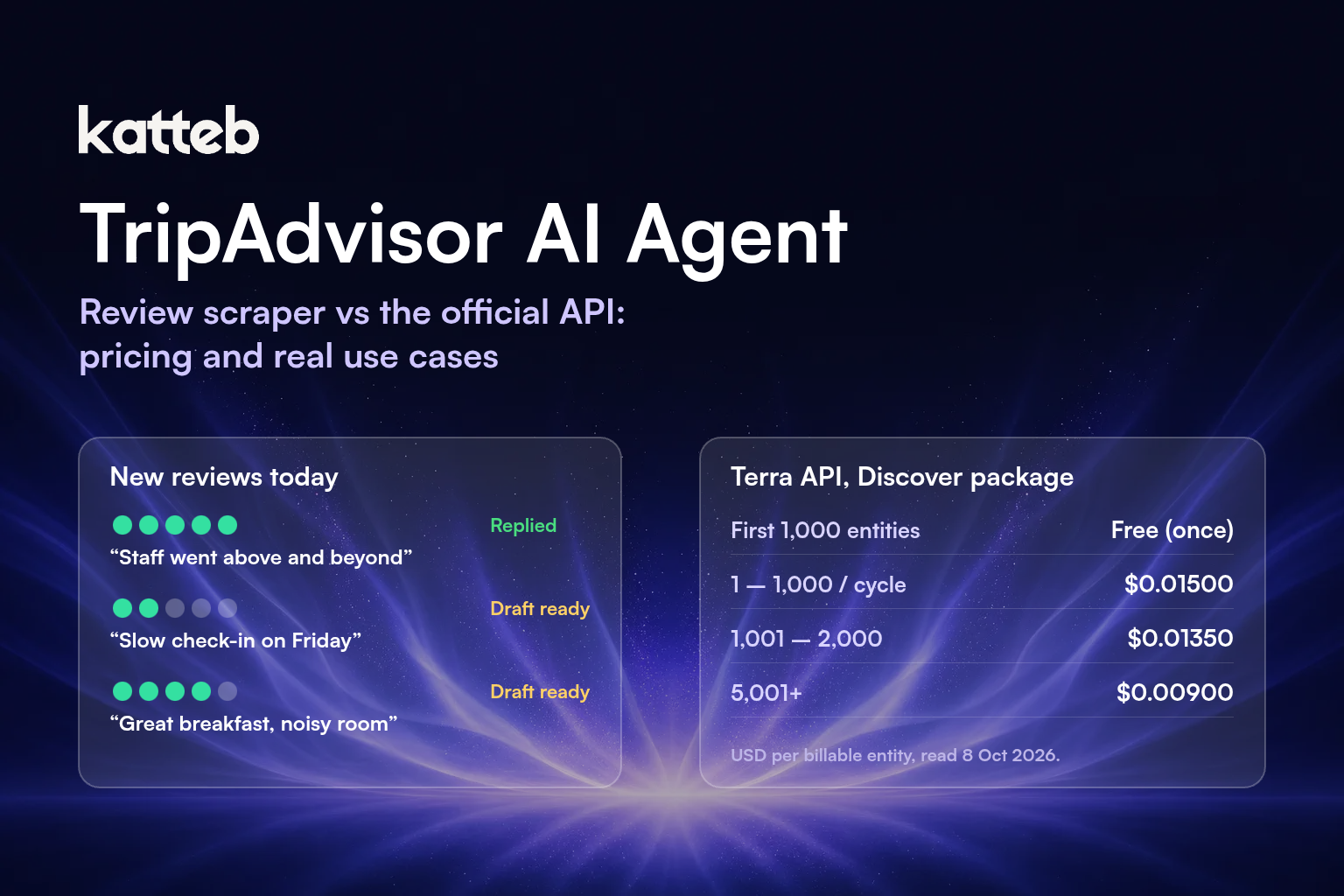
TL;DR. Most people who search for a “TripAdvisor review scraper” want one of three things: to monitor reviews of their own property and their competitors, to analyse what guests complain about, or to show TripAdvisor content in their own product. Tripadvisor’s official route is its Terra API (the legacy Content API is marked deprecated), and its self-service Discover package is priced per “billable entity”: the first 1,000 are free once per account, then $0.015 down to $0.009 each, as published on 8 October 2026. This guide explains what a TripAdvisor AI agent does, what the official API costs and allows, three worked cost scenarios with every assumption stated, and where a browser-based agent such as Katteb fits and where the API is simply the better and cheaper choice.
TripAdvisor reviews shape bookings for hotels, restaurants, tours and attractions. For an owner, a marketing agency or a travel startup, those reviews are also data: what guests praise, what they keep complaining about, how a competitor’s rating moved after a renovation, which reviews still have no reply. Reading them by hand works for one property. It stops working at ten.
That is why “TripAdvisor review scraper” gets searched. The phrase covers very different jobs, and the cheapest and safest answer depends on which job you have. Before you pay for a scraper or write one, it is worth knowing what Tripadvisor offers officially, what it charges, what its terms ask of you and what an AI agent adds on top.
What is a TripAdvisor AI agent?
A TripAdvisor AI agent is an AI system that gathers TripAdvisor information on a schedule, makes sense of it and does something useful with it, without a person driving each step. It usually combines:
- A way to read the data: the official Terra API, or a browser that opens TripAdvisor pages the way you would.
- A plan: which listings to watch (your own and your competitors’), how often, and what counts as a change worth reporting.
- Analysis: sorting reviews by theme (cleanliness, staff, noise, value), spotting rating drops and drafting replies.
- Delivery and memory: a weekly report, an alert when a one-star review lands, and a record of what was already handled.
A scraper only does the first part. The agent is everything after the data arrives.
Six things a TripAdvisor agent is actually used for
1. Watching your own reviews
New reviews are checked daily. Anything at three stars or below goes to the manager with the guest’s main complaint in one line, so nothing sits unanswered for a week.
2. Drafting owner responses
The agent drafts a reply that refers to what the guest actually wrote, in the property’s tone, and leaves it for approval. Replies that are specific read better to future guests than a template.
3. Benchmarking competitors
A hotel watches the five or ten properties it loses bookings to: their rating, review volume, what guests praise and what they complain about. A monthly summary shows where you are ahead and where you are not.
4. Finding recurring problems
Grouping three months of reviews by theme shows patterns a manager reading one review at a time will miss: the slow check-in on Fridays, the breakfast that runs out at 9:30, the Wi-Fi in one wing.
5. Agency reporting
An agency managing reputation for many venues needs the same report for each client every month. That is repetitive work with a clear format, which is where an agent saves the most time.
6. Showing TripAdvisor content in your own product
A travel app or a booking site that wants ratings, photos and review snippets next to its listings needs licensed data in volume. This is the job the official API exists for, and it is not a job for an agent working in a browser.
The official route: Tripadvisor’s Terra API
The legacy Tripadvisor Content API documentation now opens with a notice that the API is deprecated and that developers should migrate to Terra, Tripadvisor’s new partner platform. We read the Terra documentation at docs.terra.tripadvisor.com on 8 October 2026. Terra covers four kinds of content: locations (hotels, restaurants and points of interest), reviews, photos and geos, plus an AI-powered recommendations endpoint for natural-language queries.
Access comes in packages: Discover, Growth, Scale, Innovate and Transform. Discover is the self-service package; the documentation describes it as giving the most common factual location content and “a limited number” of reviews and photos, through the API only, with lower throughput.
Discover pricing (usage-based)
Discover is billed per “billable entity”. For location endpoints, each location ID returned counts as one entity. For reviews and photos, each API call counts as one entity per location. Errors (4xx and 5xx) are not billed. The first 1,000 billable entities are free, once per account lifetime, not every month. After that, the published tiers per invoice cycle are:
| Tier | Billable entities per invoice cycle | Price per entity (USD) |
|---|---|---|
| 1 | 1 – 1,000 | $0.01500 |
| 2 | 1,001 – 2,000 | $0.01350 |
| 3 | 2,001 – 3,000 | $0.01215 |
| 4 | 3,001 – 4,000 | $0.01094 |
| 5 | 4,001 – 5,000 | $0.00984 |
| 6 | 5,001+ | $0.00900 |
Tripadvisor says exact totals are computed by its billing system from metered usage and the table is the reference for tier boundaries and list prices. The page does not state in so many words whether each tier’s rate applies only to the entities inside that band or to the whole month’s volume, so in the scenarios below we show both readings where it matters.
Limits and rules that matter
- Throughput: Discover allows 10 requests per second and 10,000 calls per day, on a rolling 24-hour window. The four search and nearby endpoints share a much lower limit of 1 request per second with bursts of 5.
- Review pool: Terra does not search every review of a location. Each request draws from a fixed pool set by your contract, either the N most recent reviews or those from the last M months, and filters only narrow that pool.
- Endpoint access: your key only reaches the endpoints your package includes; others return 403.
- Display rules: Tripadvisor’s Review Implementation Policy says review text must not appear directly in your page source and must be loaded through a script call blocked in robots.txt, and it reserves the right to audit.
- Read only: the Partner API endpoints listed in the documentation are all reads. Replying to a review still happens in the owner’s own Tripadvisor account.
Scraper, API or agent?
A scraper copies pages in bulk. The API delivers licensed data in a defined format. An agent reads what it needs, the way a person would, and does the follow-up work. They are not interchangeable:
| Scraper | Terra API | Browser-based agent | |
|---|---|---|---|
| What you get | Raw page data | Licensed, structured data | Summaries, alerts, drafted replies |
| Volume | High, until blocked | High, within quota | Low to moderate, like a person |
| Republishing content | Check Tripadvisor’s terms first | Allowed under the package terms and display rules | Not what it is for |
| Replying to reviews | No | No (read-only) | Yes, in your own signed-in account, after approval |
| Engineering needed | Yes, and upkeep | Yes | No |
If you are considering a scraper, read Tripadvisor’s terms of use first. The licensed route exists, its entry price is low, and building on it avoids the cat-and-mouse of a scraper that breaks every time the page changes.
What Katteb costs, and what it is
Katteb is an agent platform: you describe a task or a goal, and an agent carries it out in a real browser, signed in to the sites you use, then reports back. Prices from katteb.com/pricing on 8 October 2026, in US dollars: Lite $19 a month or $190 a year (1 agent, 30 hours of agent time a week, daily reports); Goals $99 a month or $990 a year (10 agents, 120 hours a week, hourly to monthly schedules, 3 users). Katteb does not sell or license Tripadvisor data; its agent reads pages for your own analysis and acts in accounts you own.
Never miss a bad review again
Describe the job in one sentence, for example “every morning, check new TripAdvisor reviews for my hotel, draft a reply to anything under four stars and send me a weekly summary of what guests mention most”. Katteb writes the plan, then an agent runs it and reports every day.
Three worked cost scenarios
Assumptions for all three: prices in US dollars, list prices read on 8 October 2026, before tax; one month = 4.33 weeks; engineering, hosting and staff time are not counted; API usage is counted with the Discover rules above (one entity per reviews call per location, one per location returned).
Scenario A: one hotel watching itself and nine competitors weekly
- Entities: 10 locations × 1 reviews call × 4.33 weeks = 43.3, rounded up to 44 a month.
- Free allowance: 1,000 ÷ 44 = about 22 months before you pay anything.
- After that: 44 × $0.015 = $0.66 a month.
- Katteb Lite: $19 a month.
On raw data cost the API is the cheaper option here by about $18.34 a month ($19 − $0.66), and it is free for the first two years. What the $0.66 does not include is the code to call it, the analysis, the alerting and the replies. If you have a developer, build on the API. If you do not, the comparison is really between $19 and your own time.
Scenario B: an agency with 15 hotel clients, each watching five competitors
- Entities: 15 × (1 own + 5 competitors) = 90 locations; 90 × 4.33 = 389.7, rounded up to 390 a month.
- Free allowance: 1,000 ÷ 390 = about 2.6 months.
- After that: 390 × $0.015 = $5.85 a month.
- Katteb Goals: $99 a month (10 agents, so several clients can be grouped per agent).
Again, the API costs less for the data itself: $99 − $5.85 = $93.15 a month less. The difference is what the agency gets for the money. The API returns reviews from the pool your contract allows; it does not group them by theme, write the monthly report or post replies, because its endpoints are read-only. An agent can do the reporting and draft replies in each client’s own owner account. Whether that is worth $93 a month depends on how many staff hours the reports and replies take today.
Scenario C: a travel site showing 2,000 hotels
- Entities: 2,000 location details + 2,000 reviews calls refreshed monthly = 4,000 a month.
- If each tier’s rate applies to its own band: 1,000 × $0.015 + 1,000 × $0.0135 + 1,000 × $0.01215 + 1,000 × $0.01094 = $15 + $13.50 + $12.15 + $10.94 = $51.59 a month.
- If the tier-4 rate applies to the whole volume: 4,000 × $0.01094 = $43.76 a month.
Either way, this is a job for the API and not for an agent: you need licensed content you are allowed to display, delivered in a structured format, within the display rules. We are not comparing Katteb’s price here because Katteb does not provide that licence, and putting $99 next to $51.59 would compare two different things.
| Scenario | Terra API (after free allowance) | Katteb | Better fit |
|---|---|---|---|
| A: 1 hotel + 9 competitors | $0.66/mo | Lite $19/mo | API on cost; agent if no developer |
| B: agency, 90 locations | $5.85/mo | Goals $99/mo | API on data cost; agent for reports and replies |
| C: 2,000 hotels displayed | $43.76–$51.59/mo | Not comparable | API |
Five questions before you choose
- Will the content appear on your own site or app? If yes, you need a licence and the display rules, which means the API.
- How many locations, how often? Count entities a month and run them through the tier table.
- Do you need every review or only recent ones? Terra serves a fixed pool per contract, so check that it covers what you need.
- Who writes the replies? If the bottleneck is responding, not reading, the API alone will not fix it.
- Do you have someone to build and maintain it? If not, compare the agent’s monthly price with the hours the work takes today.
How to run TripAdvisor monitoring as a Katteb goal
- Say what should be true. “Every review of our hotel on TripAdvisor gets a reply within 48 hours, and I get a weekly summary.”
- List the listings. Your own page and the competitors you track.
- Set the rules. Draft replies for approval, or post automatically for five-star reviews only; which themes to track.
- Sign in once to your own Tripadvisor owner account so the agent can work there.
- Review two weeks of reports, then adjust the tone and the alerts.
For similar platform guides, see our Yelp AI agent article, which runs the same exercise with Yelp’s official API pricing.
Common mistakes
- Expecting the free allowance to reset. The 1,000 free entities are granted once per account, not monthly.
- Looping search endpoints. Search and nearby calls are limited to 1 per second; resolve location IDs once and store them.
- Printing review text in page source. It breaks the Review Implementation Policy and risks the licence.
- Assuming the API returns every review. It returns the pool your contract defines.
- Automating replies without review. A reply is public and permanent; keep a person in the loop for anything under four stars.
When you do not need any of this
A single venue with a handful of reviews a month does not need an API or an agent: Tripadvisor’s own notifications and ten minutes a week are enough. Bring in automation when reviews pile up faster than anyone reads them, or when you track competitors as well as yourself.
FAQ
Is there an official TripAdvisor API?
Yes. Tripadvisor’s current platform is Terra; its legacy Content API documentation is marked deprecated and points developers to Terra.
How much does the TripAdvisor API cost?
On the self-service Discover package, the first 1,000 billable entities are free once per account, then $0.015 per entity for the first 1,000 in a billing cycle, falling to $0.009 above 5,000 (published 8 October 2026). Other packages have their own commercial terms.
Can I scrape TripAdvisor reviews instead?
Read Tripadvisor’s terms of use before you do. For displaying reviews in a product, the licensed API is the route Tripadvisor provides, with its own display rules.
Can an AI agent reply to TripAdvisor reviews?
The Terra Partner API is read-only, so replies happen in the owner’s account. A Katteb agent works in a browser signed in to your own account and can draft or post replies you approve. You can describe your review workflow to a Katteb agent and try it.
Is Katteb cheaper than the TripAdvisor API?
Not on data cost. In all three scenarios above the API’s usage charges are lower than Katteb’s subscription. Katteb is priced for doing the work around the data, such as reports, alerts and replies, not for supplying the data.
The bottom line
If you need TripAdvisor content in your own product, use the Terra API: it is licensed, inexpensive at small volumes and clear about its limits. If what you need is someone to read the reviews, notice what matters, report it and reply on time, that is the work an agent does, and the price to compare it with is the staff time it replaces. Count your locations, run them through the tier table, then try an agent on one month of review monitoring and compare.
Prices in this article are list prices in US dollars read from docs.terra.tripadvisor.com (Discover Usage-based Pricing, API Access & Rate Limits, Review Implementation Policy), tripadvisor-content-api.readme.io and katteb.com/pricing on 8 October 2026, before tax. They change; check the live pages before you decide.

About Ahmed Ezat
Ahmed Ezat is the founder behind Katteb, an AI writing and SEO platform built to help businesses create fact-checked, search-ready content that ranks in both traditional search and AI-powered results. With more than a decade of hands-on experience in SEO, SaaS, and digital marketing, Ahmed has launched and scaled multiple AI products serving hundreds of thousands of users across the MENA region and globally.